Why China’s Influencer Budget Shrank While Creator Prices Rose
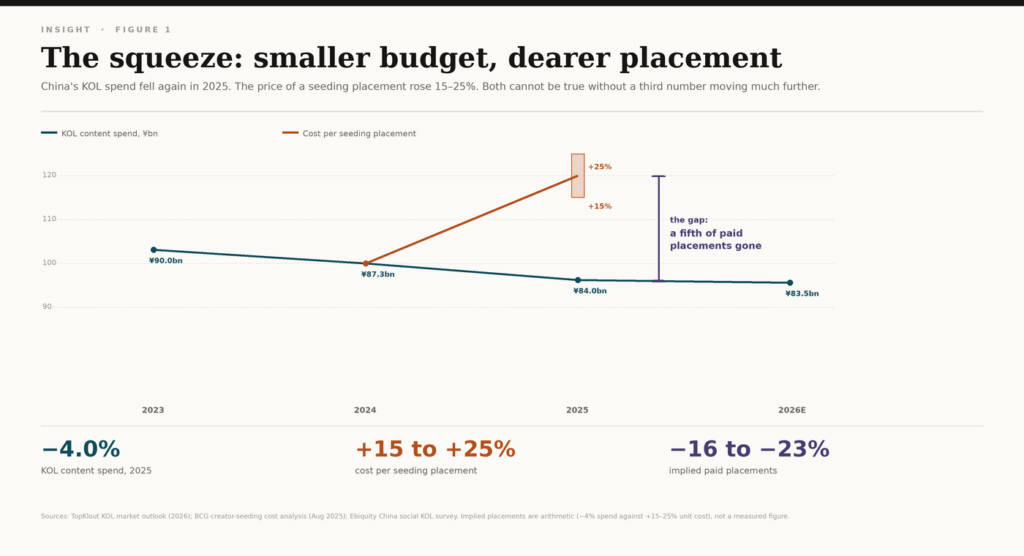
Two numbers that cannot both be comfortable. China’s KOL content spend fell about 4% in 2025 to roughly ¥84 billion — the second annual decline since a 2023 peak of ¥90 billion. Over the same stretch, the price of a creator seeding placement rose 15–25%. A market that is getting smaller is also getting dearer.
Read those numbers separately and you can tell two tidy stories: influencer marketing is cooling, or creator costs are inflating. Read them together and only one explanation reconciles them. If spend falls 4% while the unit price rises somewhere between 15% and 25%, the number of paid placements must have dropped roughly 16–23%. Call it a fifth.
That is the finding the headline hides. Brands did not buy 4% fewer creators last year. They bought about one in five fewer paid placements, and they paid more for each one. This is not a market shrinking. It is a market thinning.
Where the volume went
Three destinations absorb what used to sit on a single media line.
Store-run content. In livestream commerce, brand-run rooms now account for more than half of GMV, while the share attributable to headline livestreamers fell from roughly 27% in 2022 to roughly 11%. The transaction moved from a rented celebrity to an owned storefront.
Payroll. Douyin’s verified professional accounts — store staff, advisors, technicians — passed 3 million by the end of 2025 and have produced more than ¥40 billion in cumulative transactions. That money is spent on salaries, training and content operations. It never shows up in a creator budget, because it isn’t one.
Consolidation. Compliance is not free: disclosure labelling, claim substantiation, and the 2026 livestream rules requiring host identity verification and annual training. Those costs are fixed per campaign rather than per yuan, so they punish fragmentation. Fewer, larger, better-documented partnerships win by default.
Why it reads as a decline
Because the number everyone quotes measures the media line, not the activity. Creator-driven commerce in China keeps growing. What is contracting is the slice still bought as an arm’s-length sponsorship. A budget that migrates to payroll looks exactly like a budget that disappeared — and the industry reads it that way, then cuts the wrong line again.
What this means if you are holding the budget
Three consequences worth planning around. The cheap end of the creator market is vanishing while the supply of ordinary-looking accounts keeps multiplying, which is precisely the gap that fake seeding occupies and why platform enforcement keeps accelerating. Average deal size rises, so the negotiating advantage shifts to buyers who commission in clusters instead of one-offs. And anyone benchmarking cost per post against 2024 numbers is pricing a slice of the market that barely exists anymore.
Watch volume, not spend. Spend tells you what brands budgeted. Volume tells you what the market still does for money — and right now those two lines are moving in opposite directions.