The Star Is a Co-Signer Now: How China Turned Celebrity Endorsement Into Shared Liability
A famous face used to be the cheapest way to borrow trust in China. In 2026 it arrives with a co-signature, a clawback clause, and a regulator who actually reads the script.
Borrowed credibility used to be a simple trade. Pay a fee, rent a face for twelve months, and if that face collapsed you issued a statement, pulled the posters, and kept the upside. The fee was gone. The brand survived.
That trade is closed. Between the 2015 rewrite of the Advertising Law and the live-commerce rules that took effect in February 2026, China rebuilt endorsement regulation in layers, and every layer removed a little more room to rent trust without inheriting the consequences. An endorser must have used the product. Four categories cannot carry an endorser at all. A false endorsement can cost the celebrity one to two times the fee and three years of eligibility. A livestream is an advertisement whenever a recognisable person recommends something for sale. A synthetic face has to admit that it is synthetic.
Enforcement has caught up with the statute. Chinese market regulators closed 44,500 advertising cases in 2025 and collected RMB 252 million in fines and confiscations; food advertising alone produced 9,487 cases and RMB 35.57 million. In that record, the largest publicised bills went to endorsers and streaming entities, not to the brands that hired them.
Here is the crash course: what the rules require now, why the risk moved, and what a brand has to do before it puts a name on a claim.
What a celebrity endorsement used to be
The old model was elegant, and a little cynical. A star arrives with two assets a brand cannot manufacture quickly: attention, and the presumption of honesty. The brand bought a licence to both. Nothing in the transaction required the star to know anything about the product. That was the point.
The asymmetry was the whole business case. Under the pre-2015 regime, a scandal was a reputational event rather than a legal one. You distanced yourself, you ate the write-off, and the star absorbed the damage. Brands could borrow the halo without inheriting the liability, which meant the risk of a bad character was priced at roughly zero in the media plan.
Scale made it normal. For a decade, celebrity endorsement was the default format in beauty, food, technology and luxury, and the star eventually became the face of three things at once: the campaign, the storefront, and the livestream. When Zhao Lusi fronted a brand, or Ming Dao read a script into a phone camera, the borrowed trust travelled further than any poster ever did.
The model rested on one assumption nobody wrote down: that the celebrity was a clean vehicle. Products fail. People fall. China’s regulator looked at both failure modes and decided the brand and the star should be on the same invoice.
Five instruments, one direction
If you want to understand why 2026 feels different, stop reading about scandals and read the rulebook instead. None of these instruments was written with celebrities in mind. Together they define what a star can and cannot do.
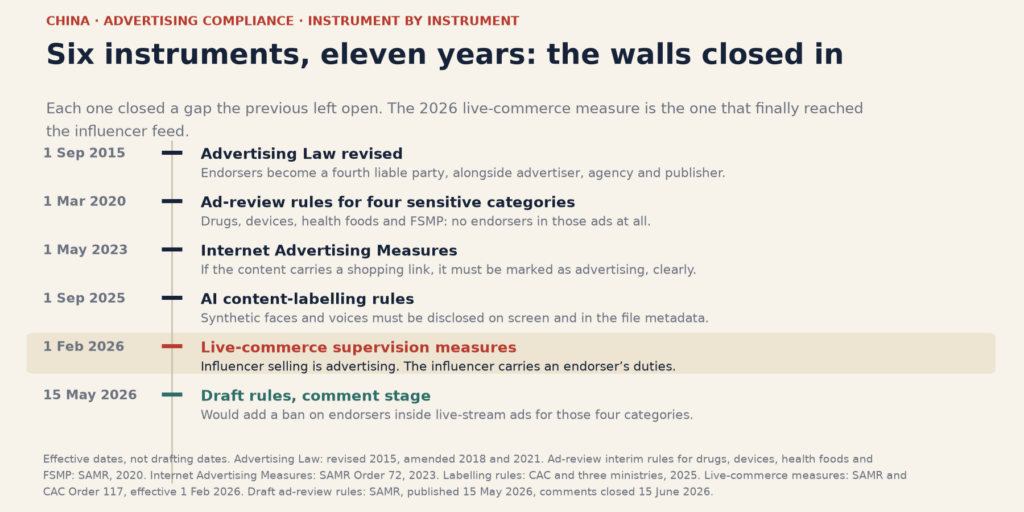
The rules that now bind the star
Rule one: the product has to have been used
Article 38 of the Advertising Law is blunt. An endorser must recommend on the basis of fact, and may not endorse goods they have not used or services they have not received. Read that twice, because most of the industry’s older creative was built on the opposite assumption.
The Li Dan case is the clearest illustration of how literal enforcement can get. In February 2021 the comedian posted a video for a women’s underwear brand with the line “an outfit that lets women win at work without trying”. He had never used the product. Beijing’s Haidian district regulator treated the post as both illegal advertising and an illegal endorsement, confiscated RMB 225,573.77 in fees, added a fine of RMB 651,147.54, and billed his agency separately for failing to review the brief. Total: roughly RMB 877,000 for one Instagram-length video.
What has changed since is the standard of proof on the other side of the table. “I tried it once” was never a defence, and it is less of one now. If a script claims that skin improved in two weeks, or that a supplement replaced a prescription, the endorser’s own experience has to be able to carry that sentence in a hearing. No brand can perform that diligence on the star’s behalf.
Rule two: four categories cannot have an endorser at all
Medical advertising may not use endorsers. Neither may drug, medical device, or health food advertising. The logic is structural rather than moral: those four categories sit under a pre-approval regime, and you cannot pre-approve a livestream.
This is the rule that quietly killed a business model. In November 2025, Shanghai’s market regulator issued compliance guidance for those categories and advised against marketing them through livestreams at all. In May 2026, SAMR published draft revisions to the pre-approval rules that would write the prohibition on endorsers into livestream advertising explicitly, alongside a ban on disguising a sales pitch as health education. The draft ran to 48 articles, 13 of them new.
Brands still slip here, usually through a loophole they invented themselves. The ambassador who never names the product but holds it in frame. The wellness “expert” hired as talent rather than as an endorser. The clip that gets re-cut and reposted as content. Regulators have spent two years closing exactly those gaps, and the closing is not finished.
Rule three: the bill goes to the face
Article 61 sets the endorser’s penalty: confiscate the fee, then add a fine of one to two times that fee. Four triggers apply, including endorsing an unused product and endorsing something you knew or should have known was false.
Article 56 goes further, and this is the clause brand lawyers read first. For false advertising of goods that affect life and health, the endorser is jointly liable with the advertiser, full stop. For everything else, joint liability attaches if the endorser knew or should have known the ad was false. Notice what this does: it puts the heaviest exposure on exactly the categories where celebrity marketing used to convert best.
Jing Tian’s 2022 case is the reference point. She endorsed an ordinary fruit-and-vegetable product that was advertised as blocking fat and sugar absorption. There was no evidence for the claim. Guangzhou’s regulator confiscated her fee and added a fine, for a combined RMB 7.22 million. That remains one of the largest individual penalties in the record.
There is a structural detail worth internalising. Because the fine is calculated from the fee, exposure scales with fame. A seven-figure endorsement does not simply buy more reach; it buys a seven-figure ceiling on the penalty.
Rule four: the livestream is now an advertisement
This is the 2026 change that most Western marketers have not priced in. The Live-Commerce Supervision Measures, issued jointly by SAMR and the cyberspace administration as Order 117 on 18 December 2025, took effect on 1 February 2026. Article 35 does the work: when live content constitutes commercial advertising, the people behind it take on the duties of an ad publisher, an ad operator, or an endorser.
Three situations generally constitute advertising. A person of influence who is not the seller recommends a product in their own name or image. A live segment is recorded, cut and republished as promotional content. Anything else that walks and talks like a sales ad.
Article 34 of the same measure adds the AI clause: no fabricating or impersonating commercial claims through technology. Between the two, the compliance surface of a live slot is now roughly the compliance surface of a television campaign, with none of the lead time.
Rule five: three years of silence
Article 38 has a third paragraph that rarely appears in agency decks. Anyone penalised for endorsing a false ad cannot be used as an endorser for three years. Not by the brand that hired them. By anyone.
Read that as a career instrument rather than a fine. A penalty in a false-ad case does not just cost a star money; it removes them from the market for three seasons of campaigns, which is longer than most celebrity careers can absorb. A separate paragraph bans endorsers under ten years old outright, a rule that mostly matters for family-focused brands using child talent.
The liability shift
The old frame was a transfer of trust. The new frame is a merger of risk. Sign a star and you acquire their conduct history, their fan base, their category exposure, and their appetite for saying things on camera. They acquire your product’s substantiation file.
Two failure modes now exist, and each one produces the same kind of invoice. If the product fails, the star eats a fine and possibly a ban, and the brand eats the campaign plus a regulatory case. If the star fails, the campaign dies, the recall costs land, and the brand spends the next quarter explaining why its face was that face. In China’s trust-scarce, publicly punishing market, that explanation becomes part of the brand’s story rather than a footnote to it.
The YouthIt case in April 2026 is the model specimen. CCTV reported that the “Australian” supplement brand, sold at RMB 293 a bottle and shifting millions of units a year, was made in China; that its Melbourne registered address was a car repair shop; that its awards were bought and its experts hired; and that it carried no health-food registration. A dozen or so celebrities had endorsed it or sold it, including a brand ambassador and a 2024 endorser. One top livestream channel is reported to have moved RMB 10 to 25 million worth of it. Nearly 2,000 separate selling accounts pushed the brand across Douyin, Xiaohongshu and Taobao Live between January 2024 and March 2026.
The reputational damage did not stop at the brand. Within days, the celebrities were issuing apologies and refund promises. By May, 47 consumers had filed a collective claim against one of the hosts who had not settled refunds, arguing that she had failed in her review duty and shared liability for the false claims.
Notice what the refund promises reveal. “We will refund” has become the minimum acceptable response, and it is not a legal defence. Regulators were explicit that a quick refund does not erase an endorsement violation.
The clock
Something else changed, and it is not in the statute. The exit got faster, then it got contractual.
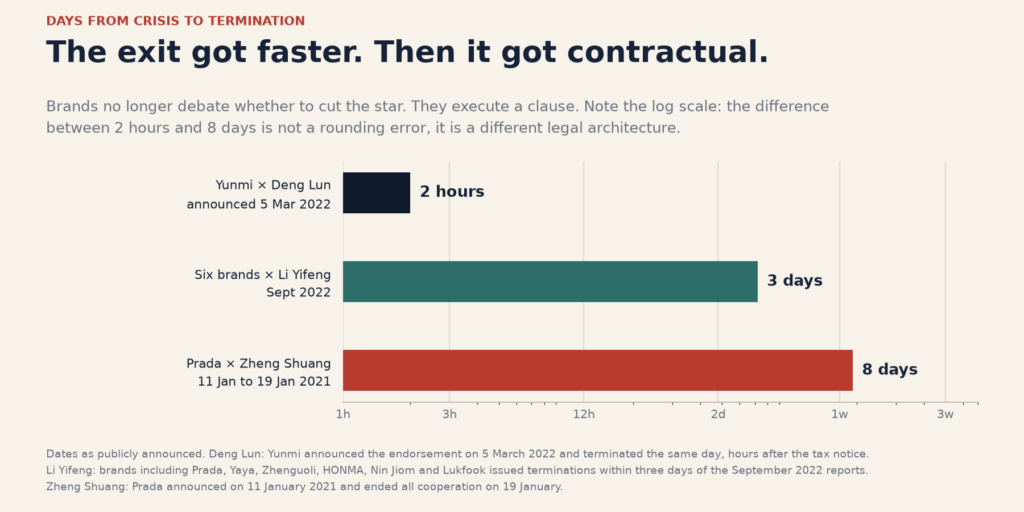
Prada announced Zheng Shuang as one of three brand ambassadors on 11 January 2021 and terminated all cooperation on 19 January. Eight days. Its Hong Kong shares fell 1.7% on the day the story broke and closed 3.14% higher on the day it cut her, which is the market telling you what it thinks about speed.
Yunmi beat that record by an order of magnitude. It announced Deng Lun on 5 March 2022; the tax authorities published their finding two hours later; the contract was terminated the same afternoon. Li Yifeng’s partners, six of them including Prada, cleared out within three days in September 2022.
The interesting part is not the speed. It is that speed is now pre-written. A morality clause with an objective trigger, a termination right, and a clawback mechanism converts a two-week negotiation into a two-hour execution. The brands that move in hours are the ones that drafted for it.
What the money says
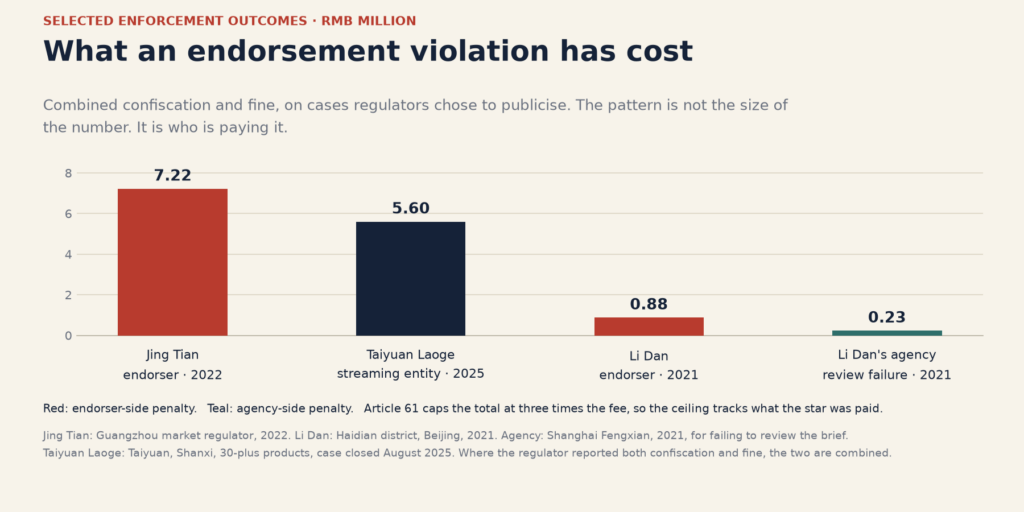
Three patterns are worth carrying into a budget meeting.
First, the penalties are tiered to the fee, which makes the biggest names the biggest exposures and the smallest names almost free to insure. Second, the agency gets billed alongside the talent, which means the review failure is priced separately from the endorsement failure. Third, and least comfortable: for a star earning eight figures per campaign, a seven-figure penalty is a cost of doing business, while a three-year ban is an existential one. The ban is the part that changes behaviour.
What this means for brands: the playbook
Vet the endorser like a co-signer, not a purchase
Diversity of conduct history, category fit, fan-base volatility, and whether the star has ever been penalised for an endorsement before. That last check matters more than any reputation score, because Article 38’s three-year bar is public information if you look for it. Ask for the last three contracts and what happened at the end of them. Ask what the star’s team does when a brand is accused. You are not buying reach. You are adding a partner to your P&L.
Contract the exit, not just the fee
Five clauses do most of the work: a morality clause with an objective trigger rather than a subjective one; a termination right that takes effect on notice; a clawback that recovers the unearned fee; a genuine-use warranty from the endorser, with indemnity for regulatory penalties; and script approval rights that let you refuse a line the substantiation file cannot carry. Add an audit right over the star’s use claims, and a category warranty that the product is not in a banned class.
De-risk the category before you de-risk the celebrity
If the product cannot survive a substantiation hearing, no face makes it safer. For health-adjacent goods, confirm the registration status and the claims dossier first. For the four restricted categories, accept that the endorsement route is closing, not tightening, and rebuild the campaign around demonstration, retail media, or expert content that does not read as an endorsement.
Break the single point of failure
A single star is a single point of failure with a public profile. Portfolio structures (multiple faces, staggered terms, a tier below the celebrity) cost more to manage and less to lose. The market has already moved this way: in 2025, top-tier creators took 13.1% of brand deals and 20.5% of spend, while mid-tier and long-tail creators took 86.8% of deals and just under 80% of the money.
Rehearse the forty-eight hours
Pre-approved statements, a takedown list per platform, a legal opinion on the clause trigger, and a refund mechanism ready to publish before you need it. YouthIt set the new expectation: an apology plus a refund within a day, or a lawsuit within a month.
Where brands get this wrong
Diligence cannot hedge conduct. A clean record is evidence about the past. The only real protection against a star falling tomorrow is a clause that executes today, and even that recovers fees rather than reputation.
Over-correction is expensive. Some brands responded by abandoning celebrity work entirely. The halo still functions when the risk is managed; the regulation re-priced the endorsement, it did not ban it. What it banned was the unexamined one.
The cut can start a second crisis. Dropping a controversial star quickly can mobilise that star’s fans against the brand. The speed that protects you legally can cost you socially. Decide in advance which constituency you are prepared to lose.
The line keeps moving. The May 2026 draft would tighten live advertising for the four restricted categories further. The AI labelling rules add a disclosure layer that most creative teams have not built into their workflows. A compliance position that was correct in 2024 is not necessarily correct now.
The forward look
The AI face problem
The AI-generated content labelling rules took effect on 1 September 2025 and require both an on-screen disclosure and an embedded marker in the file. Beijing’s market regulator reminded advertisers in October 2026 that an unlabelled synthetic ad is likely non-compliant, and that a virtual presenter is not a human endorsement.
Then the harder question arrives. An endorser must have used the product. A model cannot. So a synthetic spokesperson can demonstrate a product, but it cannot vouch for an experience it never had, and any script that implies otherwise is false on its face. Compare the American position: the FTC’s revised Endorsement Guides reach virtual influencers, the 2024 consumer review rule carries civil penalties reported at up to USD 53,088 per violation, and in January 2026 the commission sent warning letters to ten companies under that rule. Different instruments, same conclusion. The endorser is now a regulated party, whether or not it has a pulse.
The money moves down the pyramid
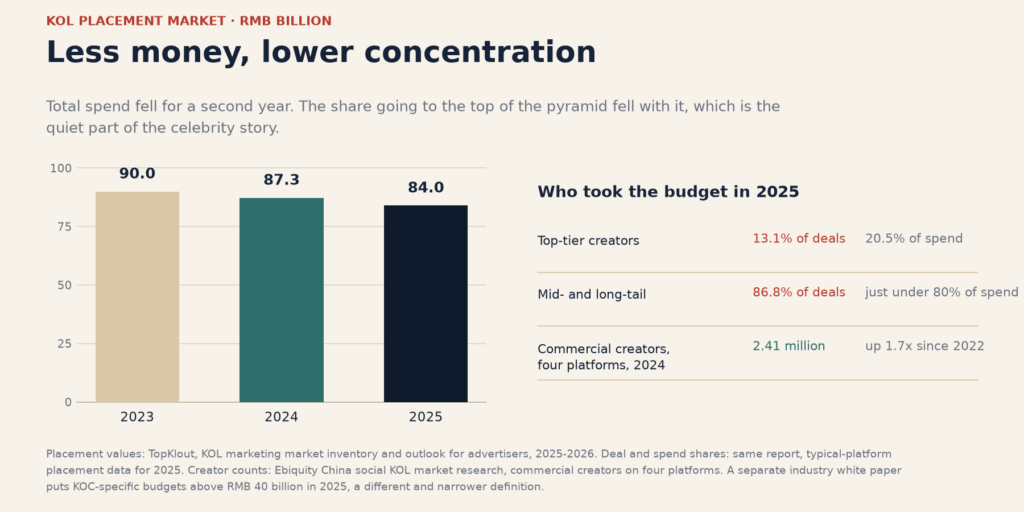
The numbers tell a story about incentives rather than taste. Placement spend fell from RMB 90 billion in 2023 to RMB 87.3 billion in 2024 and RMB 84 billion in 2025. Commercial creators across the four main platforms reached 2.41 million in 2024, up 1.7 times since 2022. And the share going to the very top of the pyramid kept shrinking while the mid-tier absorbed the difference.
Regulation pushes in the same direction. A micro-creator with 30,000 followers is cheaper to replace, easier to contract, less likely to have a scandal portfolio, and more plausibly a genuine user of the product they are praising. KOC budgets have grown accordingly, with one industry white paper putting the category above RMB 40 billion in 2025, up more than 60% year on year, on a narrower definition than the totals above.
Proof of use becomes a product feature
Expect the compliance burden to turn into a marketing asset. Brands that can show a documented use record, a category clearance, and a labelled synthetic disclosure will start treating those artefacts as trust signals rather than paperwork. The alternative, a script that nobody can defend, is now a liability with a public price.
The verdict
China’s endorsement crackdown did not kill celebrity marketing. It re-priced it, from a rented halo to a co-signed liability. The star is personally exposed for what they promote, barred from whole categories, required to have actually used the product, and removable from the market for three years. The brand inherits the star’s conduct the moment the contract is signed, and the star inherits the product’s claims.
The brands that treat an endorsement as a purchase will keep discovering, expensively, that they have merged their P&L with a stranger’s judgement. The ones that treat it as a partnership with a pre-written exit will keep using the halo, and keep sleeping.