INSIGHT — The Moat Was a Feature: Why CDP and SCRM Collapsed in China
A CDP’s hardest job is identity resolution. In China that job ships as a platform setting, so the category had nothing to defend.
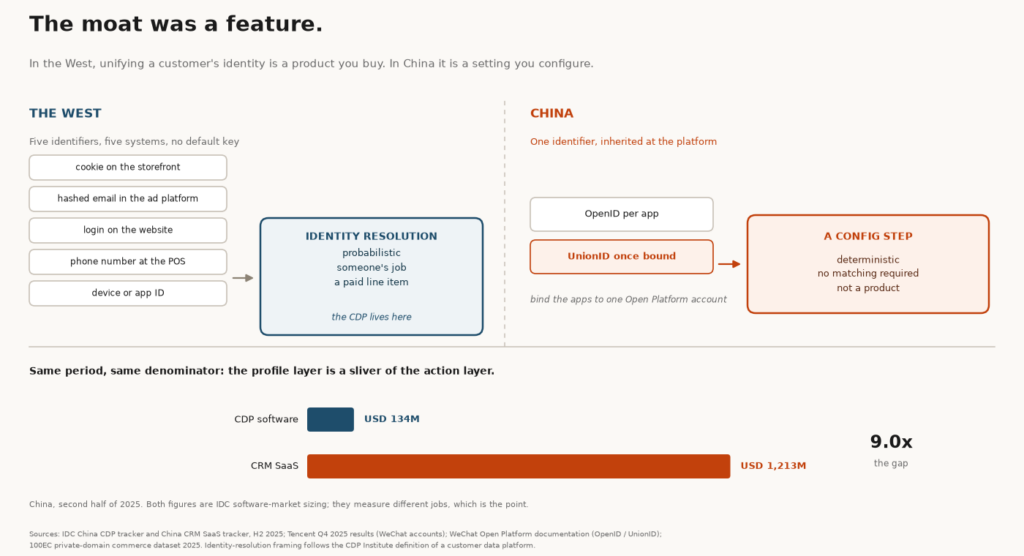
Western procurement teams treat identity resolution as the centre of gravity in a customer data stack. And it deserves the weight. Your customer exists in fragments: a cookie on the storefront, a hashed email in the ad platform, a login on the website, a phone number at the point of sale, a device ID in the app. Nobody owns the key. Reconciling those fragments into one person is difficult, probabilistic, and — for a decade — a paid line item. The entire CDP category rests on that difficulty. Its 2013 founding definition is explicit that the product is packaged software creating a persistent, unified customer database accessible to other systems. The value is in the packaging, because the underlying problem is genuinely hard.
Now read WeChat’s own documentation. Every WeChat user carries a different OpenID for each app — your mini-program, your official account, your mobile app all see different OpenIDs for the same human. That sounds like the Western fragmentation problem. It is not, and the next sentence is where the category dies: bind those apps to a single WeChat Open Platform account, and each user resolves to one UnionID, identical across all of them. The platform’s shorthand is blunt about it. WeChat user + AppID = OpenID. WeChat user + Open Platform account = UnionID.
That is a deterministic mapping. There is no matching to do, no confidence threshold to tune, no false-positive review queue. What a Western CDP sells as data science is, in China, a configuration step in an admin console.
Sit with the consequence, because it is larger than it looks. A moat is something your competitor cannot have. If the identity key is issued by a platform that also issues it to your competitor, then nobody in your category owns a moat — the platform does. Every vendor building on that key is competing on everything except the hard part: interface quality, sales scripts, group operations, onboarding speed. Those are features. Features get bundled, copied, and priced toward zero. This is the mechanical reason Chinese vendors converged on “CDP + SCRM in one.” It is not category confusion. It is the predictable behaviour of firms whose only defensible ground got taken by the substrate.
The market data reads exactly as this argument predicts. IDC puts China’s CDP software market at about USD 134 million in the second half of 2025, growing 18.5% year on year. That is a healthy software market. Set it beside China’s CRM SaaS market in the same period: USD 1,213 million. The profile layer is roughly a ninth the size of the action layer in the same country, in the same six months, measured by the same analyst house. Where identity is free, the record is cheap and the relationship is where the money is.
A second consequence is the part Western teams discover late and expensively. When identity arrives free, value migrates to the layer you cannot configure — the transaction, the service, the compliance surface. That is precisely where Chinese vendors are now fighting. Both large listed players shrank their subscription bases in 2025 while repositioning toward AI and services revenue. They are not losing to each other. They are converging on the only ground left.
The lesson for a global brand is not that Chinese software is worse. It is that architecture is downstream of where identity lives. Bring a Western CDP design into a market where identity is a platform setting and you will spend a year building a resolver for a problem that no longer exists.