Why Beauty Kept Its Premium While Watches Lost Theirs
One mechanism, one chart, and one reason the same shopper paid full price for a serum and walked past a watch in the same week.
In 2025, the same Chinese shopper, in the same week, made two decisions that look contradictory.
She paid full price for a serum. She walked past a watch.
Beauty grew 4–7% while the personal luxury market contracted 3–5%. Watches fell 14–17%. Fashion fell 5–8%, leather goods 8–11%. Resale grew 15–20%. If the story were simply that Chinese consumers got frugal, those numbers should have moved together. They didn’t. Something else is doing the sorting.
Here is the mechanism I keep coming back to: the variable is not the category. It is checkability.
A premium is a claim, not a price
A premium is not a number. It is a claim attached to a number — this cream changes your skin, this watch holds its value, this bag says something about you before you speak. Pingti is an audit of that claim, run by the buyer, at almost no cost, in public. And an audit can only end three ways.
It can be checked on your own body. This is the cheapest possible test: one application, one week, one look in the mirror. It is also the only test the buyer fully controls. That is why the beauty that grew was specifically the science-led end — Euromonitor put premium beauty at 4% growth to 204 billion yuan in 2025, and attributed it to a sustained willingness to pay for clinically validated, science-backed formulas.
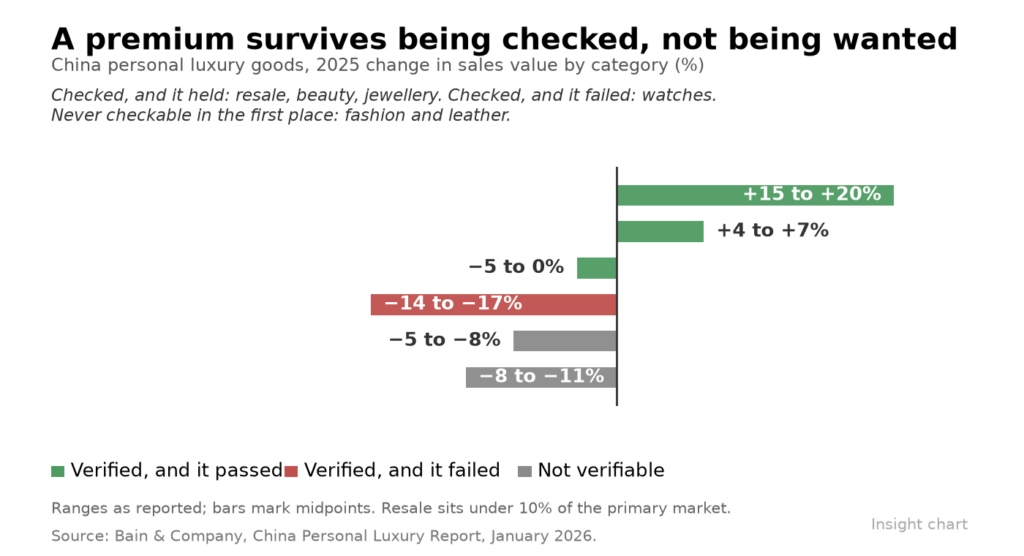
It can be checked by an expert or a market. Resale is verification with a price attached, and in 2025 two things happened at once. Live-stream authentication collapsed the cost of confirming authenticity, and the resale market grew 15–20% while still sitting under a tenth of the primary market. Meanwhile the watch’s central claim — that it stores value — was perfectly checkable, and the check came back negative. Buyers rotated into other assets, second-hand alternatives and smart wearables, and watches fell 14–17%.
It cannot be checked at all. This is where the damage concentrates. Bain’s own account of fashion and leather is almost brutally plain: past and continuing price increases, limited innovation, and purchases consumers found difficult to justify. No new claim was offered, only a higher number. Unverifiable, and therefore repriced.
The part that should worry brand teams
The premium did not fail where it was expensive. It failed where it was uncheckable. Beauty is not a cheap category. Watches are not a cheap category. One could be tested by the buyer and passed. One could be tested by the market and failed. Two could not be tested at all, and were quietly retired as a pricing strategy.
And the cost of checking is still falling. 1688 matches a photograph to a factory. Nearly three million comparison posts tell a stranger which equivalent is worth buying. Live commerce authenticates goods on camera. Each of those is a subsidy to the buyer’s audit function — which means the unverifiable premium is a shrinking asset class, not a temporary discount cycle.
That reframes the strategic question. Most brands are still asking how to justify the price. The sharper question is narrower and harder: what can a customer verify in thirty seconds, and what does that check return? If the honest answer is nothing, the premium is not a price. It is a loan against trust, and the repayment date has arrived.
A caveat, because this is a fit rather than a proof: watches also lost gifting volume and overseas spend, and resale growth was partly supply-driven. But six categories moving in this order is too orderly to be coincidence, and the ordering is not by price, by age, or by how badly each category needs the money. It is by how easily the claim can be inspected.