Video Is a Stock, Live Is a Flow: The Economics Behind TikTok Shop’s American Shelf
In Southeast Asia, TikTok Shop sells roughly evenly across three surfaces: the storefront, the video feed, and the live room. In the United States, the same app, the same algorithm and a largely identical catalogue have settled somewhere else entirely.
Live dropped from 14% of US sales in 2025 to 8.2% in the first half of 2026. Over the same six months the storefront climbed from 36% to 51.4%, and shoppable video slipped from 50% to 40.4%. Momentum Works, which publishes the underlying tracker, put it plainly: the storefront, not video and not live, is where sales now close.
That is the interesting part. Live commerce is usually described as a technology — a feature you switch on. It is not. It is a retail habit, and habits are the one thing that does not travel with software.
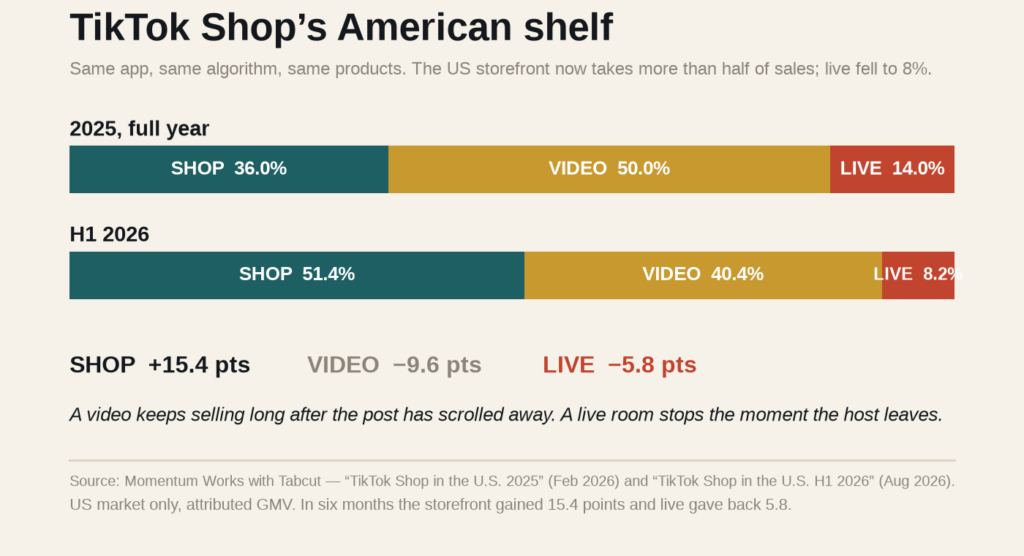
Video is a stock. Live is a flow.
Every hour of live selling costs a human being. Revenue scales with host-hours, which gives the format a hard cost floor that never depreciates. A video is the opposite: shoot it once, and it keeps converting for weeks at zero marginal labour.
Put those two cost curves in a market where host time is expensive and no shopper has been trained to sit through a two-hour stream, and the arithmetic stops being close. Live also demands appointment attention — an audience that shows up at a set time and stays. The US feed is engineered for the opposite: swipe, skip, forget. You cannot build a shopping event on an interface designed to break attention.
The habit was imported, and it did not take
Live shopping in China and Southeast Asia was not invented by an app. It was built by roughly a decade of Taobao Live and Shopee Live, cheap host labour, dense last-mile delivery, and cash-on-delivery norms that made buying from a stranger on screen feel ordinary.
TikTok shipped the feature in three years. It could not ship the decade. The interface arrived fully formed; the behaviour did not. The platform’s own data is what happens when a format outruns its audience.
Then the duty cliff rearranged the basket
This part is inference rather than proof, but the sequencing is loud. The flat duty floor of about $80 per parcel ended the economics of the sub-$10 direct shipment. Sellers responded by pushing inventory into US warehouses — and local inventory forces a different kind of business: planned assortment, reordering, searchable listings, repeat purchase.
Every one of those is a storefront property, not a stage property. A rule designed to slow China’s platforms instead selected for the sellers who behave like ordinary retailers. The shock did not kill social commerce in the US. It reorganised which surface the money closes on.
What this means if you sell there
Video is your top of funnel. The storefront is your checkout. Budget accordingly: listings, product cards, search terms, creative volume — not studio hours and not a permanent presenter roster.
Treat live as a promotion, not a channel. Launches, drops, clearance, event moments. It works when there is a reason to gather, and it punishes you when there is not.
Keep the geographic humility, too. Southeast Asia still runs close to an even three-way split, which means the same platform is two different businesses depending on where the shopper learned to buy. Copy the mechanic. Do not copy the country.
The livestream did not fail. It got demoted to what it always was in this market: a promotion, not a storefront.