Why AI Never Trusts a Company’s Own Announcement
Here is a fact that has no business being true. Take one corporate announcement. Publish it once on the wire as a press release, and once more as a story written by an outside reporter who checked the same facts. Both versions now sit on the open web, both are indexed, both are readable by the same model.
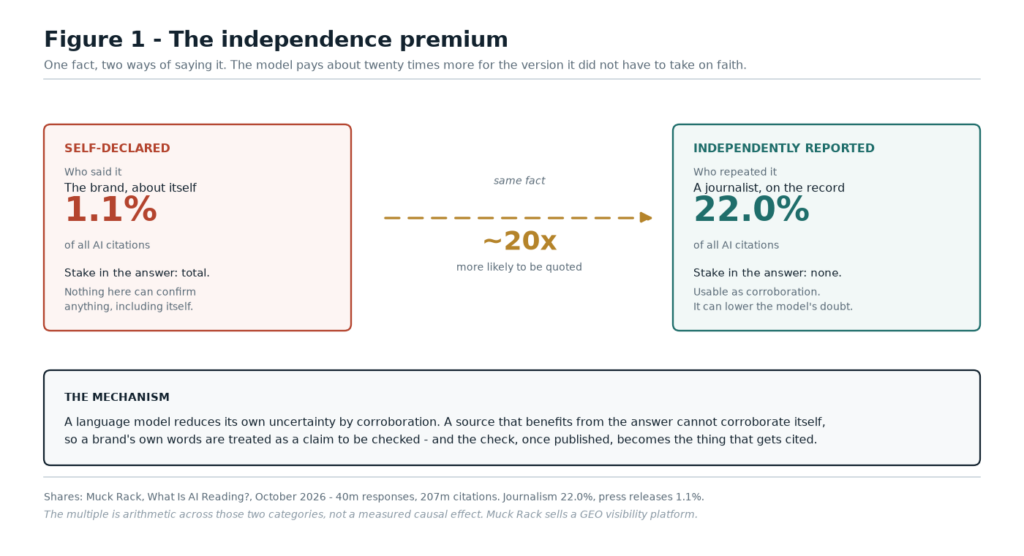
The release captures 1.1% of all AI citations. The reported version captures 22.0%.
Same facts. Different quantity of truth, as far as the model is concerned. And the gap is not a small efficiency difference you can close with better formatting — it is roughly twenty to one, and it holds across four consecutive editions of the same dataset, in seventeen industries, on three different model families.
Corroboration, not credibility
The instinctive explanation is authority, and it is wrong. A model has no editorial standards. It is not weighing your brand’s reputation against a newspaper’s, because it cannot feel the difference between a respected masthead and a well-formatted blog.
What a model is actually doing, at the level that matters here, is reducing its own uncertainty. Ask it about a company’s new factory and it faces a choice: repeat what the company said, or repeat what someone else said about what the company said. The first option cannot reduce uncertainty at all, because the source’s interest is identical to the claim’s content. The second option can, because an independent party staked something on it — a byline, a publication, a legal exposure to being wrong.
This is why the framing should be corroboration rather than credibility. Credibility is a property of a source. Corroboration is a relationship between sources, and models are built to detect relationships. Your release is not disbelieved. It is simply unable to corroborate anything, including itself.
Why this is worse in China than anywhere else
If the premium is a structural property of how models work, then a market that built an entire industry on simulating independence should be the most exposed to it.
Chinese PR did exactly that. The soft-article trade — paid placements dressed to look like editorial — was never a fringe tactic; it grew into a large, platform-mediated market that most Western analysts never measured. CIPRA puts the whole sector at 87.33 billion RMB, growing 4.1% and now trailing GDP for four straight years, with the top thirty firms growing revenue 2.1% while profit fell 6.4%. A great deal of that revenue was earned by making paid content look unpaid.
That trade made sense against a human reader, who evaluated a soft article by how much it felt like a news story. It makes much less sense against a model, which does not read tone — it reads who benefits. Formatting can imitate a byline. It cannot imitate the absence of a stake.
The uncomfortable arithmetic for buyers
If the premium is real, then buying independence should be the highest-return line in a PR budget, and buying the appearance of independence should be the worst. That is roughly what the data implies, and it inverts a habit.
A syndicated release is cheap, fast, measurable and almost worthless as share of voice. An independent write-up is slow, uncertain, unmeasurable in advance, and worth twenty times more per citation. The rational move is not to abandon the release — it is to stop expecting the release to do the job that only corroboration can do, and to spend the difference on earning checks rather than on manufacturing the look of them.
There is one legitimate way to buy back some of that premium, and it is boring: publish the canonical version on a domain you control. Press material hosted on a brand’s own site accounted for about 3% of citations generally and 18% on ChatGPT specifically in an independent analysis of four million citations — several times the rate of wire-syndicated copies. Models deduplicate near-identical text and credit whoever they crawled first. Own the first version, and you own a larger share of a small number.
What follows from this
Three consequences, in descending order of confidence.
The release’s job description changes permanently. Not a pitch, not a placement, but the dated, structured, checkable version of events that makes someone else’s verification possible. Everything valuable about it is instrumental.
Soft-article budgets will quietly rot before anyone admits it. The format still works on humans and still fails on models, and the two audiences increasingly overlap in the same decision.
And measurement has to move, because the premium is invisible to placement counting. You cannot see a twenty-to-one gap in a coverage report. You can only see it in which domains the model cites next to your name.
The press release did not lose its authority. It lost its ability to vouch for itself, in a system that now rewards exactly one thing: someone else vouching for it.