The Economics Behind the Course-to-Cohort Pivot
The tell is not in a press release. It sits four lines apart inside one company’s revenue table.
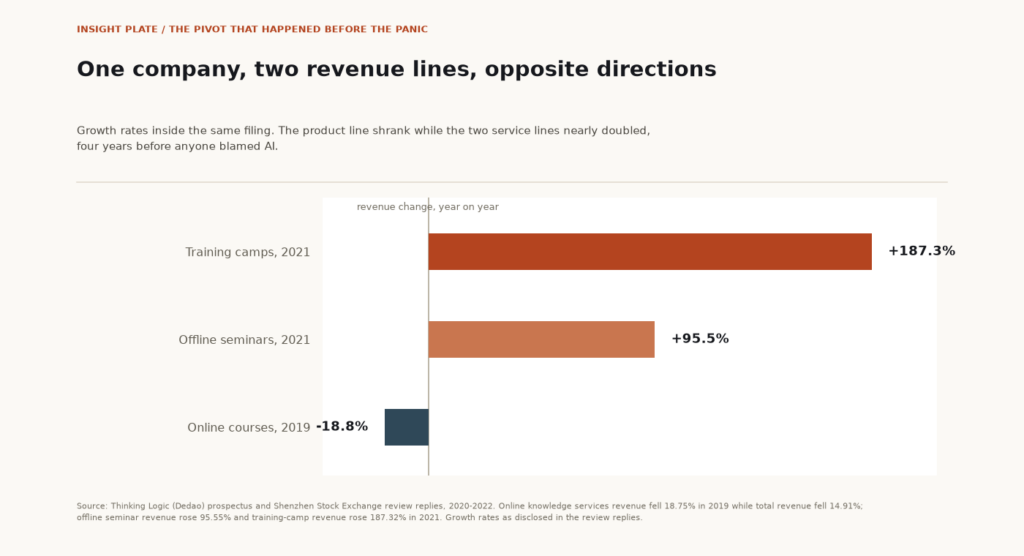
Read Dedao’s listing file closely and you find a product line shrinking while two service lines nearly doubled. Online knowledge services revenue fell 18.75 percent in 2019, dragging total revenue down 14.91 percent. Two years later, offline seminars were up 95.55 percent and training camps up 187.32 percent. That is 2021. Not 2025, not 2026. The pivot to cohorts happened roughly four years before anyone started blaming AI — and the reason had nothing to do with teaching.
It was arithmetic. A course is a product: near-zero marginal cost, revenue booked at the moment of sale, no obligation to deliver anything afterwards. A cohort is a service: someone has to show up, keep a schedule, read the work, answer the question. That is why the price is many times higher. You are not buying more knowledge. You are buying presence, and presence has a headcount cost.
Then comes the part almost nobody says out loud. In a product model, finishing is a cost. Complete the course and you will not buy the next one on the same subject, while the company has already taken your money. In a service model, finishing is revenue, because it produces renewal, referral and the testimonial that sells the next cohort. Identical behaviour, opposite sign. That single asymmetry explains why course completion gets treated as an industry embarrassment while cohort completion gets printed on the landing page.
For Dedao the arithmetic eventually got loud. Average revenue per paying user sat at 231.93 yuan in 2019. By 2021 the company held 49 million registered users against 632,400 daily actives, and added 590,900 new paying users — down from 911,000 two years earlier. Fixed price, exhausted audience, a product line that could no longer defend its price. When those three conditions meet, the only lever left is the unit of sale. Sell fewer things, bigger.
AI did not create that problem, but it removed the route back. The product line’s premium was synthesis: someone read a hundred sources and handed you the ten percent that mattered. That is a prompt now, and it ends inside the chat roughly a third of the time. A model cannot attend your Tuesday.
Which leaves the honest catch. Services do not scale like products. Dedao’s gross margin sat near 44 percent on a partly productised mix; put a facilitator in every seat and the curve flattens into labour. You cannot serve 49 million people with humans. So the pivot buys margin and forfeits reach in the same motion — the addressable market shrinks exactly as the price rises. Whether that reads as a rescue or a retreat depends on which of the two you needed.
What it actually is. A margin rescue dressed as pedagogy, and it works. It also converts a platform into a consultancy with an app attached, and consultancies do not compound. That is the trade nobody put on the slide: the industry did not learn to teach better. It learned to charge for the one thing a model cannot fake — a person, scheduled, who notices.