The 10% Cut: How China’s Platforms Turned Ad Budgets Into Payrolls
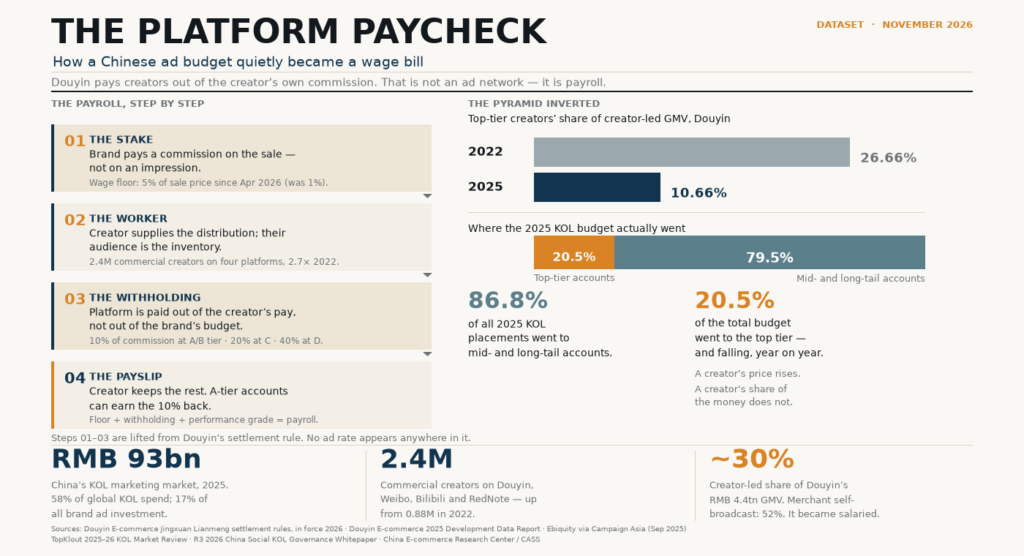
China’s KOL marketing market reached RMB 93 billion in 2025 — 58% of global influencer spend and 17% of all brand advertising investment in the country. The four major platforms now carry 2.4 million commercial creators, up from 880,000 in 2022.
Those numbers get quoted constantly. The number that explains them almost never does: 10%.
Read Douyin’s settlement rule and you will find that when a brand pays a creator a commission, the platform takes 10% of that commission back as a technical service fee. Since July that flat rate became a graded one — 10% for A, B+ and B-tier accounts, 20% for C, 40% for D — and A-tier accounts can earn the full 10% back by hitting their posting and compliance targets. In April, Douyin also set a wage floor: a 5% minimum commission on nearly every product category, up from 1%, with gold, second-hand luxury and used 3C carved out.
A floor, a withholding rate and a performance grade. That is not a media rate card. That is a payslip.
Why the platform chose payroll over ad sales
Because the scarce input changed. Reach stopped being scarce somewhere around 2023; trust did not. Ebiquity’s read of the market is blunt: budgets are rotating away from top-tier names toward mid- and long-tail creators, who took 86.8% of 2025 placements and roughly 80% of the money. On Douyin, top-tier creators’ share of creator-driven GMV fell from 26.66% in 2022 to 10.66% in 2025, while accounts under a million followers now account for more than 85% of it.
That is not a star system. That is a distributed workforce — and a payroll is how you administer one.
The misread worth correcting
The reflex is to file this under influencer marketing. But influencer marketing was a line item bolted onto a media plan; R3 found brands now plan to increase paid amplification of existing creator content (about 30%) at nearly twice the rate they plan to buy more creator content (17%). The budget did not migrate from ads to creators. It migrated from buying impressions to paying for distribution — and then renting the algorithm to push it.
The part the thesis has to survive
Creator-led livestreams now account for only about 30% of Douyin’s RMB 4.4 trillion GMV; merchant self-broadcast takes 52%. So the network did not become freelance — it became salaried. Brand studios hire hosts, grade them, pay them and buy traffic behind them. Same payroll logic, different employer. Anyone claiming creators are the whole ad network is overstating it: the trust layer moved, the volume layer stayed with the merchant.
Three things to do on Monday
Budget creators as headcount — a standing line with an owner, not a campaign with an end date. Stop negotiating on followers; a 5% floor already publishes the market’s reserve price for attention. And pay on settlement, not clicks: with return rates in content commerce running between 30% and 50%, the only conversion worth commissioning is the one that survives the refund window.
The ad network did not get more digital. It got a payroll department.