Why US Mobile Ad Share Peaked at 68% and Stayed There
The device split stopped measuring devices. That is the whole story.
A number that looks like a fact
Every planning deck in the industry carries the same line: mobile is about two-thirds of US digital ad spend. It reads as a settled fact about consumer behaviour.
It is actually a fact about accounting.
US mobile share went 65.9% in 2019, 68.0% in 2020, 67.9% in 2021, and has sat near 66% ever since. Six years, four percentage points of movement in either direction, and a peak nobody expected to be a ceiling. If the number tracked device usage, it should still be climbing — Americans spend more of their digital day on a phone than they did in 2020.
It didn’t climb because the number stopped being about phones.
The denominator outgrew the numerator
Run the 2026 growth rates side by side and the mechanism is almost embarrassingly plain.
US mobile ad spend is forecast to grow about 5%. Commerce media grows 18%. Connected TV grows 14.5%. Retail media grows 14.1%.
Three of the four fastest-growing categories sit outside the mobile line. Only one sits inside it.
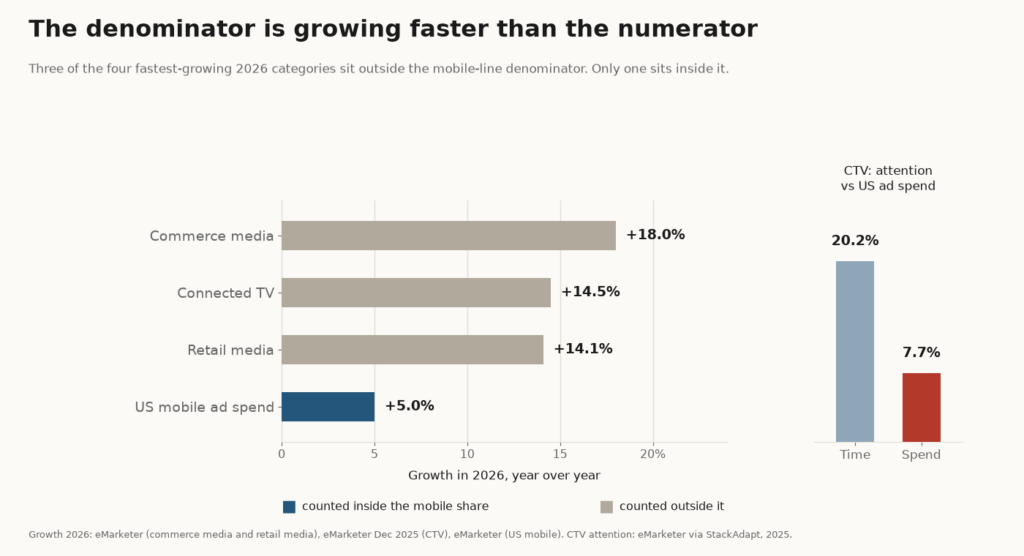
A share is a fraction. When the numerator grows 5% and the denominator grows 8%–18%, the share falls — while every absolute dollar in the category rises. Mobile ad spend can grow every single year and still lose share every single year. Both facts are true, and the flat line is what happens when they are.
Retail media is a data asset, not a screen
The deeper reason sits in how the industry redefined what it was counting.
A device split answers a question: where is the screen? Mobile, desktop, tablet, TV. Retail media answers a completely different question: whose first-party data is attached to the impression?
That is why retail media gets its own line. It runs on a phone, a laptop, a TV and a store screen, and a device counter can only file it under whichever surface it happened to land on. So the industry gave it a separate label — and once a channel has its own label, it gets its own budget line, its own measurement contract and its own buyer.
The inventory moved with the label. Retail media networks now push most of their growth off their own properties and onto the open web and CTV — inventory that lands in the books as “retail media” or “connected TV” and never as “mobile.” IAB Europe’s 2025 buyer survey shows the shift clearly: the share of buyers putting more than 41% of retail media budget into off-site formats went from 30% to 46% in a single year. Only about 30% of retailers even offer off-site today, which tells you how much further that reclassification has to run.
What it changes
Stop treating the flat line as a demand signal. It is a filing decision.
The money didn’t leave mobile. It left the category called mobile — into labels that describe a data relationship rather than a screen. Which means the two-thirds figure is not a forecast of mobile’s importance. It is a running count of how much spending the industry still chooses to file under a device heading.
And that count is going down by design, not by demand.