Nine Ways Ad Buying Diverges: China vs the West
A Western media buyer dropped into Shanghai would recognize the budget, the brand, and the objective. Almost nothing else.
That is the uncomfortable truth about buying media in China, and it is not a complaint about cultural difference. It is a structural fact. The platforms are different, the payment rails are different, the measurement is different, the regulator behaves differently, and the transaction itself — what you are actually buying — is a different object. Port a Western media plan into China line by line and it doesn’t underperform. It misfires, because the machinery it assumes simply isn’t there.
So let’s take the nine differences apart, then look at why they exist, what Western buyers get wrong, and what to do instead.
1. The Nine Differences, Stated Plainly
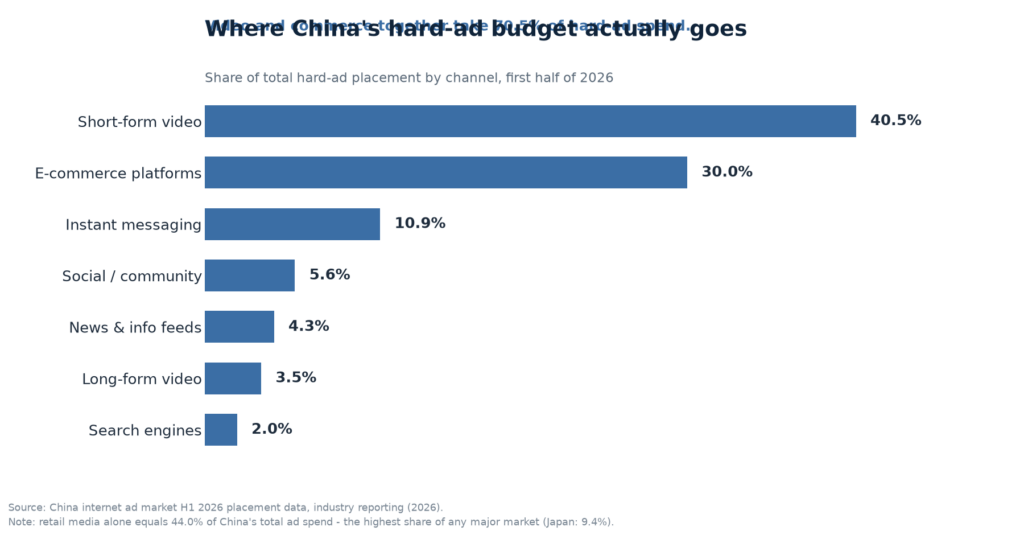
Here is the whole argument on one page. Everything after this is elaboration.
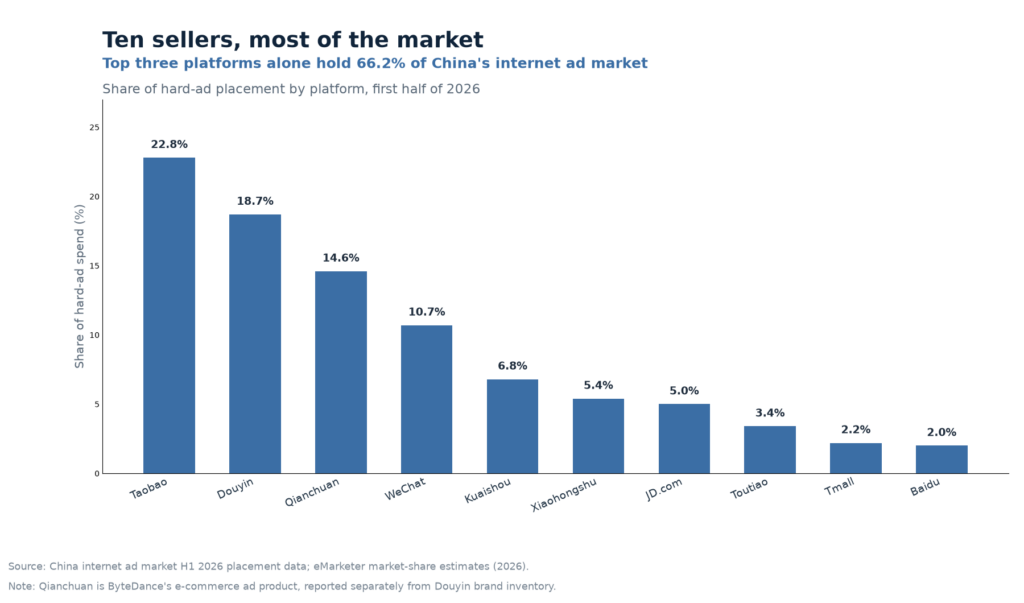
One: concentration versus fragmentation. China’s advertising lives inside a handful of super-apps that own reach, data, and checkout in the same place. The West’s advertising lives across thousands of sites and apps that share nothing. In China, three companies — ByteDance, Alibaba, Tencent — hold 66.2% of internet ad revenue, and the top ten platforms absorb 91.6% of hard-ad placement.
Two: the shape of the market. In China, automation happens inside the platform. In the West, automation happens in a layer between publishers and buyers — exchanges, DSPs, SSPs, verification vendors. China has that layer. It is just thinner, poorer, and subordinated to platform systems.
Three: payment rails. Chinese advertising sits downstream of a mobile wallet that everyone already has. The West’s sits upstream of a card and a redirect. That single difference changes what a click is worth.
Four: measurement. China measures inside walled gardens, using login identity, one silo at a time. The West measures across sites by design — though that design is now decaying fast.
Five: regulation. China reviews before publication, mandates visible labels, and sets a statutory fine floor. The West investigates after the fact and relies on consent regimes and litigation.
Six: the buying motion. In China the dominant buying unit is a live session with a person in it. In the West it is an impression, a click, an auction.
Seven: who sells it. Chinese inventory is sold through platform trading desks and creator networks. Western inventory is sold through agencies, resellers, and intermediaries.
Eight: identity. China has one phone-bound ID per walled garden. The West has cookies, IP addresses, hashed emails, and licensed identity graphs — a portfolio, not a single key.
Nine: the role of creative. In China, creative and media never separated. In the West they are managed as separate P&Ls, often by separate companies.
Nine rows. Now the part that matters: each row changes what the other eight can do.
2. Why This Is Structural, Not Cosmetic
The mobile-first leapfrog
China’s digital economy grew up after mobile. It never had the desktop-web ancestry — open browsers, independent sites, cookies as currency — that shaped the West’s advertising apparatus. It was born inside apps. That is why the super-app model is the default rather than an anomaly, and why there is no meaningful Chinese equivalent of the open programmatic web.
Western buyers tend to hear this as a maturity gap. It isn’t. It’s a different starting condition, and the apparatus built on top of it is internally coherent.
Payment arrived at birth
Alipay and WeChat Pay were baked into the ecosystem from the beginning. By the end of 2025, China had 1.017 billion online payment users — 90.3% of all internet users — with mobile payment penetration at 86%. In 2025 the system processed 231.4 billion mobile transactions worth RMB 571.97 trillion. Nearly nine in ten users pay by phone every day.
Think about what that means for an advertiser. The distance between seeing an ad and completing a purchase is one tap, inside the same app, with no card entry, no redirect, and no third-party checkout. The West still doesn’t have this. It has cards, wallets, and platform checkouts, each adding friction and each taking a fee at the exact moment of conversion.
This is why content-commerce isn’t a Chinese marketing trend. It’s the natural shape of a market where payment is a native feature of the page.
Regulation works on a different clock
China’s Advertising Law prohibits absolute superlatives — Article 9(3) bars 国家级, 最高级, 最佳 and anything semantically close, and the regulator’s 2023 enforcement guidance spells out how broadly that reaches. Enforcement is pre-publication, and platforms censor in real time. The penalty structure is unusually sharp: Article 57 sets a floor of RMB 200,000, with a ceiling of RMB 1 million.
That floor is the detail Western brand teams miss. Call it roughly USD 28,000, and it applies whether the offending word appeared on a billboard or in a livestream caption. It is not a rounding error; it is a budget line.
Since May 2023, the Internet Advertising Measures have added a second layer. Ads must be identifiable as ads, paid search results must be labelled, soft-sell content carrying a purchase link must show a visible 广告 mark, and algorithmically placed ads must be logged into an ad archive.
The West’s model is the opposite in kind. The FTC and the ASA enforce after publication, in a competitive-market framework, with remedies that arrive years later. One system shapes behaviour before the ad ships. The other shapes it through precedent and risk appetite.
The identity asymmetry, and how it inverted
For two decades the West’s advantage was cross-site identity. That advantage is now gone — not because cookies were removed, but because the replacement never arrived.
Google abandoned deprecation in July 2024, confirmed in April 2025 that it wouldn’t even show users a cookie-choice prompt, and on 17 October 2025 retired most of the Privacy Sandbox, including Topics, Protected Audience, and Attribution Reporting. Third-party cookies remain in Chrome with no end date. Meanwhile Safari has blocked them by default since 2020, Firefox partitions them per site, and apps and connected TV never used them at all.
So the West’s “single customer view” was always partly a fiction, and it is now a shrinking one. China never had that fiction. It had something narrower but more durable: one logged-in, phone-bound identity per walled garden, stable for years, and complete within that garden. Less elegant. Considerably more usable.
3. What Western Buyers Get Wrong, Mechanically
They look for an open market and find a closed one
The most common error is assuming Chinese programmatic buying works like Western programmatic buying. It doesn’t — but not in the way most people think.
Here’s the correction that matters. The overwhelming majority of China’s digital display advertising transacts programmatically — eMarketer’s benchmark put China at 80.7% against 91.1% in the US, a gap of about ten points, not a chasm. The automation is real and at scale. What differs is where it happens.
In the US, walled gardens account for roughly three-quarters of programmatic display, leaving a meaningful open-web segment traded through independent exchanges. In China, that open-exchange layer is thin and marginal, because ByteDance, Alibaba, and Tencent run their own bidding systems end to end and have no reason to expose inventory to third parties.
So a Western buyer doesn’t find “no programmatic.” They find programmatic they cannot access, audit, or arbitrage. The buying interface exists; the market doesn’t.
They expect attribution across channels
A Western buyer arrives with a cross-channel attribution model and asks for the unified journey. In China there is no unified journey to model, because there is no cross-platform identity spine. Each platform reports its own numbers, in its own definitions, against its own conversions.
The practical consequence is that Chinese media measurement is a portfolio of siloed truths. You can compare platforms on cost and on your own downstream data. You cannot reconstruct a user’s path across them. Brands that accept this and design around it — geo-tests, promo-code attribution, holdout cells — get further than brands that demand what doesn’t exist.
They treat content-commerce as a niche
This is the most expensive mistake, and the data is unambiguous.
China’s live commerce GMV exceeded RMB 5 trillion in 2025, roughly one-third of all online retail, with 660 million users spending an average of RMB 7,968 a year — up 6% year on year. Store-operated livestreams, where brands run their own channels, now account for over half of GMV. And top-tier host concentration has collapsed: the biggest names drive 10.66% of GMV, while mid- and small-tier hosts drive 89.34%.
Read that last number again. China’s creator economy has decentralized, not consolidated. For a media buyer, that means the buying surface is not a handful of celebrity livestreams you can book. It is a long tail of brand-owned channels and mid-tier creators, each with small audiences, that together constitute the primary commerce channel.
Treating that as “influencer marketing, experimental budget” is a category error with a very large price tag.
They misread the compliance surface
A Western-compliant claim and a China-compliant claim are different objects. “The best,” “number one,” “the leading” — all standard Western copy, all prohibited or heavily restricted in China.
Add the AI labelling regime. Since 1 September 2025, the Measures for Labelling AI-Generated Synthetic Content require both explicit labels (visible marks) and implicit labels (metadata), with mandatory national standard GB 45438-2025 specifying the methods. Platforms are already enforcing it. ByteDance’s ad arm reported pre-blocking more than 840,000 AI-related non-compliant assets in Q3 2025 alone — a self-reported figure, but a revealing one.
If your creative pipeline generates AI imagery or copy, you have a labelling obligation in China with no direct Western equivalent.
4. The Playbook, for a Western Brand
Five moves. None of them optional.
Rearchitect around the platforms, not the funnel
Stop mapping your plan to “search, social, display, video.” Map it to Taobao, Douyin, WeChat, Xiaohongshu, JD.com, and Baidu. The platform is the strategy. There is no neutral layer above them to plan against.
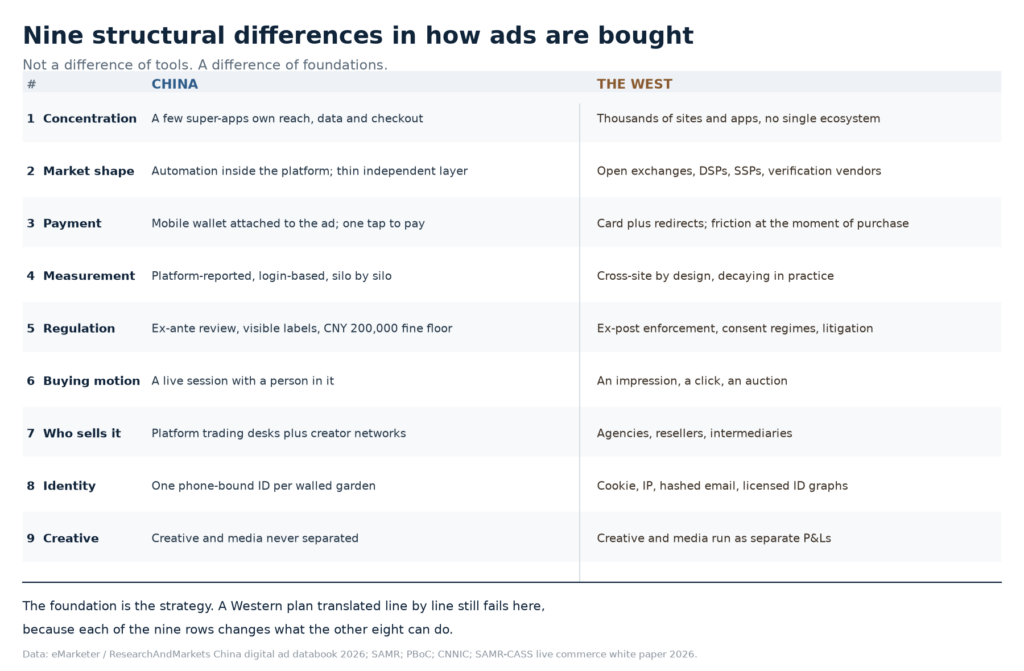
Retail media deserves its own line in the plan, not a sub-bullet. It represents 44.0% of China’s total ad spend — the highest share of any major market, against 9.4% in Japan. Nearly half of Chinese advertising happens inside a transaction environment.
Make content-commerce core, and staff it like media
Livestream and short-video commerce should carry core budget, not test budget. And given that 89% of live-commerce GMV now flows through non-top-tier hosts, the capability you need is a creator-and-store-broadcast operation, not a celebrity booking desk. That is a media-buying function in China, with media-buying accountabilities.
Buy measurement you can defend, not measurement you’d prefer
Accept platform-native reporting as the baseline. Then build your own incrementality: geo holdouts, promo-code attribution, matched-market tests. Do not spend eighteen months trying to build a cross-platform attribution model — you will be building against a data structure that does not exist.
Build compliance before you build creative
Superlative bans, ad identifiability, AI content labels, live-commerce disclosure. Get the claims matrix approved before the campaign concept, not after. The RMB 200,000 floor makes compliance a budget line, not a legal footnote.
Localize the buying capability, not just the language
These differences are too structural to run remotely. A China-native buying team — in-house or agency — is the minimum viable structure. A regional team in Singapore interpreting a Shanghai market through translated dashboards will get the mechanics wrong in ways that cost real money.
5. Is the Gap Closing?
Partly, and asymmetrically.
What is converging: the West is importing Chinese mechanics. TikTok Shop, live shopping, creator-led commerce, short-video performance buying — all now mainstream Western practice. Retail media is scaling everywhere. The formats are converging fast.
What is not converging: the foundations. There is no Western Alipay equivalent — no universal, zero-friction, platform-native payment rail. There is no Western WeChat — no single app owning messaging, payments, mini-programs, and commerce. And there is no Western ex-ante advertising regulator with a statutory fine floor and real-time platform censorship.
These three pillars are unlikely to converge, because each is rooted in how that internet grew up. Payment-at-birth cannot be retrofitted onto a card-based economy. Super-app concentration cannot be assembled from fragmented Western platforms with separate ownership and separate data. Pre-publication review is incompatible with the West’s free-speech and due-process architecture.
So the honest forecast is not convergence. It is two systems that will keep borrowing each other’s surface features while resting on foundations that stay distinct.
The Takeaway
The nine differences aren’t quirks to be smoothed over with local hires and translated decks. They are two different machines, built from two different internet histories — one mobile-first with payment at birth, one desktop-first with payment bolted on later.
For a Western brand, buying media in China is not a translation exercise. It is a rebuild, on a foundation that will not behave like the one at home. The brands that accept this and construct a China-native buying capability will find the world’s most frictionless advertising market — a $163.1 billion digital ad market growing at double digits, with payment and purchase fused into the same screen. The brands that don’t will keep running the playbook that works everywhere else, and keep wondering why it doesn’t work here.