Why AI’s Productivity Boom Stops at the Review Gate
Every quarter for two years, the same two numbers have appeared in the same survey, and the industry keeps reading them as a contradiction instead of a sequence.
Eighty percent of respondents to McKinsey’s 2026 State of AI say AI improved their own productivity. Six percent of organizations qualify as high performers — able to attribute at least 5% of EBIT to it. The middle number, the share that can trace any EBIT impact at all, sits at 37%, unchanged for a year.
The default explanation is that the tools are not ready or the culture is not. Neither survives contact with the data. Nearly nine in ten organizations use AI in at least one function. Forty-four percent are scaling it enterprise-wide, up from 38%. The gains at the desk are real and measured. What is missing is not adoption. It is conversion.
Here is the mechanism. Think of two gears. AI spins the small one — the individual task — fast. The big gear is the workflow wrapped around that task: the review, the approval, the handoff, the sign-off that makes the output usable. The big gear has not been resized, and no amount of speed in the small gear turns it faster.
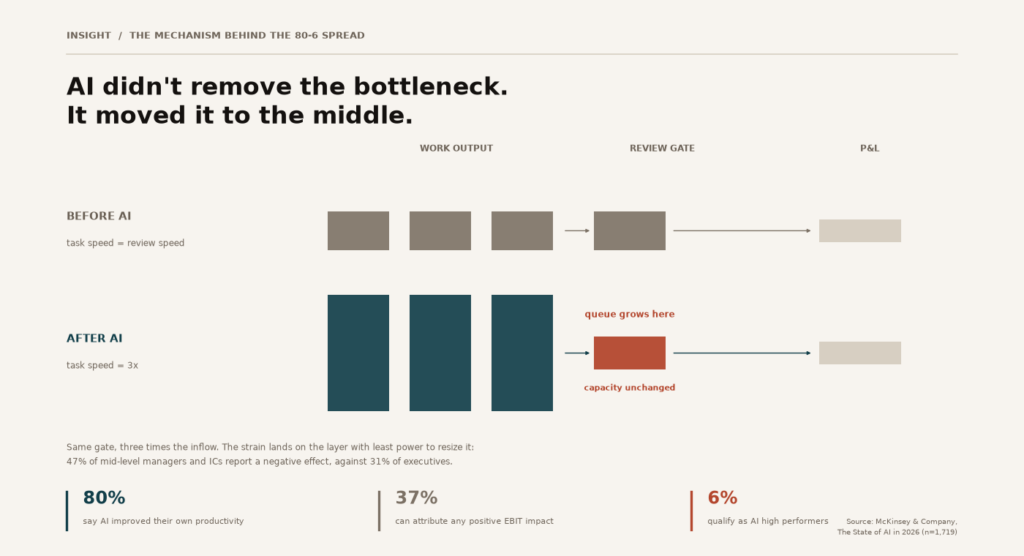
So work arrives at the same gate, three times as fast. The constraint does not vanish; it relocates — out of the task and into the seam between tasks. And because the gate is a person, the queue stays invisible until it becomes someone’s evening.
That is why the strain shows up in the middle and not at the top. McKinsey found 47% of mid-level managers and individual contributors report at least one negative effect from AI use, against 31% of executives. Only 13% say AI makes them anxious about their own prospects. This is not fear of replacement. It is throughput.
Two mechanisms compound it. First, verification cost scales with volume: every additional draft needs a read, and the reader’s judgment did not get faster — only their typing did. Second, the manager who could remove a step is the same manager absorbing the queue, so the person with authority to redesign the gate has the least time to do it. The system optimizes for shipping more and quietly taxes the one role that could reshape the pipe.
The exception is instructive. McKinsey’s high performers are about three times as likely to have fundamentally redesigned workflows around AI — 75% versus 25%, up from 55% and 20% a year earlier. The distance is widening, not closing. They are also roughly twice as likely to have senior leaders visibly owning the agenda and defined ways to measure impact. Authority and measurement, in other words. Not model choice.
The practical version is small and unpopular: before you buy another seat, name the gate. Then name the signature you can remove from it. If nobody can name both, you are not adopting a capability. You are speeding up the small gear and calling it transformation.