Cheap Content, Expensive Trust
Marketing spent twenty years getting very good at measuring the wrong thing. The bill is arriving now, denominated in the one currency the dashboard was never built to track.
In brief
- Clicks were a proxy for attention. At some point the proxy became the target, and the dashboard quietly became the strategy.
- Every optimization that lifts click-through carries a trust cost. That cost gets paid later, by someone else, on a different line of the P&L.
- Trust behaves like a purchase consideration now, not a brand attribute: people pay more for it, and they leave without it.
- Generative AI made content cheap. Trust became the scarce input, and scarcity is where margin lives.
- Optimizing for trust does not mean ignoring performance. It means demoting the click from goal to instrument.
The Proxy That Ate the Goal
Nobody sat in a meeting and decided that clicking was the point of marketing. It happened the way most bad decisions happen: incrementally, with good intentions, and with a spreadsheet open.
A click began as a reasonable stand-in. It stood for attention, attention stood for interest, and interest stood for intent. Three substitutions deep, we stopped checking the middle term. The proxy became the target. And once a measure becomes a target, it stops being a good measure. That is not a marketing insight; it is a piece of hard-won wisdom from monetary policy, and it applies to your media plan with unpleasant precision.
The reason is not stupidity. It is arithmetic. Clicks arrive instantly, cost almost nothing to count, can be optimized in a dashboard by Tuesday, and make whoever reports them look competent. Trust is none of those things. It is slow, it is noisy, and it never shows up in a weekly review. So the organization gravitates toward the number it can move, and the number it can move is the one closest to the surface.
The Dashboard Rewrote the Job
Here is a finding that belongs pinned to every marketing wall.
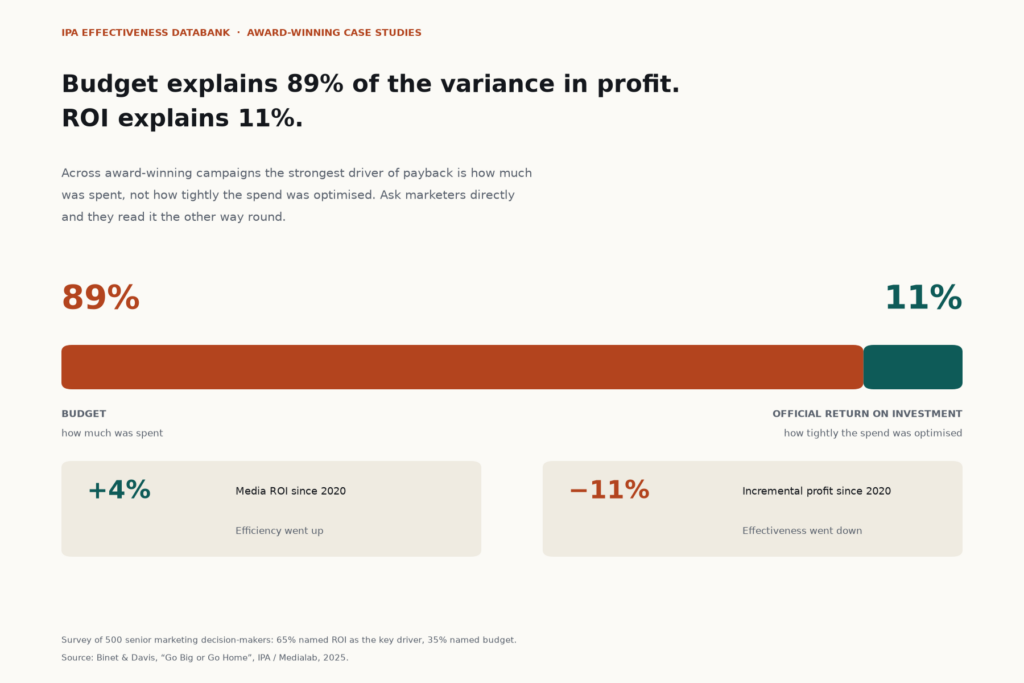
When Les Binet and Will Davis went back through the IPA Effectiveness Databank — the same award-winning cases the industry cites as its best work — they found that 89% of the variation in profit came down to budget, and 11% to ROI. Budget was roughly eight times more consequential than efficiency.
Then they surveyed 500 senior marketing decision-makers. Sixty-five percent named ROI as the decisive factor. Thirty-five percent named budget.
The industry is optimizing the 11% and calling it discipline.
The split shows up in where money actually goes. Adobe and MMA Global surveyed 389 senior marketers and found 57% of budget now flowing to performance marketing, while only 19% of those same people describe their organization as performance-led. That is close to an inversion of the 60:40 brand-to-activation balance the IPA work has recommended for a decade — and almost nobody will say out loud that they did it.
Binet has a name for where this ends: a death spiral. Smaller budgets, narrower targeting, smaller campaigns, thinner profits, smaller budgets. Each turn of the wheel looks like a rational response to the previous turn.
What the Efficiency Obsession Actually Costs
Optimization is not free. It just bills a different department.
Ask why 51% of all web traffic is now automated, for the first time in a decade, with 37% of it actively malicious. Every fraction of that traffic that reaches a conversion pixel is a number somebody will report as demand. Somewhere a team gets congratulated for it.
Then ask what a clickbait headline really costs.
Researchers examined 19,386 articles from 27 leading online publishers and confirmed that clickbait posts earned substantially fewer shares than comparable non-clickbait content — a result that held with large effect sizes even after controlling for selection effects. The mechanism was not mysterious. Readers inferred manipulative intent, then devalued the source. Marketing science calls it source derogation, and it is the cleanest empirical account of a brand spending its own equity to buy a Tuesday.
The damage concentrates where credibility matters most. Separate experimental work found that clickbait-style presentation lowers perceived truthfulness across the board but penalizes accurate content hardest, precisely because audiences already discount claims that look unreliable. A randomized experiment on native advertising found clickbait-formatted ad headlines measurably degraded readers’ assessment of the surrounding article’s credibility. The publisher paid twice: once in cash, once in trust.
None of this appears in the dashboard. That is what makes it dangerous.
What Trust Actually Buys
Stop treating trust as a mood. Treat it as a line item.
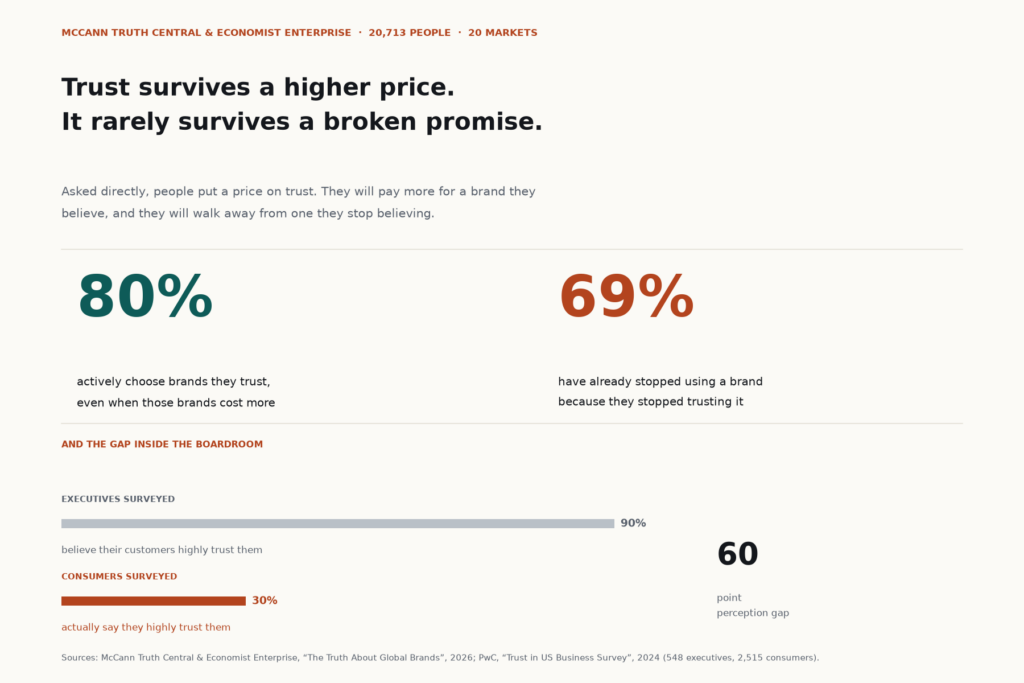
McCann and Economist Enterprise surveyed 20,713 people across 20 markets. 80% said they would actively choose a brand they trust even if it cost more. Sixty-nine percent said they had already stopped using a brand because they stopped trusting it — rising to 79% among B2B decision-makers. Seventy-two percent said prioritizing truth matters more now than ever. Fifty-five percent said brands are less truthful than they were twenty years ago. Seventy-six percent worry they will soon be unable to tell a real person from a synthetic one online.
Read those last figures together. People want truth more, and believe they are getting less of it.
Those are stated intentions, and stated intentions flatter. But the aggregate financial picture is hard to argue with. Echo Research’s eighteenth annual valuation puts corporate reputation at 23.8% of S&P 500 market value — roughly $14.9 trillion — up from a 2022 peak of 34% and still, by their model, worth more than a fifth of every listed company in America. Ninety-two percent of those companies generate positive value from reputation. Eight percent are actively destroying it.
The Gap Inside the Boardroom
Meanwhile the people allocating budget are living in a different reality.
PwC asked 548 US executives and 2,515 consumers. Ninety percent of executives believed customers highly trusted their company. Thirty percent of customers actually did. A 60-point gap, wider than in either of the two previous years.
That gap is the most expensive blind spot in marketing, because it means the people deciding how much to spend on trust have no working instrument for the asset they are spending it on. They are budgeting blind, and the market research they commission keeps telling them what they want to hear.
Trust Is the Only Input Getting Scarcer
Here is what has actually changed since anyone last wrote this argument.
In 2023, the case for trust was philosophical. In 2026, it is structural, because generative AI broke the relationship between production cost and perceived value.
Canva surveyed 1,415 marketing leaders and 3,547 consumers across seven countries. 97% of marketing leaders use AI daily. Seventy-eight percent of consumers would rather see ads made by people, even if AI could make better ones. Eighty-seven percent say the best advertising still requires a human touch. Seventy-four percent say they are more likely to buy from an ad made entirely by humans. Seventy percent say they can tell an AI ad because it feels like it is missing its soul.
Gartner’s May–June 2026 survey of 1,006 US consumers lands in the same place from a different angle.
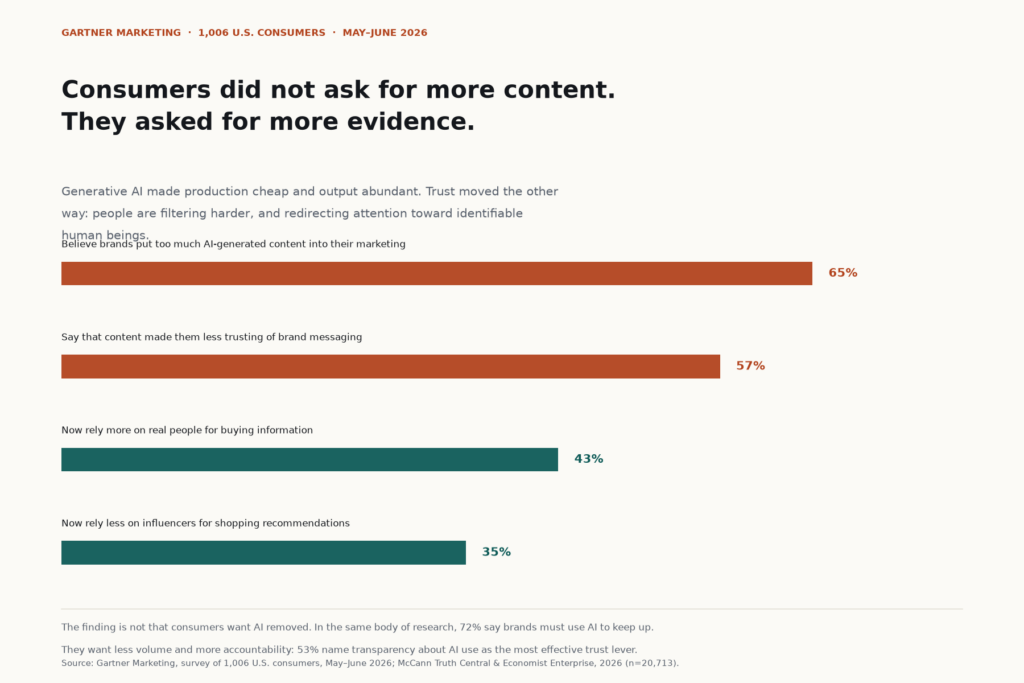
Sprout Social’s Q1 2026 survey of 2,250 users adds the behavioural coda: 88% say AI video tools have eroded their trust in social news, 66% are more selective than a year ago, and half of Gen Z have already blocked, muted, or unfollowed a brand because its content felt like slop.
Sit with that. The cheapest content in history is being actively screened out by the audience it was made for.
Which means the thing that cannot be generated — a track record, a named person standing behind a claim, a promise kept twice — is the only thing left with a moat. You can prompt a headline. You cannot prompt a reputation.
The Paradox That Isn’t
Here is where most trust writing starts contradicting itself, so let me walk into it deliberately.
Gartner found that 50% of consumers would rather give their business to a brand that uses no generative AI in customer-facing content. McCann found that 72% of consumers say brands must use AI to keep up.
Both are true, and the apparent contradiction dissolves on contact with the details. Read what people actually object to. Only 11% of B2B decision-makers said avoiding AI altogether helps build trust. Fifty-three percent said the most effective trust lever is transparency about AI use. Forty-five percent said brands should help them tell what is real from what isn’t. Canva found 68% don’t mind AI in ads at all if the output is genuinely useful or relevant.
Nobody is asking you to hand-write your copy by candlelight. They are asking you to stop shipping volume you would not defend in person. The objection is not to the tool. It is to the absence of anyone accountable for what the tool produced.
And the audience is now equipped to check. By the end of 2025, only 27% of consumers said they judge whether information is true by intuition. The rest have moved to verification — checking sources, comparing claims, looking for proof points. A brand that gestures at evidence is competing in a market that has learned to go looking for it.
When the Click Itself Disappears
There is a second reason to move, and this one is not philosophical at all: the metric is being dismantled underneath you.
Pew Research Center tracked 900 US adults and 68,879 real Google searches in March 2025. When an AI summary appeared above the results, users clicked a traditional result link in 8% of visits. Without a summary, they clicked in 15%. Of the 12,593 searches that produced a summary, 1% ended with a click on a citation inside the summary itself. Twenty-six percent of sessions simply ended there, against 16% without a summary.
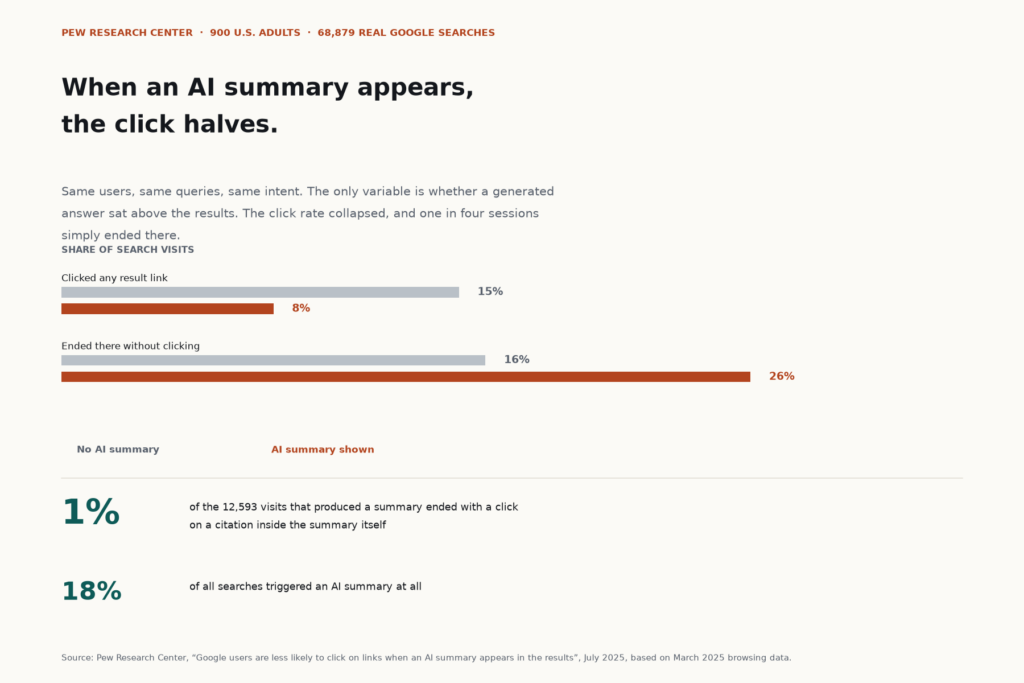
If your growth model assumes a click, you now need roughly twice the impressions to buy the same number of them — from a system that is increasingly answering the question itself. Optimizing harder against a shrinking denominator is not a strategy. It is a treadmill with better reporting.
The Evidence Against Me
I would rather make this argument honestly than make it easy, so here is the part most trust evangelism skips.
First objection, from the most rigorous school in marketing. The Ehrenberg-Bass Institute, working from decades of panel data, argues that growth comes from penetration rather than from deepening affection. Big brands have more buyers; their buyers are only marginally more loyal than small brands’ buyers. On that reading, the lever is mental and physical availability — be easy to mind and easy to find. Loyalty, in the strong sense most of us imagine it, is largely a story we tell about purchase data.
Second objection, from the data I just used. Gartner’s search research complicates my own click-disappearance argument. Only about a third of consumers think GenAI chatbots are as good as search engines for learning something new. Thirty-one percent say AI summaries make them spend more time searching; only 16% say less. More than two thirds keep browsing after reading an AI Overview. The summary is not the end of the journey — it is an additional toll gate on it.
Third objection, to the industry’s favourite statistic. The most quoted trust number in marketing — a 5% retention gain producing 25% to 95% more profit — traces back to a thought experiment, not a panel study, and it rests on assumptions about retention cost that later research has questioned hard. People quote it anyway, which tells you something about how badly this field wants a tidy number.
So no: trust is not a magic variable that outranks availability, distribution, and price. Any version of this argument that claims otherwise is selling you something.
Here is the version I will defend. Trust is what makes availability pay. Reach a buyer who has never heard of you and you have bought one exposure. Reach a buyer who has already decided you are the safe choice and you have bought a preference that survives the next price war. Penetration determines how many people can buy. Trust decides what happens when two options are equally easy to find and equally well priced.
“You Can’t Run a Business on a Feeling”
This is the objection that ends most trust conversations in real conference rooms, and it deserves a real answer.
It is true that leadership needs numbers. It is also true that trust has legible proxies: repeat purchase rate, cohort retention, referral as a share of acquisition, opt-in growth, share of search, complaint intensity, and — the one nobody likes — the share of customers who will pay a premium without being discount-led into it. All of them lag. All of them are noisy. None of them are impossible.
Then the second objection: clicks pay for the brand work. Also true. Performance marketing funds the long game. But that is an argument for balance, not for optimization on the funding mechanism. Fund the asset with the mechanism. Do not confuse the two. The mechanism is how you pay for the asset; the asset is what you are actually building.
What Optimizing for Trust Actually Looks Like
Five moves. None of them is a campaign.
Change what sits at the top of the scorecard. Not “we want more traffic” but “we want to be the brand people believe over the cheaper alternative.” Then track the leading indicators of that belief: retention by acquisition cohort, referral share, opt-in growth, unprompted mentions, and pricing power measured as realized premium rather than discount depth.
Treat honesty as a growth tactic, not a compliance function. Under-claim. Deliver slightly more than the copy promised. Correct yourself publicly the one time you get it wrong. These behaviours are unglamorous, they will never win a creative award, and they are the only known mechanism for compounding trust. Click-chasing forbids all three, because all three lower this month’s conversion rate.
Demote the click to a diagnostic. Clicks answer a mechanical question: did the page load, did the offer make sense, did the button look clickable. That is genuinely useful information. It is not a definition of success. Use clicks to debug. Stop using them to declare victory.
Run a trust test before every optimization. “Should we make the CTA more aggressive?” is not a performance question. It is a question about what you are willing to spend. Add one line to the pre-launch checklist: does this earn trust or borrow it? Borrowing is sometimes correct. Borrowing without knowing you borrowed is how brands end up in a spiral they cannot name.
Budget for the lag. Trust pays out after the reporting period that will be used to judge you. So build the case in the language finance already respects: cohort economics, retention curves, realized price premium, and the cost of customers you no longer have to buy a second time. If you cannot fund patience, you will not have any.
The Scoreboard You Should Actually Use
| What you used to watch | What it was a proxy for | What to watch instead |
|---|---|---|
| Click-through rate | Attention | Search volume for your brand name |
| Cost per click | Efficiency of purchase | Realized price premium vs. category |
| Session duration | Interest | Repeat purchase by acquisition cohort |
| Conversion rate this week | Intent | 90-day retention of new customers |
| Impressions | Reach | Share of unprompted mentions |
| Engagement rate | Relevance | Complaint intensity and resolution time |
Not one of these is as satisfying as a rising CTR on a Monday morning. That is the point. The satisfying metric is usually the one that was easy to game.
What This Costs You
Intellectual honesty requires admitting the price.
Optimizing for trust is slower, less visible, politically harder to defend, and it will lose you arguments with people holding better-looking dashboards. It also asks you to accept an uncomfortable possibility: that some of the growth you reported last quarter was rented, and the rent is now due.
Most organizations will not make this trade. They will keep optimizing the 11%, keep halving their own reach, and keep wondering why the efficiency numbers look excellent while the business does not.
The Cause and the Effect
Marketing’s great self-deception was never that it chased clicks. It was that it swapped its actual goal for a measurable one, then forgot the swap had happened.
The reorientation is simple to state and hard to execute: stop optimizing for what the dashboard can count, and start optimizing for what the customer actually feels. Trust is the cause. The click is downstream of it, and increasingly, the click is not even there.
Build the cause — patiently, consistently, and slightly against the grain of your own reporting — and the numbers you stopped chasing will find you anyway. They always do. Just not this quarter.