Why Your AI Bill Rose While the Price Fell 280 Times
Somewhere in the last eighteen months, marketing stopped buying software and started buying work.
That sounds like an upgrade, and in most ways it is. But it comes with a bill that behaves nothing like a licence fee, and almost nobody in a marketing department was trained to read it. You used to know what a tool cost before you used it. Now the cost arrives after the fact, in units you never chose, priced by a model you will probably swap out within a year.
A word of warning before we go further: this is not another “AI is expensive” piece. The opposite is happening. AI has become remarkably, almost absurdly cheap per unit. The problem is that the unit is not the thing you buy.
What a token actually is, in plain terms
A token is the smallest chunk of text a model reads or writes. In English, it lands at roughly four characters, or about three-quarters of a word, so a thousand tokens is around 750 words. “Marketing” may split into two tokens. A comma costs something. A stray space costs something.
You pay twice for every exchange. There are input tokens, which is everything you send: your prompt, your retrieved documents, your conversation history, your system instructions, the tool definitions you attached. Then there are output tokens, which is what the model produces. On almost every price list, output costs several times more than fresh input.
Here is where it gets strange. A prompt is not a message you send once. In any conversation or agent loop, the entire history is re-sent on every single turn, because the model has no memory between calls. A twenty-turn session does not cost twenty times one turn. It costs closer to twenty times an average of a growing pile. The context is the bill.
The strangest price chart in technology
Now look at what has happened to the price of that unit. Stanford’s AI Index recorded the cost of running a system at GPT-3.5 level of capability falling from roughly twenty dollars per million tokens in November 2022 to about seven cents by October 2024. That is a decline of more than 280 times in under two years.
Epoch AI, an independent research institute, pushed the measurement further and got a cleaner answer, because they stopped measuring price per token and started measuring the cost of achieving a fixed result. Across five benchmarks in maths, science and games of skill, the cost of a given level of AI performance has fallen roughly 47 percent per quarter since 2023, which compounds to about thirteen times a year. Their comparison set is brutal: that is about four times faster than DNA sequencing got cheaper, six times faster than computing, eighteen times faster than lithium batteries, and, over the century to 1973, fifty-four times faster than electricity.
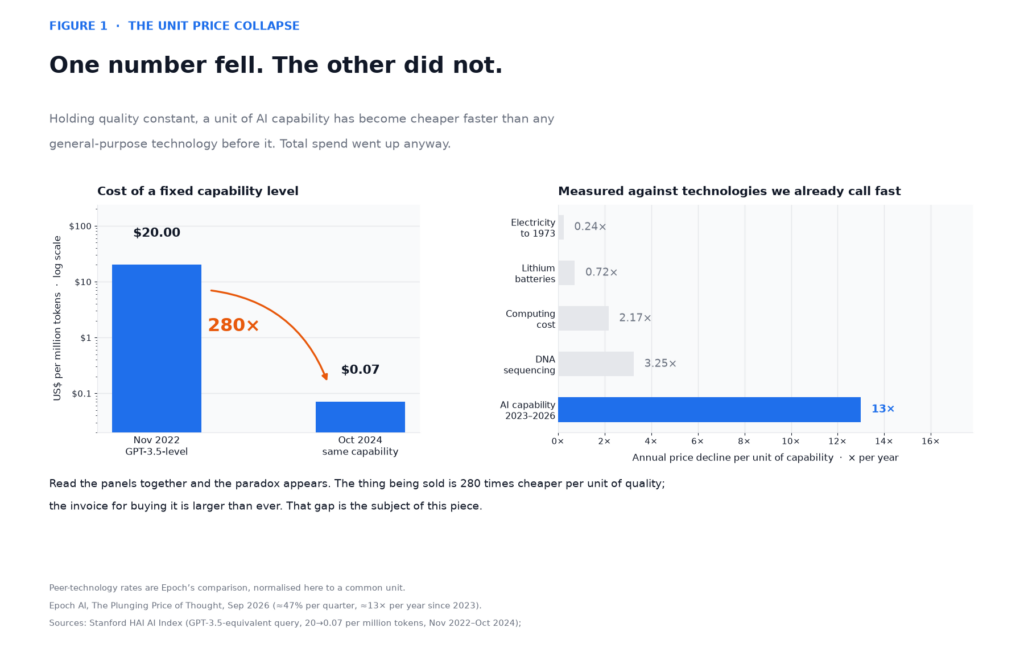
So the input is getting cheaper at a rate no other general-purpose technology has managed. Which makes the next number genuinely hard to sit with.
Gartner’s September 2026 forecast puts worldwide AI spending at 2.67 trillion dollars for the year, up 49.5 percent on 2025, with 3.64 trillion projected for 2027. Menlo Ventures, surveying close to four hundred US enterprise decision-makers, estimates enterprise AI deployment spend reached 176.8 billion dollars by September 2026, roughly 5.4 times the prior year. And the detail that should make a CMO sit up: the average enterprise planned to grow AI spend about 1.9 times. It grew 4.7 times.
Why the bill went up while the price went down
The tidy explanation is that usage grew faster than price fell. True, but too vague to act on. The real explanation is that the shape of a task changed, and the shape is what you are actually paying for.
In 2023 a typical AI interaction was one prompt, one answer, a few thousand tokens, one model call. Cheap, bounded, predictable. By 2026 the same business outcome runs through an agent: it plans, retrieves context, calls a tool, reads the result, re-plans, checks its own work, and occasionally starts over. Twelve model calls for a single user-level task is ordinary.
Menlo’s data on OpenRouter, a platform that routes traffic across hundreds of models, shows agents now account for 80 percent of all tokens processed there, roughly seven times human-driven usage. Since agent traffic first overtook human traffic in early February 2026, it has grown 37-fold. Spending stopped tracking seats and started tracking work.
The multiplier stack: how one prompt becomes a thousand
This is the part that price lists never show you, because a price list is quoted per token and a bill is generated per task.
Gartner’s modelling puts agents at five to thirty times the tokens of a standard chatbot for an equivalent task. Goldman Sachs Research, in its May 2026 work on what it calls the agentic economy, draws the tiers more sharply. A typical chatbot session consumes around a thousand tokens. An embedded copilot might clear five thousand a day. An always-on agent that monitors, verifies and re-reads its own context can pass a hundred thousand tokens a day.
Then there is the extreme case. A systematic study of token consumption in agentic coding, led by Longju Bai at Michigan with co-authors from Stanford, MIT, Microsoft and Google DeepMind, found these tasks consuming roughly a thousand times the tokens of ordinary code reasoning or code chat. In their words, agentic tasks are uniquely expensive.
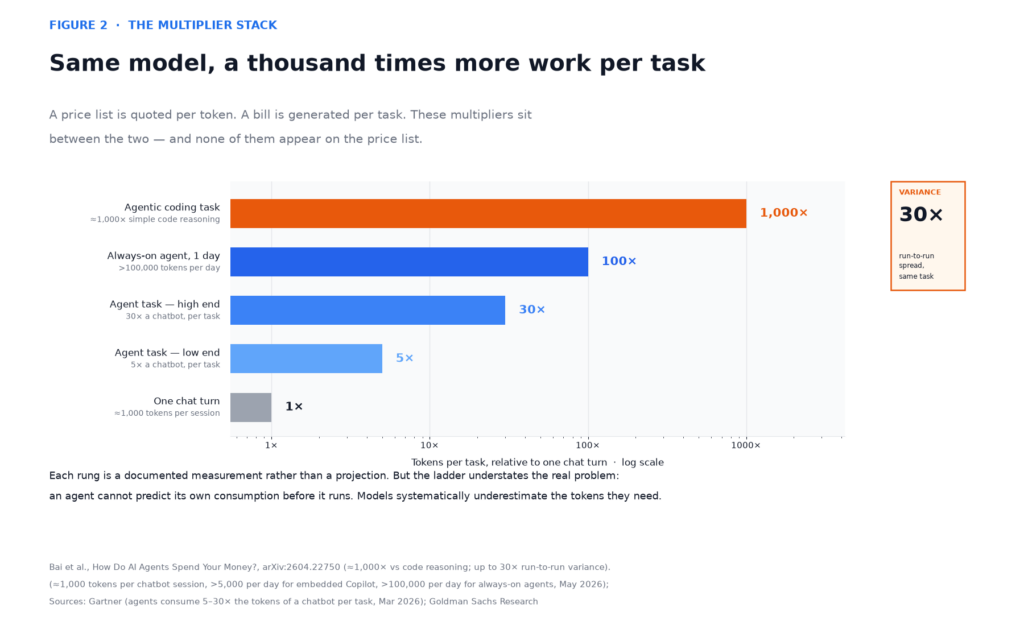
And here is the finding that should end any remaining faith in budget forecasts. In the same study, runs on the same task, with the same model, differed by up to thirty times in total tokens. Token usage turned out to be highly variable and inherently stochastic. More tokens did not buy better results either: accuracy peaked at intermediate cost and saturated or declined beyond it. The models could not predict their own consumption before running, and systematically underestimated it.
That last sentence deserves a second read. The thing generating your bill is also the thing least able to forecast it.
Where marketing actually sits in all this
Marketing has a specific and slightly awkward position in this economy. It is token-hungry, it is highly repetitive, and its output quality is genuinely hard to verify. Coding has compilers and tests. Marketing has a brand team arguing about a headline at 6pm.
The evidence is already in the trade press. IBM’s 2026 ACAM Australia benchmark, built on responses from 126 CMOs, produced a phrase that has stuck: jackhammer AI syndrome. Marketers reaching for frontier models to solve simple problems. As ACAM co-founder Douglas Nicol put it, you are using a jackhammer to open a walnut, and your token burn rate climbs through the year. He added that CFOs are already asking about the bills.
A Coca-Cola campaign, according to the agencies that built it, ran on about seventy thousand individual prompts and millions of tokens. Not because anyone was wasteful, but because that is what iteration at creative scale looks like when every iteration is metered.
The unit economics, taken one driver at a time
Four levers move a marketing token bill. They are not equally important, and the biggest one is usually ignored.
Model tier. Frontier models cost multiples of smaller ones. Anthropic’s Opus line moved from 15 dollars per million input and 75 per million output to 5 and 25 when Opus 4.5 shipped in November 2025, a two-thirds cut, and then to 4 and 20 with Opus 5.5 a year later. That is real progress. But the same company will sell you a Haiku-class model at a tenth of that, and most summarisation, classification, reformatting and first-draft work does not need the flagship.
Context length. This is where marketing quietly bleeds. Pasting a full brand book, a campaign brief, a transcript and a competitor teardown into every call means paying for all of it on every turn. Long context is not free storage. It is a recurring charge.
Output volume. Output is the expensive side of the meter almost everywhere. Generating twelve headline variants, four long-form drafts and a landing page rewrite multiplies the priciest token class.
Agent loops and cache behaviour. This is the one that separates a 700,000 dollar bill from a 70,000 dollar one at identical task volume. More on it below.
The one number that changes how you should budget
Prompt caching is the most under-used lever in marketing AI, and the arithmetic is unusually clean.
When you cache a stable prefix, a system prompt, a set of tool definitions, a fixed policy document, you pay a premium once to write it, then a fraction of the input rate to read it on every subsequent call. On Claude Opus 5.5, list prices are 4 dollars per million fresh input tokens, 5 dollars to write a five-minute cache, and 20 cents to read from it. Output stays at 20 dollars regardless, so caching does nothing for you if your problem is long answers.
Run the numbers on a single prefix shared across N calls. Uncached, N calls cost 4N dollars per million. Cached, it costs 5 plus 0.2 times (N minus 1). Break-even lands at about 1.26 calls, which in practice means: if the prefix is ever read back even once, caching it was correct. In steady state, with caches expiring and prefixes being edited, the break-even is a cache hit rate of roughly 21 percent. Below that, caching costs you money.
Now scale that logic to the whole workload. Menlo reports that in agent traffic, cache reads can make up 95 percent or more of all tokens, and at a mix of 3 percent fresh input and 2 percent output, an agent session blends down to around 70 cents per million tokens. The same model, priced at 20 dollars for output and 4 for input, produces a blended rate 24 times lower purely because of workload shape.
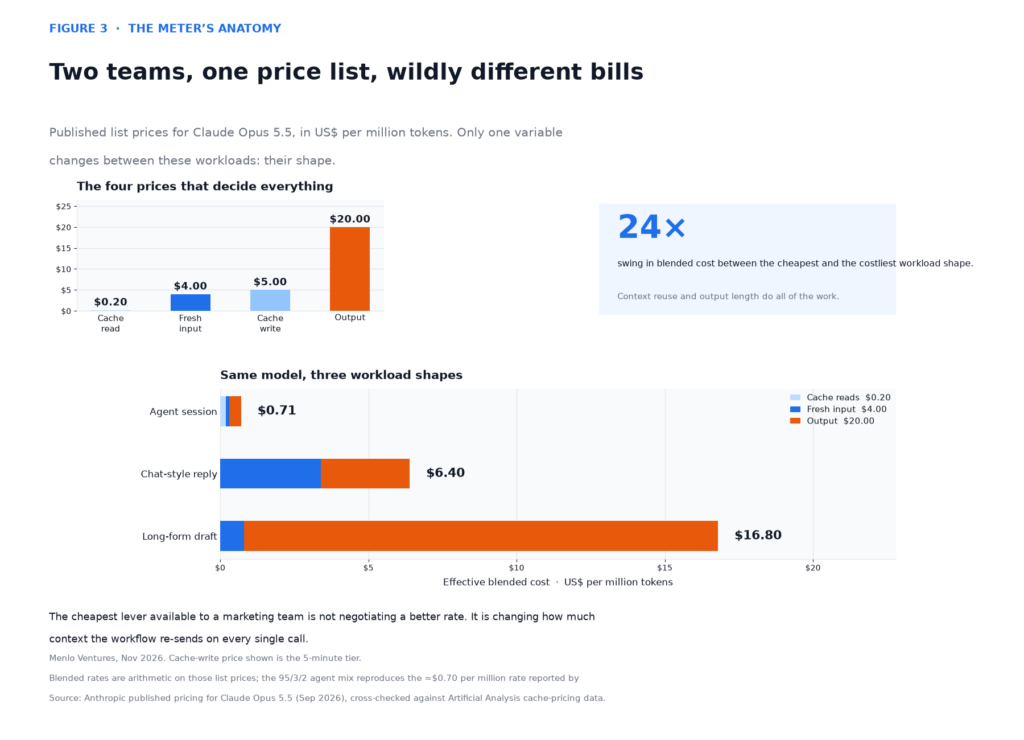
Read that again. The cheapest lever available to a marketing team is not renegotiating the rate card. It is changing how much context the workflow re-sends on every call.
The token-efficiency playbook, for people who are not engineers
- Right-size the model to the task. Classification, tagging, summarisation, reformatting, extracting a brief from a transcript: none of these need a flagship. Reserve the frontier tier for strategy synthesis, creative direction and anything a client will read twice.
- Audit your prompts for dead weight. A prompt carrying three thousand tokens of background it never references is a subscription to that background. Lean prompts cost less and frequently perform better, because the model is not asked to sift.
- Cache everything stable. System prompts, brand guidelines, tone-of-voice documents, tool schemas. Structure the workflow so the stable part sits first and never changes mid-session. Change one character in a cached prefix and the whole cache is void.
- Cap the loops. Set a maximum number of tool calls or re-planning steps per task. Agents that keep going do not get better, they get dearer: accuracy plateaus while cost climbs.
- Meter the meter. Treat AI spend as a utility line with an owner, an alert threshold and a monthly reconciliation. Gartner found 41 percent of organisations running consumption-based martech have built or are building real-time usage controls, and roughly half keep renegotiating contracts to head off spikes. A quarter are re-engineering systems specifically to consume less. These are not paranoid teams. They read an invoice.
What the meter does to agency economics
Something structural is happening in client-agency pricing, and token costs are the reason.
Historically, 60 to 70 percent of an agency’s operating cost was labour, and labour never appeared inside a CPM because nobody metered a human. AI labour is metered by construction, down to the fraction of a cent. For the first time, the thinking half of a campaign carries a directly attributable, auditable unit cost.
Agencies are splitting three ways on what to do with it: pass it through as a production cost, absorb it as overhead, or bundle it into a platform subscription priced per generation. None of these is obviously right, and a holding company offering to absorb a client’s entire AI infrastructure bill in exchange for routing a majority of media spend through principal inventory is not generosity. It is margin management in a new costume.
The practical consequence for marketers is simple. When your agency says AI made the work cheaper, ask which part got cheaper and who received the difference. Efficiency that never reaches the invoice is not efficiency you bought.
Three things that will decide the next two years
Price keeps falling, and it will not save you. Gartner projects inference on a trillion-parameter model costing providers more than 90 percent less in 2030 than in 2025. Goldman Sachs expects per-token compute cost to keep falling 60 to 70 percent a year. Both firms say the same thing about what that means for your budget, which is: nothing good. Gartner’s analyst Will Sommer puts it as a warning against confusing the deflation of commodity tokens with the democratisation of frontier reasoning.
Volume is the variable that wins. Goldman projects token consumption rising 24-fold by 2030 to about 120 quadrillion tokens a month, with roughly 30 percent of daily AI queries run by agents. If unit price falls 10 times and volume rises 24, the bill goes up.
Orchestration becomes the skill. The winning architecture is not one model. It is a router: cheap models for the 80 percent of work that is routine, frontier models gated behind genuine need, caching in front of everything repetitive. Gartner’s framing is blunt. Teams that mask architectural inefficiency with cheap tokens today will find agentic scale elusive tomorrow.
What to do on Monday
Pull three months of AI invoices and split them by workflow, not by vendor. You will find that a small number of workflows account for most of the spend, and that at least one of them is running a frontier model on a task a small model handles.
Then, for each of those workflows, ask four questions. Which model tier does this actually need? How much of the context is stable and therefore cacheable? What is the maximum number of steps this loop should be allowed? And who owns the number if it doubles next quarter?
Answer those and you have something most marketing departments still do not: a cost model that survives contact with an agent.
The takeaway
AI is no longer a subscription. It is a utility, metered by consumption, priced per unit, and governed by the same law that governs every metered resource: the people who measure it pay less for the same output than the people who do not.
The uncomfortable part is that the meter does not reward enthusiasm. It rewards shape. Two teams can use the identical model at the identical rate and receive bills that differ by an order of magnitude, because one re-sends forty thousand tokens of context on every turn and the other cached it once.
The brands that win the next phase will not be the ones that use the most AI. They will be the ones that get the most out of each token, and know which tokens were worth spending.