Marketing Ops in 2026: The Function That Turned Marketing Into a System
There is a Slack channel in almost every mature marketing organisation that you have never been invited to. It is where the UTM taxonomy gets argued over, where a broken lead-routing rule gets traced back to a field someone renamed in March, where the number that appears in the board deck gets reconciled against the number in the CRM. Nobody outside the channel knows it exists. Everybody outside the channel depends on it.
That channel is marketing operations. And the strange thing about the function is that its success is measured precisely by how little you notice it.
For most of the last decade, marketing ops was the team you called when the CRM broke. Today it is the team that decides whether your AI pilots produce anything, whether your attribution survives scrutiny, and whether the marketing organisation can answer a CFO’s question in under a week. The job title hasn’t changed much. The job has.
The Department That Fixed the CRM and Ended Up Owning the P&L Path
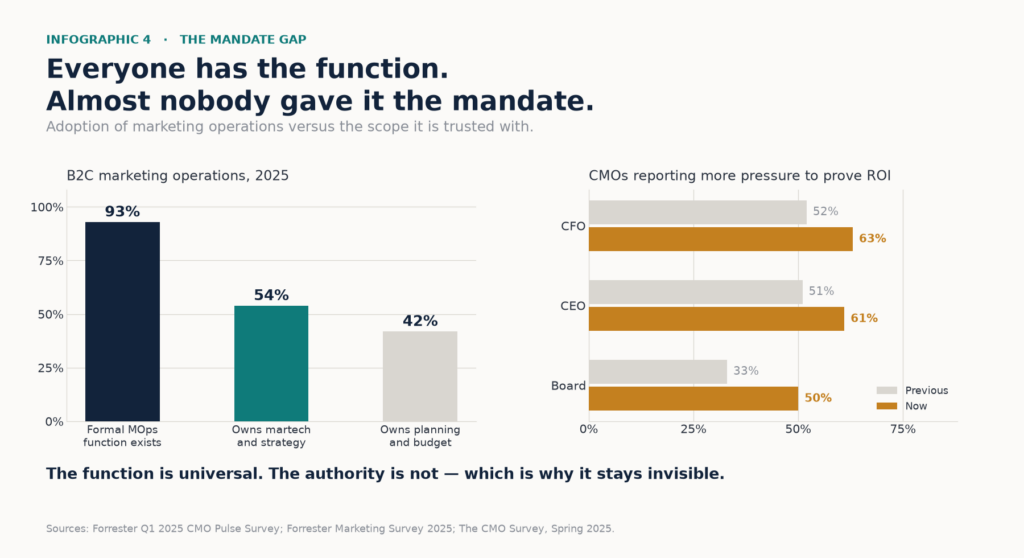
Start with the adoption number, because it reframes everything else. Forrester’s Q1 2025 CMO Pulse Survey found that 93% of VP-and-above B2C marketing and advertising decision-makers say they have a formal marketing operations function. Not a person who does it on the side. A function.
So the argument that marketing ops is “emerging” is over. It emerged. The interesting question now is what it is actually allowed to do — and there the numbers get much less comfortable. In Forrester’s Marketing Survey 2025, B2C marketing operations functions were mainly responsible for marketing technology and strategy management at 54%, and for planning and budget management at 42%. Which means the function exists almost everywhere, but is trusted with the full scope in something closer to half of organisations.
That gap between existence and mandate is the real story of the function in 2026. It’s also the reason so many marketing ops leaders feel like they’re running a data centre for a company that keeps calling it a help desk.
What Marketing Ops Actually Owns
Strip away the job descriptions and marketing ops owns one thing: the operating system of marketing. Not a campaign. Not a channel. The conditions under which every campaign and every channel either works or doesn’t.
Concretely, four pillars.
Pillar one: data and measurement
Collection, hygiene, identity resolution, governance, attribution modelling, reporting, forecasting. This is the layer that turns activity into evidence. When someone asks “did that work,” the answer comes from here — or it doesn’t come at all.
Pillar two: technology and integration
Stack architecture, tool selection, consolidation, integration health, access and permissions. The discipline of making twenty systems behave like one system, which is roughly as easy as it sounds.
Pillar three: process and workflow
Planning cadence, approval chains, SLAs, handoffs between brand, performance, product and sales. The operational rhythm. Unglamorous, and the difference between a team that ships and a team that meets about shipping.
Pillar four: efficiency and scale
Automation design, friction removal, enablement, cost per outcome. This is where the function stops being infrastructure and starts being leverage.
Notice what’s missing from that list: creative. Notice what’s also missing: the actual campaigns. Marketing ops is the only function in marketing whose job is the health of the whole system rather than the success of one part of it. That’s a genuinely unusual remit, and it explains both why the function is so valuable and why it is so easy to under-resource. Nobody gets promoted for the absence of an incident.
Why the Function Rose: Five Forces
The elevation of marketing ops wasn’t a strategic choice anybody made. It was a series of forces that converged on one team because no other team was standing in the right place.
Force one: the stack stopped being a stack
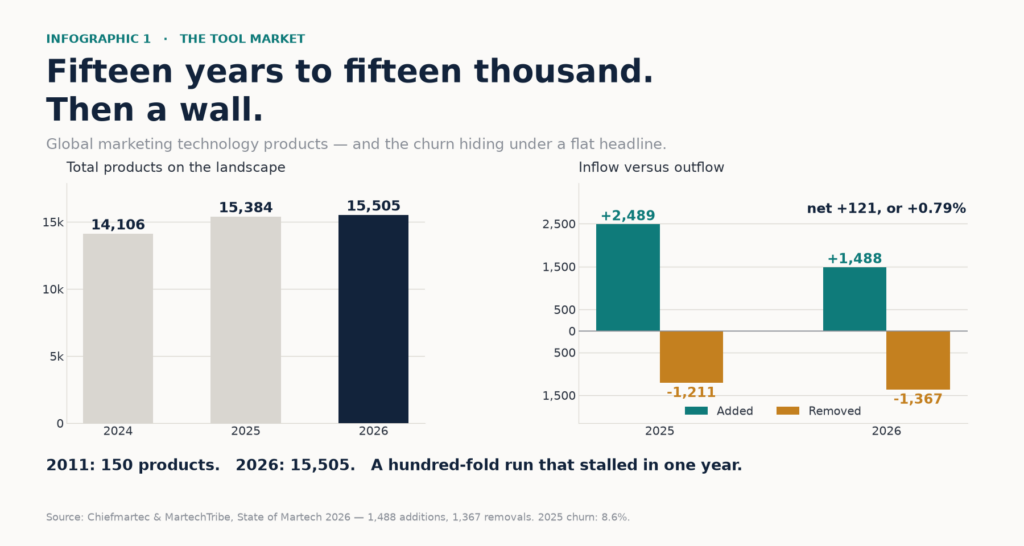
The 2026 martech landscape counted 15,505 products, up 121 from 15,384 — growth of 0.79%, the first time in fifteen years the curve has effectively flatlined. That flat headline hides something more violent: 1,488 products were added and 1,367 were removed in the same year. Inflow fell 40% year on year; outflow rose 13%.
Behind that churn sits an even more awkward fact. Average companies run somewhere in the neighbourhood of 275 SaaS applications, and enterprises around 660, according to Zylo’s SaaS data cited in the State of Martech research. Somebody has to own that. Not “own” in the sense of having purchased it. Own it in the sense of knowing what connects to what, what’s duplicated, what’s quietly rotting, and what breaks downstream if you turn it off.
That somebody is marketing ops, whether or not the org chart says so.
Force two: data became a governance problem, not a reporting problem
Gartner’s long-standing benchmark puts the cost of poor data quality at an average of $12.9 million a year per organisation. That number is old enough that you’ve probably seen it a hundred times, and it undersells the current problem. Bad records used to sit in one database and annoy one analyst. Now a single bad record propagates through APIs into every connected system, and then into a model, and then into a decision.
Data quality stopped being a hygiene task and became a risk function. Risk functions need an owner. Marketing ops became that owner by default.
Force three: signal loss rearranged the plumbing
Here’s where most 2026 commentary gets it wrong, so it’s worth being precise. The widely predicted cookie apocalypse did not arrive on schedule. In April 2025, Google confirmed it would keep third-party cookies in Chrome and would not roll out a standalone prompt for them.
And yet the measurement problem got worse anyway, because the losses came from somewhere else. Apple’s tracking transparency changes cut off a large share of mobile signal years ago. In-app browsers fragment the rest. Consent rates vary wildly by market. And most consequentially, a growing share of research now happens inside AI assistants, where there is no click, no session, no keyword path, and nothing to tag.
You can’t replace a cookie with a better cookie when the underlying behaviour has moved somewhere cookies never reached. What you need instead is a different measurement architecture — modelled, triangulated, governed. Building that is marketing ops work. There is no other team with the plumbing knowledge to do it.
Force four: AI needed an owner who wasn’t the content team
Gartner’s 2026 CMO Spend Survey found CMOs allocating an average of 15.3% of marketing budgets to AI, while only 30% report mature or fully developed AI readiness. Seventy per cent call becoming an AI leader a critical 2026 goal. The same seventy per cent admit their internal marketing processes aren’t mature enough to implement it.
Read those two sentences together and you have the entire problem. The money moved before the foundations did. And foundations — data, permissions, workflows, governance, integration — are not the content team’s remit. They’re the operating system’s remit.
The organisations that are further along prove the point. Gartner found that AI-ready marketing organisations allocate 21.3% of budget to AI and carry larger budgets overall at 8.9% of company revenue, against a 7.8% average. They aren’t spending more because they’re richer. They’re spending more effectively because someone built the plumbing first.
Force five: the CFO moved into the room
In the Spring 2025 CMO Survey from Duke’s Fuqua School, Deloitte and the AMA, 63% of marketing leaders reported increased pressure from the CFO, up from 52%. Sixty-one per cent faced more scrutiny from the CEO, up from 51%. Half reported more pressure from the board, up from 33%.
Their single biggest stated challenge: demonstrating the impact of marketing on financial results.
That’s not a creative problem. That’s a measurement architecture problem wearing a creative problem’s clothes. And when the pressure lands, the function that built the attribution model is the function holding the answer.
The Numbers That Explain the Anxiety
If marketing ops is now central, why does it still feel fragile? Because the economics of the stack it manages are genuinely bad, and the function gets blamed for arithmetic it inherited.
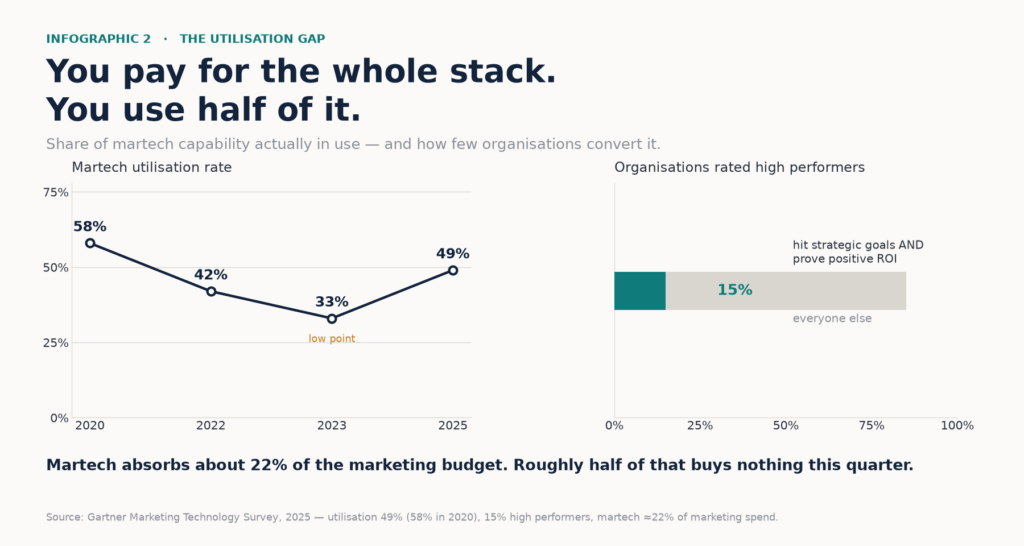
Gartner’s 2025 Marketing Technology Survey found martech utilisation at 49% — meaning roughly half of the capability you pay for is not being used. For context, that figure sat at 58% in 2020, fell to 42% in 2022, hit a low of 33% in 2023, and has partially recovered. Only 15% of organisations qualify as high performers: the ones that meet strategic goals and demonstrate positive ROI.
Martech absorbs about 22% of the marketing budget. So for a mid-sized company spending $2 million on marketing, roughly $440,000 goes into software and about half of it buys nothing this quarter.
That’s the paradox marketing ops lives inside. The function is judged on the efficiency of a system whose inefficiency was decided before the function had a vote.
From Order-Taker to Co-Strategist
The shift in the function’s standing is real, but it’s uneven, and it’s worth describing honestly rather than aspirationally.
The old model: marketing ops receives a request, builds the report, fixes the tool, closes the ticket. The new model: marketing ops sits in the planning conversation because the plan is now constrained by what the data can actually support and what the stack can actually execute.
What forces the shift isn’t ambition. It’s that strategy and infrastructure have become the same conversation. You cannot decide to “go after mid-market” without deciding whether your identity resolution can see mid-market accounts, whether your routing rules will misassign them, and whether your attribution will credit the right touch. The strategic choice and the operational consequence are one decision, split across two meetings.
Marketing ops also occupies a position no other function can: it’s the only team with a legitimate reason to talk to brand, performance, product, sales and finance in the same week, about the same numbers. That connective role is the function’s real source of influence — not technical skill, which can be hired, but cross-silo literacy, which cannot be bought.
And there is a talent signal worth noting. In the MarketingProfs and MarketingOps.com State of the Marketing Operations Professional research, 81% of practitioners named integration with existing technology as their top criterion for evaluating new martech — nearly double the next factor. That tells you what the job actually is. It isn’t buying tools. It’s making them coexist.
The Context Layer Nobody Put on the Org Chart
Here’s the part of the function that most organisations haven’t staffed yet, and it’s the part that will decide who’s competitive in 2027.
Scott Brinker’s State of Martech 2026 frames the shift as martech platforms turning from applications humans operate into infrastructure agents can use. The evidence is hard to argue with: over 29,000 MCP servers appeared in roughly eighteen months, and major platforms from Adobe to HubSpot to Snowflake have shipped or announced agent-facing interfaces. In the last era, martech competed to be where marketers worked. In the next, it competes to be what agents can work with.
Which raises a question marketing ops is uniquely positioned to answer: when an agent acts on your behalf, what is it allowed to see, and what is it allowed to do?
Brinker’s answer is context — customer context, company context, and systems context, converging into what the report calls Golden Context. That’s a strategic idea, but the work of producing it is operational. Permissions. Data lineage. Content governance. Consent state. Which system has the authoritative version of a customer’s history. Whether the brand rules are machine-readable or sitting in a PDF nobody opens.
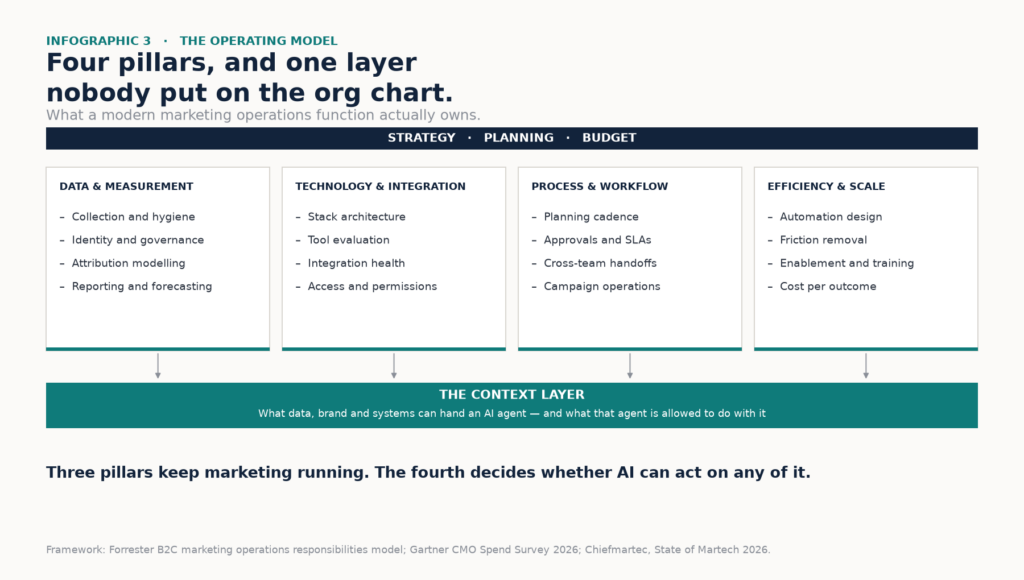
This is why the function’s fourth pillar — efficiency and scale — matters more than it sounds. It isn’t about squeezing cost. It’s about whether your stack can be handed to something that doesn’t read Slack and can’t ask a clarifying question.
Where Marketing Ops Gets It Wrong
Four honest failure modes. All of them are structural, not personal.
The invisibility paradox
The function is at its most valuable when nothing goes wrong, which is exactly when it’s easiest to cut. Practitioners report this consistently: the State of the Marketing Operations Professional research recorded engagement declining for a third consecutive year, alongside falling scores for fair compensation, role understanding, and feeling valued. Being indispensable and being recognised are not the same thing, and the gap has a cost — 56% of practitioners said their organisations don’t provide adequate training and development, which is a slow way to lose the only people who understand the plumbing.
The tool-proliferation trap
When you own the stack, every new tool arrives as your problem to integrate. Resist becoming the curator of waste. The 62.1% of respondents in the 2025 State of Your Stack survey who reported using more tools than two years earlier are not a healthy market signal; they’re a warning. Owning a bloated stack is not the same as owning a capability.
Process as an end rather than an enabler
The most common way a good operations function goes bad: it optimises for the process instead of the outcome the process existed to produce. Approval chains lengthen. Governance becomes gatekeeping. The team gets excellent at running a system nobody wants to use. A test worth applying quarterly: name three decisions that got faster this quarter because of something you built. If you can’t, you built bureaucracy with better documentation.
Measurement fixation
Attribution is a tool, not a worldview. When the function’s entire legitimacy rests on what can be provably attributed, strategy drifts toward short-term, trackable activity and away from brand. Forrester’s 2026 predictions flag this directly: confidence in marketing measurement is expected to decline by 7%, with 79% of B2C marketing leaders confident in 2025 — and 2026 bringing politicised metrics, AI transparency concerns, and open-source marketing mix modelling that most brands lack the data culture to use well.
The mature position isn’t “prove everything.” It’s “know precisely which claims your data can support, and say so out loud.” That distinction is the whole job.
What Good Looks Like
A working model, not a maturity ladder.
Marketing ops reports into the CMO but holds a dotted line into finance, because the numbers have to survive two audiences. It owns a named budget line for the stack, which is visible and defensible rather than buried inside programme spend. It publishes a quarterly stack review with utilisation evidence, not a tool count. It holds decision rights over data definitions — one definition of “qualified,” one definition of “active,” enforced in code rather than in a wiki.
And it has a charter, written down, that states what it is accountable for and what it explicitly is not. The single fastest improvement most organisations can make is to stop asking the operations function to also be the analytics help desk, the webinar team, and the admin for four platforms.
A Ninety-Day Starting Point
If you’re the person who just inherited this, three moves, in order.
Weeks 1–4: instrument the truth. Pull actual utilisation data — logins, feature adoption, licence counts — for every tool in the stack. Not a vendor conversation. Your own numbers. Most organisations discover a quarter of the stack is dormant or duplicated, which tracks with Gartner’s ~50% figure and gives you your first credible sentence for the CFO.
Weeks 5–8: fix one definition. Pick the metric that causes the most arguments. Customer, qualified lead, active account — whatever it is. Define it once, encode it in the systems, and publish the definition with an owner and a change process. One enforced definition does more for cross-functional trust than a year of dashboards.
Weeks 9–12: document what an agent would need. For your top three AI use cases, write down what data, permissions, content rules and approval boundaries the system would require. You are not deploying agents in ninety days. You are discovering, on paper, whether your foundations could support one — and that document is the most useful artefact marketing ops can produce in 2026.
The Short Version
Marketing ops stopped being a support function the moment marketing stopped being a set of campaigns and became a system. The system is now too large to hold in anyone’s head, too expensive to run on intuition, and too exposed to be governed by whoever happens to be free on Thursday.
The 2026 numbers are not flattering. A market that grew a hundredfold in fifteen years has hit a plateau. Half of what organisations buy goes unused. AI budgets are running well ahead of the processes meant to absorb them. And marketing leaders are reporting more scrutiny from finance, more pressure from the board, and less confidence in their own measurement than a year ago.
But look at where the answers to all of those problems live. Utilisation is an operations problem. Data foundations are an operations problem. Measurement credibility is an operations problem. Agent-readiness is an operations problem.
The brands that get the next three years right will not be the ones with the largest stack or the loudest AI announcement. They’ll be the ones that finally gave the invisible function a mandate, a budget line, and a seat in the room where the plan gets made — and then stopped calling it support.