Why Loyalty Programmes Stall: The Funding Test Behind Every Reward That Dies
Every loyalty programme that fails is diagnosed as a creative problem. The rewards were boring. The UX was clunky. The messaging did not land. So the team redesigns the tier names, adds a spin-to-win wheel, and launches it again — and nine months later the programme is flat for the second time.
I would argue the diagnosis is looking in the wrong place. The thing that kills loyalty mechanics is not how the reward feels. It is which line item pays for it. And almost nobody runs that test before launch.
The incentive is rarely the problem
Think about what a reward actually is inside a company. It is not a gift. It is a cost with a name attached.
If that cost sits in the marketing budget, it entered the world through an approval process where it competed against every other campaign, and it will be judged in the next cycle by whether it beat the alternative. Which means a marketing-funded reward is permanently provisional. It is a discount wearing a governance structure.
If the cost comes out of an operating margin that already exists — a payment fee, a spread, a retained resale commission — then the reward is not competing with anything. It is spending money the business was previously handing to somebody else.
That is the whole mechanism. Not gamification. Not tier design. Funding source.
The ninety-day number is a funding symptom
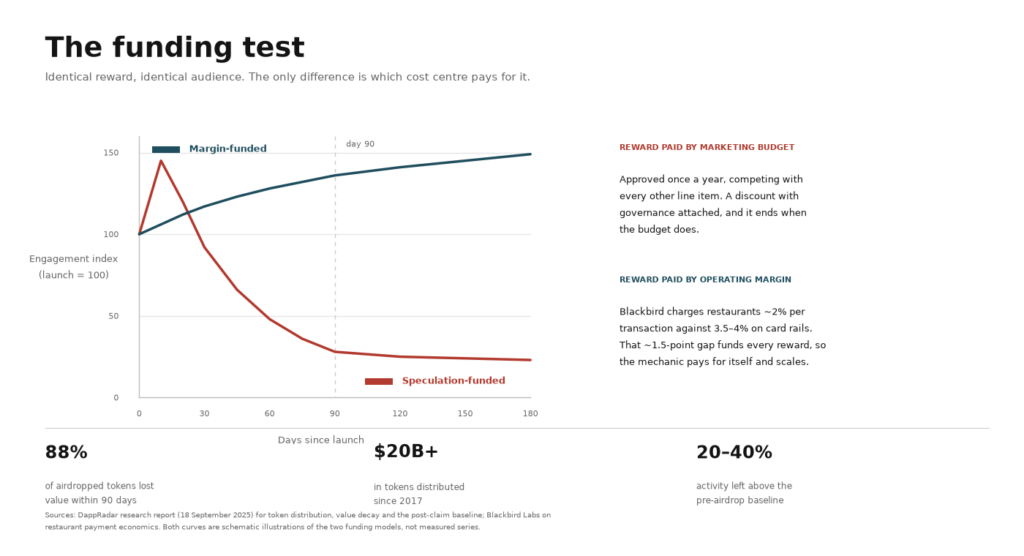
Here is where it gets uncomfortable. DappRadar’s September 2025 research found that 88% of airdropped tokens lost value within ninety days, and that user activity settled at only 20–40% above the pre-airdrop baseline once the claim window closed. More than twenty billion dollars has been distributed since 2017 to produce that pattern.
Most commentary treats this as a crypto problem. It is not. Any incentive funded by a marketing budget produces this exact curve, whether it pays in tokens, cashback, or free shipping. You buy a spike, you get a spike, and then you are back to your baseline minus the money.
The token version was just unusual in that the reward also had a visible price chart, so the decay was publicly auditable. With cashback, the same decay happens quietly.
What the survivors did differently
The clearest case is Blackbird, the dining app that is usually described as a crypto loyalty product. That framing is wrong in a way that matters.
Blackbird charges restaurants about 2% per transaction against the 3.5–4% that card processors typically take. That margin gap — roughly 1.5 points on every check — is where the rewards come from. The loyalty mechanic is funded by a cost reduction the restaurant already wanted. It is not asking the business to spend more; it is asking the business to route a payment differently and share the savings.
That is why it can scale to roughly a thousand restaurants without a per-market subsidy decision, and why it survived a downturn that would have ended a marketing-funded programme.
Compare the failure cases. Starbucks shut down Odyssey in March 2024 at roughly 58,000 active users, then rebuilt the underlying Rewards programme into a three-tier structure that now reports 35.6 million 90-day active members. The brand kept the mechanic and dropped the wrapper. Nike’s RTFKT spent its way into a class action. Flyfish sold access as an appreciating asset and paid a $750,000 SEC settlement.
None of those outcomes turn on technology quality. They turn on whether the value flowed from margin or from budget.
How to run the test on your own programme
Three questions, in order.
Name the line item. Not the department. The actual account the reward is debited from. If the honest answer is “marketing programs” or “growth experiments,” you have a programme with an expiry date.
Ask what cost it displaces. A good loyalty mechanic replaces something the customer or the partner was already paying. Shipping, processing, acquisition, resale leakage. If it displaces nothing, it is a transfer, and transfers show up on a P&L as pure expense.
Check whether it survives a flat budget. Not a cut — just flat. If your mechanic needs year-over-year budget growth to keep the same reward value, the mechanic is not self-funding; it is scaling-dependent, which is a different and worse thing.
The uncomfortable implication
If this test is right, then most loyalty strategy work is aimed at the wrong variable. Teams spend quarters on segmentation, reward calendars, and emotional messaging while the funding structure quietly determines the ceiling.
And there is a second-order consequence worth naming. Marketing-funded programmes have an incentive to over-report early engagement, because that is the only phase where the numbers look like success. That is not cynicism about marketers; it is what happens when a mechanic’s funding depends on a quarterly story.
The programmes that never needed the story are the ones still running.