Why ChatGPT Cites Your English Page to a Dutch Customer
Why AI answers reach for your English pages when the customer never asked for English
The observation that looks like a bug
If you run a multilingual site, you have seen it. A customer in Ghent asks ChatGPT a question in Dutch. The answer comes back in fluent Dutch, and the sources beneath it are in English.
The instinct is to call this a flaw. Barry, the model is lazy. But look at the server logs and a stranger story appears, one with a clear economic logic behind it, and one that tells you exactly where in the pipeline your leverage sits.
Where the preference actually enters
OpenAI runs three crawlers, and treating them as one obscures everything:
- GPTBot collects training data.
- OAI-SearchBot surfaces pages in ChatGPT’s search features.
- ChatGPT-User performs live retrieval when a real person asks a question.
The decisive finding is that neither bot picks a language at random. Each one is optimising for a different objective.
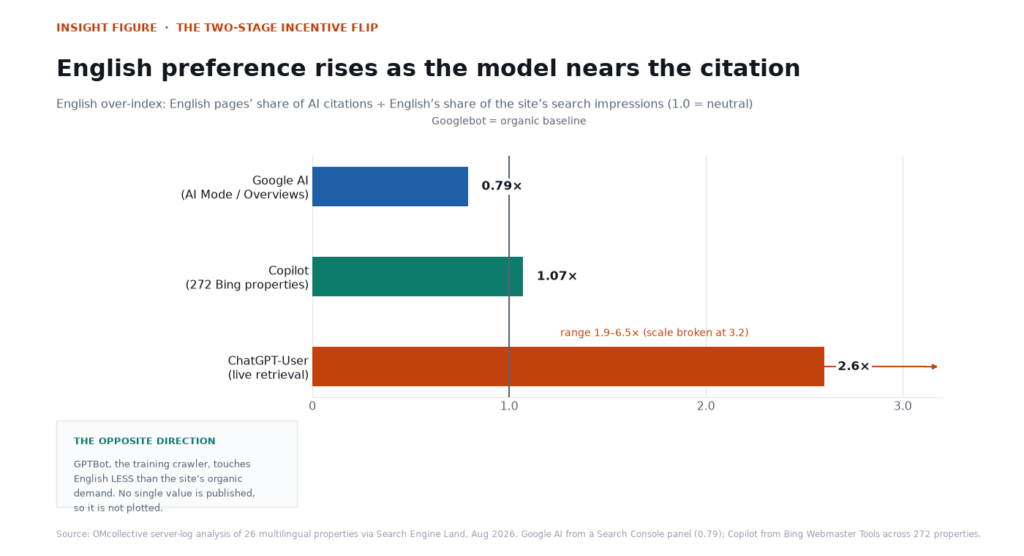
GPTBot, the training crawler, touches English less than the site’s organic search demand would justify. That isn’t perversity; it’s arithmetic. The model already learned English from an enormous English corpus. The scarce, valuable training signal is the Dutch, Polish and Japanese pages it hasn’t seen a million times. So it sweeps everything and under-weights the language it knows.
ChatGPT-User is optimising for a different thing entirely: reducing the risk of being wrong, right now.
The economics of a single retrieval decision
Picture what ChatGPT-User faces. It has a specific question, seconds to answer, and a thin set of candidate pages. It must pick the version most likely to contain a correct, complete, quotable answer.
Now put a maintainer’s incentives inside that decision. The English version of a page was, in most organisations, written first. It has the most internal links, the longest editorial history, the most updates, the most authoritative backlinks — because English is where the brand’s authority was built. It is also the version most likely to be current.
Meanwhile the Dutch page may be a translation, one revision behind, thinner in the middle. To a retrieval system scoring for answer reliability, choosing the English page is not bias. It’s the defensible call.
This is why the effect intensifies along the chain rather than staying flat: an index already multilingual for years doesn’t need to gamble, but live retrieval inside an English-dominant model does. Copilot, on a long multilingual index, lands at 1.07 — effectively neutral. Google’s AI sits at 0.79, marginally under-fetching English. ChatGPT lands at 2.6, and up to 6.5 on some properties.
The preference isn’t a personality trait of the model. It’s a rational shortcut taken by a system with less multilingual infrastructure to lean on.
The perverse result: quality creates the bias
Here is the part worth sitting with. The English bias is manufactured largely by your own maintenance habits.
A Swiss or Belgian company maintains English best because that’s where the marketing team, the PR agency and the executive attention live. That superior upkeep is precisely what makes the English page the safer retrieval target. You didn’t do anything wrong. You built authority in one language and then asked an AI to pick the best answer without telling it which language the customer speaks.
Then the flip side arrives. In the same dataset, one bank left an outdated English PDF of its rates online long after the Dutch and French pages were corrected. The assistant pulled the stale English file and quoted old rates to customers who had asked in another language.
A neglected English asset doesn’t sit quietly in a directory. It becomes the answer.
What the mechanism tells you to do
Once you see the bias as an incentive problem, the advice inverts from everything the “add an /en/ folder” crowd will tell you.
Fix the weaker translation, don’t just add English. If the retrieval bot prefers English because English is more complete and more current, then closing the completeness gap removes the reason to prefer it. Parity of upkeep beats parity of word count.
Treat the English version as canonical in the model’s eyes. Assume any LLM will treat it as your source of truth. That makes English accuracy a compliance issue, not a content nice-to-have.
Time your English investment to the platform. The advantage is largest where retrieval is least mature. OpenAI is training on more languages, so the premium should erode — which argues for fixing the local versions now rather than paying for English twice.
The mechanism in one line
The model isn’t prejudiced against Dutch. It’s minimising its chance of quoting something wrong, and your own habits made the English page the safest bet on the table. Change the habits, and the preference loses its reason to exist.