Why Marketing’s AI Budget Outlived the 2026 Cut
Marketing budgets were flat this year. AI budgets were not. That combination should be impossible.
An exemption, not a return
By the first quarter of 2026, the contradiction was sitting in plain sight. Marketing budgets had stalled at 7.8% of company revenue — the fourth flat year in a row, and roughly 18% below where they sat in 2022. Yet AI’s share of that frozen budget climbed to 15.3%.
Read those two numbers together and something odd appears. In a flat budget, a rising line item is not growth. It is cannibalisation. Every point of AI spend came out of an agency retainer, a media plan or a headcount requisition, and every one of those has an owner who noticed.
So why did the cut not happen to AI?
The economics behind the exemption
Because AI was never priced as a marketing investment. It was priced as an insurance premium.
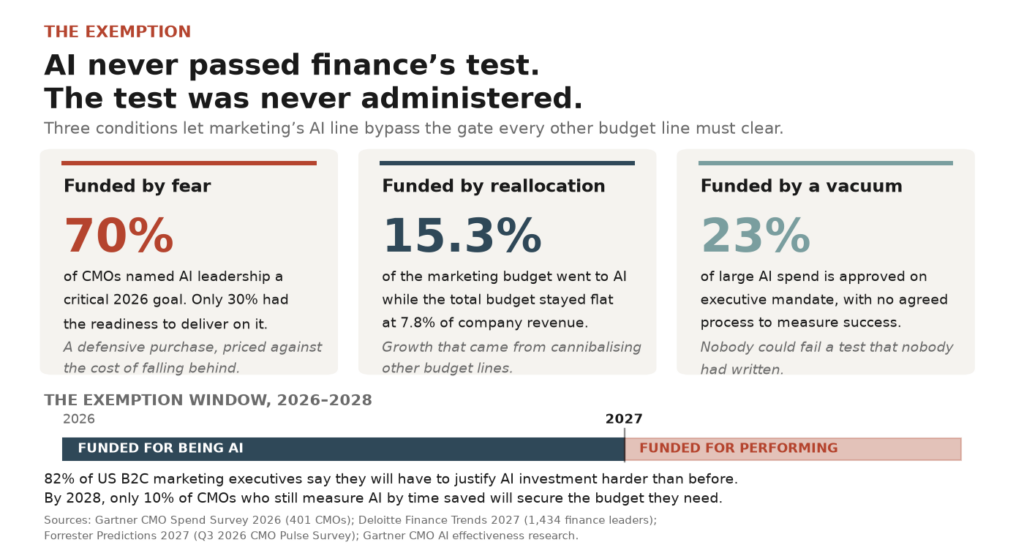
Seventy percent of CMOs named AI leadership a critical goal for 2026. Only 30% said their organizations had the readiness to deliver on it. A 40-point gap between ambition and capability is not a business case. It is a fear, and fear prices differently. You do not ask an insurance premium to beat its benchmark. You ask it to prevent a scenario you cannot afford.
That is the first mechanism: funded by fear. AI spend was defended against the cost of falling behind, not against a return it had to beat. Defensive budgets are almost impossible to cut, because cutting them looks like accepting the risk.
The second mechanism, and the third
Funded by reallocation. With total budget flat, CMOs needed AI line items to appear without asking for new money. Reallocation is quiet. It moves between quarters, inside categories nobody externally audits. The 15.3% did not arrive as a decision anyone had to defend in public.
Funded by a vacuum. Then the strangest one. Twenty-three percent of large AI and technology investments are approved on executive or board mandate, with no process in place to measure success. Nobody could fail a test that had not been written.
Three mechanisms, one result: AI cleared finance without ever sitting the exam.
What it actually feels like from the inside
Here is the part that does not appear in the survey data. Inside a marketing team during a flat-budget year, AI money feels different from every other money. It is the only budget line you can ask for without justifying the channel. Nobody wants to be the person who slowed the AI programme.
That is not a culture problem. It is what an exemption feels like when you are standing inside it — and it is precisely why the exemption is finite.
The window is closing
Forrester dates the end at 2027, when AI stops being funded for being AI and starts being funded for performing. The signals are already visible: 82% of US B2C marketing executives expect to justify future AI investment harder than before, and 78% say leadership already demands stronger evidence than it did a year ago.
Gartner puts a sharper edge on it. By 2028, only 10% of CMOs who still measure AI by time saved rather than business outcomes will secure the budget they need. Eighty-one percent are still using time saved.
Which means the anomaly was never really about technology. It was about a temporary suspension of the rules. Marketing did not win the argument with finance — it was let through the gate.
The teams that use this window to write down a number, hit it, and report it honestly will keep the budget when the exemption ends. The ones that spent three years being exempt will have to explain where it went.