Why CFOs Say Yes to AI and No to Everything Else
Marketing won the AI argument. Then it walked into the budget meeting, where the rules are older, colder, and written by someone else.
The pitch that died on the finance desk
You have seen this meeting. The CMO is excited. The deck has a rocket on it. Someone says the word “transformative” three times. And then the CFO, who has been quiet for eleven minutes, looks up and says: “Show me the ROI.”
That is usually the end of it. The deck goes back into a folder, the folder goes onto a drive, and eighteen months later a competitor launches the thing you wanted to build.
Here is the part most marketing teams never learn: the CFO was not being difficult. The CFO was doing the job. Every spend decision in that building passes through a narrow gate — does this cut cost, add revenue, or reduce risk, and can you defend the path to that number? Marketing walked in with enthusiasm and no answer to the only question that mattered.
So let us flip the frame. Instead of asking how to pitch AI better, let us look at how finance actually evaluates and approves AI marketing spend. Because the difference between an approved budget and a rejected one is rarely about technology. It is about which language you spoke in the room.
Marketing finally got the AI budget. Finance noticed.
Start with the numbers, because they explain the tension better than any argument.
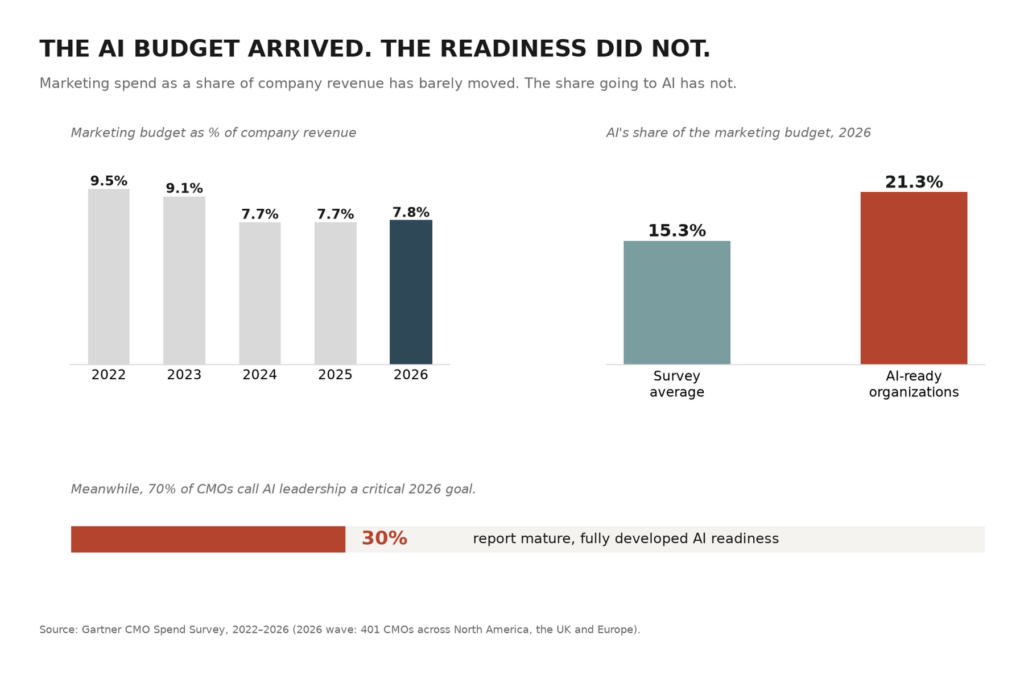
Gartner’s 2026 CMO Spend Survey — 401 marketing leaders across North America, the UK and Europe — found that CMOs now direct 15.3% of their marketing budgets to AI initiatives. That is not a pilot line item. That is a real allocation, carved out of a budget that has barely moved.
Here is the squeeze. Marketing budgets sat at roughly 7.8% of company revenue in 2026, up a tenth of a point from 7.7% the year before, and well below the 9.5% recorded back in 2022. Meanwhile 56% of CMOs say they do not have the budget to deliver their strategy at all, and 54% say they lack the necessary resources.
So AI is not being funded by growth. It is being funded by reallocation. Which means every dollar going into AI is a dollar that came out of something else — an agency retainer, a media buy, a headcount requisition. And reallocation is exactly the kind of decision a CFO wants to review personally. In Deloitte’s 2027 finance survey of 1,434 finance leaders across 26 countries, 54% now say they personally lead enterprise AI and technology capital-allocation decisions. More than two-thirds took on that responsibility within the past three years.
Now the uncomfortable half. Seventy percent of CMOs call AI leadership a critical goal for 2026. Only 30% say their organizations have mature, fully developed AI readiness. That forty-point gap has a price attached to it: the organizations with genuine readiness allocate 21.3% of marketing budget to AI, while everyone else allocates 15.3% and wonders why it is not working.
Read that again. The ready ones spend more, not less. They are not more cautious. They are more credible — and credibility is what unlocks the second tranche of money.
What a CFO is actually doing while you present
You need the mental model, because it is not hostile. It is narrow.
A CFO evaluates every spend through three lenses and nothing else: does this reduce cost, increase revenue, or mitigate risk — and is there a defensible path to each? Innovation, transformation, competitive positioning, “everyone else is doing it” — none of those are categories in the model. They are noise.
There is also an asymmetry that marketing people consistently underestimate. When you say “this is transformative,” finance hears risk. Transformative means unproven. It means hard to reverse. It means the number could land anywhere. Your excitement is evidence of your conviction. It is not evidence of anything else.
And there is the quiet part. The CFO is scanning your pitch for a legitimate reason to say no. Not because they enjoy saying no — because a CFO who approves everything does not stay a CFO. Your job in that room is to remove every legitimate reason, one at a time, before they find one.
Worth knowing where their attention actually sits. In Deloitte’s second-quarter 2026 CFO Signals survey of 200 North American CFOs, the single biggest internal concern about AI was not competitive risk or talent. It was cost uncertainty and lack of transparency, cited by 46% — a direct consequence of vendors moving from flat fees to consumption pricing. Fifty-nine percent named the tension between deploying fast and managing risk as their top governance challenge.
Translation: the person across the table is worried about a bill that fluctuates and a system nobody can fully see. A pitch that arrives with a fixed budget, a clear owner and a stop condition answers both fears without being asked.
The three frames finance uses to say yes
There is no single approved pitch. There are three doors, and they open at different speeds.
The cost-reduction frame. The easiest door, and the one marketing teams skip because it feels small. AI that demonstrably removes cost — fewer agency hours, less manual production, lower cost per asset — speaks the CFO’s native language. MIT’s Project NANDA found that the clearest measured returns came from replacing expensive external work: between $2 million and $10 million a year in customer service and document processing, and up to 30% lower costs for creative agencies. That is a number a CFO can bank. It does not require a belief in the future. It requires last quarter’s invoice.
The revenue-attribution frame. Higher ceiling, harder climb. This is AI spend tied to measurable revenue lift — better conversion, faster test velocity, more campaigns shipped. The catch is the word attributable. Finance will not accept a dashboard that credits your campaigns for sales that would have happened anyway. You need a defensible model, and increasingly that means marketing mix modelling or incrementality testing rather than last-click.
The risk-mitigation frame. The most underused door in the building. AI that reduces risk — compliance automation, output validation, brand governance, hallucination controls — protects existing value. Finance approves protection of existing value with noticeably less friction than creation of new value, because the downside is already on the balance sheet. When 43% of CFOs name potential litigation over protected or private content as their top external AI concern, and 41% name cybersecurity, a proposal that resolves either is not a cost. It is relief.
Pick one door before you build the deck. Most failed pitches opened all three at once and convinced nobody.
The payback clock nobody warned you about
This is where the conversation usually breaks, and it is not the marketer’s fault.
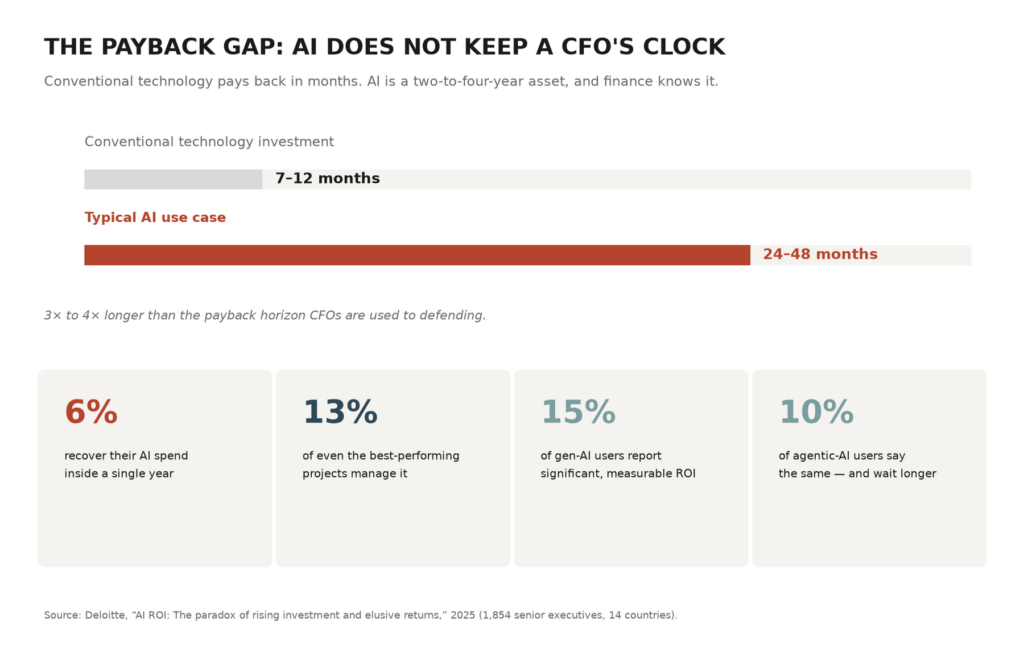
Deloitte surveyed 1,854 senior executives across 14 countries. The finding that matters most is not about adoption — 85% increased AI investment last year and 91% plan to increase again. It is about time.
A typical AI use case takes two to four years to deliver satisfactory ROI. Conventional technology investments pay back in seven to twelve months. Only 6% of organizations recover AI spend inside a single year. Even among the best-performing projects, just 13% see returns within twelve months.
Sit with that. The CFO’s entire professional instinct is calibrated to a seven-to-twelve-month clock. You are handing them an asset that pays back three to four times slower, with less predictable depreciation, and asking them to feel good about it. Of course they hesitate.
The picture splits further by type. Among organizations using generative AI, 15% report significant measurable ROI today, and 38% expect it within a year. Agentic AI is slower: 10% see meaningful returns now, and most expect one to five years. CFOs surveyed separately by PYMNTS estimated that embedding generative AI across an entire organization would take an average of 6.28 years — nearly double what the same group predicted five months earlier.
None of that argues against AI. It argues for telling the truth about timing before finance discovers it on their own. A marketer who says the real number out loud in the meeting gains something rare: they sound like they read the same research as the CFO.
The 95% number your CFO has already heard
Assume finance knows about MIT’s GenAI Divide study. They probably do.
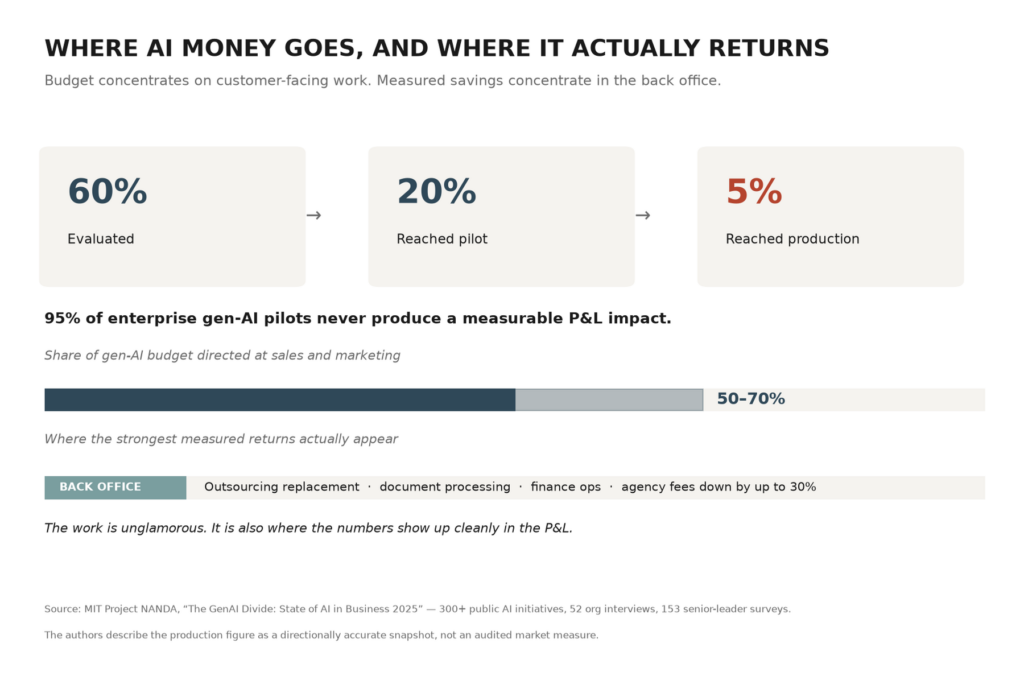
The headline is brutal: 95% of enterprise generative AI pilots produce no measurable P&L impact, against $30 to 40 billion in investment. Fewer than one in ten organizations see returns at the million-dollar scale.
Most marketers hear that and panic. Wrong reaction. The CFO has heard the number and drawn a specific conclusion: the category is unproven, so my default is no. Your proposal now has to overcome a prior belief, not fill a knowledge gap.
Read the study more carefully, though, and there is a gift inside it. The failure was not model quality. It was workflow integration — pilots with no documented baseline, tools bolted onto processes nobody redesigned. And the authors are explicit that these figures are a directionally accurate snapshot drawn from 300+ public initiatives, 52 organisation interviews and 153 senior-leader surveys, not an audited market measure. That honesty helps you, because it reframes the debate from “is AI good?” to “is your workflow ready?”
One more finding is worth saying out loud, because it is disarming: somewhere between 50% and 70% of generative AI budgets go to sales and marketing, while the strongest documented returns sit in unglamorous back-office work. Admitting the base rate is the fastest way to be taken seriously by someone who assumes the base rate.
Where the money goes, and where it actually comes back
The pilot-to-production funnel is where credibility is won or lost.
Of the organizations studied, 60% evaluated custom enterprise AI tools. Twenty percent reached pilot. Five percent reached production with sustained impact. Large enterprises had the worst conversion rate despite the largest budgets; mid-market firms moved faster, often reaching full implementation inside 90 days, largely because fewer people had to agree.
For a marketing leader, the implication is structural. If you propose a broad “AI for marketing” programme, you are proposing the exact shape of project that historically fails. If you propose one workflow, one metric, one owner, you are proposing the shape that survives.
The allocation mismatch matters too. Sales and marketing absorb most of the budget; the back office absorbs the returns. That does not mean marketing AI cannot work. It means marketing AI has to be measured on outcomes finance recognises — cost per asset produced, cycle time to launch, cost per acquired customer — rather than the activity metrics that dominate marketing dashboards.
The martech picture confirms the pattern. In Gartner’s survey of 413 marketing technology leaders, 81% were piloting or running AI agents, and 89% expected significant business benefits. Yet 45% said the vendor-offered agents they had actually deployed failed to meet expectations of business performance, and half said their organizations lacked the data and technical readiness to deploy them properly. Expectation is not evidence. Readiness is.
Anatomy of a pitch that gets approved
Let us make this concrete, because abstraction is what kills these conversations.
What finance rejects:
“AI will transform our marketing, make us more innovative, and keep us competitive.”
No number. No timeline. No owner. No definition of failure. That is not a business case; it is a mood.
What finance approves:
“AI-assisted production will cut our cost per creative asset by 22% within two quarters. We will measure cost per approved asset and time-to-launch. Priya owns the number. We are committing $180,000 for a six-month pilot with a defined stop condition.”
Specific. Timebound. Falsifiable. One named human accountable. A spend small enough to be reversed. Every element maps to something a CFO is professionally required to check.
The principle underneath is simple and slightly uncomfortable: CFOs approve commitments, not aspirations. A promise you can be held to is worth more than a vision you cannot be measured against — even when the vision is larger. Ambiguity reads as risk, and risk reads as no.
The five objections, and what actually answers them
| What the CFO says | What actually works |
|---|---|
| “Show me the ROI.” | A timebound, metric-backed projection plus a pilot with a written stop condition. Not a range. A number you will be judged on. |
| “This is just hype.” | Reframe into cost reduction or risk mitigation. Those two frames survive a skeptical finance team. “Transformation” does not. |
| “We tried AI and it didn’t work.” | Separate the tool from the workflow. Name what failed — data, integration, ownership, baseline — and show which of those you have fixed. |
| “Why now?” | Attach it to a current, dated problem: rising acquisition cost, a missed service level, a compliance deadline. Urgency with a date beats urgency with a feeling. |
| “What if it doesn’t pay back?” | Propose staged funding. Finance approves small reversible bets at a completely different rate than large irreversible ones. |
That last row is the most important line in this article. Which brings us to how approval actually happens.
How finance actually structures the yes
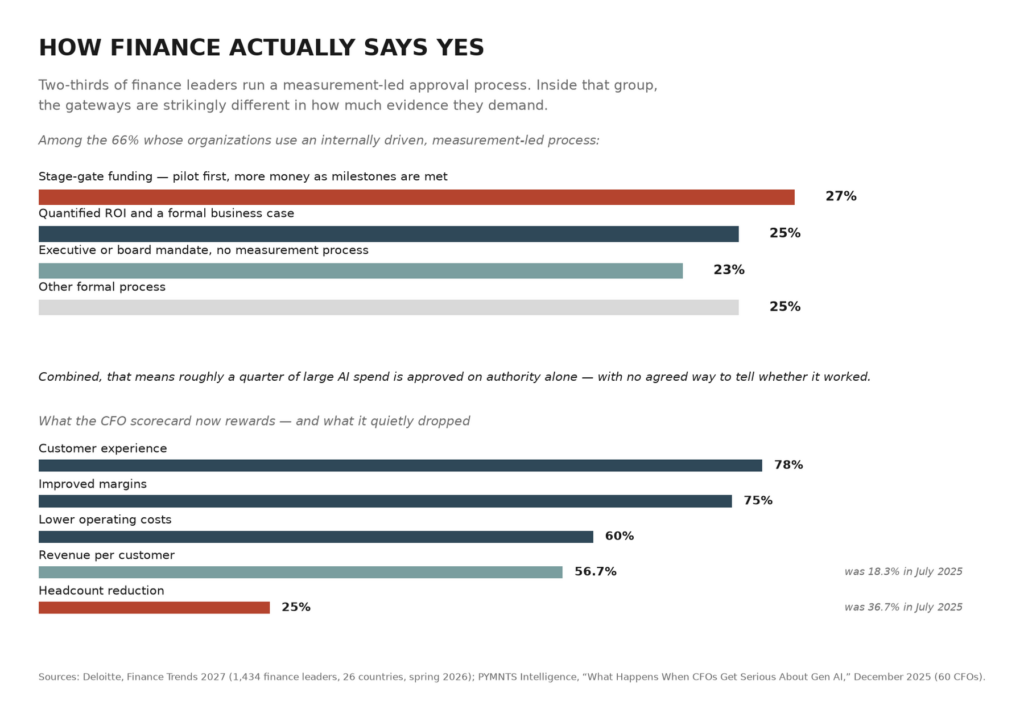
Deloitte’s Finance Trends 2027 research asked 1,434 finance leaders how their organizations most often approve large AI and technology investments. Sixty-six percent said they use an internally driven process that puts measurement at the front.
Inside that group, the split is revealing. Twenty-seven percent approve through stage-gate funding — a pilot first, with more money released as milestones are met. Twenty-five percent require quantified ROI and a formal business case. Twenty-three percent say executive or board mandates drive most decisions, with no process in place to measure success.
That last number should bother you. Roughly a quarter of large AI spend in these organizations is approved because someone senior said so, and nobody agreed in advance on how to tell whether it worked. Mandate is fast. Mandate is also borrowed time — and it is the first thing to get cut when the champion moves on or the cost line gets questioned.
Stage-gate is slower to start and far more durable. It also has a measurable payoff. Gartner’s survey of 1,303 functional leaders found that organizations which consistently track AI ROI, treat AI as a portfolio of value, and reallocate or discontinue underperforming initiatives reported positive returns in 81% of their AI initiatives. Low performers could not state a rate of return for 29% of theirs. The difference is not better models. It is a scoreboard.
And note the surrounding context: only 22% of organizations have successfully scaled AI across multiple business units, while 85% of functional leaders still plan to increase spending in 2026. More money, thin proof, weak scaling. That is the environment your proposal enters.
The scorecard quietly changed while you were not looking
Something shifted in what finance measures, and it should change what you promise.
In PYMNTS Intelligence’s survey of 60 CFOs at companies with at least $1 billion in revenue, customer experience was the most-cited measure of generative AI return at 78.3%, followed by improved margins at 75% and lower operating costs at 60%.
Now the interesting pair. Revenue per customer was tracked by 56.7% of CFOs — up from 18.3% five months earlier. Headcount reduction was tracked by just 25%, down from 36.7%.
Finance is moving off the crude measure. The pitch that promised fewer people is aging badly. The pitch that promises growth per customer is where the scorecard is heading.
That is a gift to marketers, if you notice it in time. Revenue per customer is a marketing metric. Headcount avoided is not something marketing can credibly own.
There is a second shift worth flagging. Deloitte’s October 2026 enterprise survey of 3,500 leaders found 81% reporting faster decisions and execution, but only 25% saying AI had deeply transformed the business. Revenue gains from AI rose to 28%, up from 20% nine months earlier. Speed is now common. Transformation is not. If your pitch is about speed, you are selling the thing everyone already has.
The staged-approval playbook
If you take one process out of this piece, take this one.
Step one: ask for something small enough to be slightly embarrassing. A bounded pilot with a named success metric and a written stop condition. Do not ask for the platform. Ask for the workflow.
Step two: agree the measurement before you spend. Not after. Pilots without a documented baseline are a large part of why the 95% figure exists. Define success retroactively and finance will discount it entirely, correctly.
Step three: report the delta, including the misses. A clean before-and-after with the failure included builds more credibility than a perfect story with a suspicious gap in it. CFOs are professional pattern-matchers. They will find the gap.
Step four: scale with data, not advocacy. The second ask should require no persuasion at all, because the pilot already made the argument.
Step five: let the flywheel turn. Every honest pilot makes the next approval cheaper. You are not just buying a budget — you are training a CFO to trust your ROI discipline. That asset compounds in a way no campaign does.
What the next twelve months probably look like
Two forecasts worth carrying into the room.
Forrester expects AI’s exemption from normal business rules to expire in 2027 — that AI will get funded because it performs, not because it is AI. Their Q3 2026 survey found 82% of US B2C marketing executives expect to provide stronger justification for future AI investment, and 78% say leadership already demands stronger evidence than it did a year ago. They also predict that consumption-based pricing will force CMOs to scale back about a third of AI initiatives, with procurement and finance taking a bigger seat at the table.
Gartner is blunter about the metric. By 2028, only 10% of CMOs who measure AI by time saved rather than business outcomes will secure the budget they need. Eighty-one percent of marketing leaders still evaluate AI-driven automation by time saved, and 68% by cost efficiency. That is a majority standing on the wrong side of the number they will be judged on.
And the reveal that should worry everyone: 42% of CMOs still use generative AI mainly as an assistant for isolated tasks, while 43% report marketing AI investment above $15 million this year, up from 28% a year earlier. Big money, narrow use. That is a budget waiting to be questioned.
The takeaway
The path to AI marketing budget approval runs through a narrow gate: cost reduction, revenue attribution, or risk mitigation. Each one needs a specific, timebound, measurable claim. Each needs a named owner. Each needs an exit condition that makes the bet reversible.
Marketing keeps losing this argument because it keeps bringing conviction to a meeting that runs on evidence. The CFO is not the enemy of your AI strategy. The CFO is the quality control.
So stop pitching transformation. Start committing to a number. Then hit it, report it honestly, and ask for more. That is the whole game — and it is a game marketing is unusually well equipped to win, once it agrees to keep score.