Why Chinese Seeding Campaigns Get Worse the More You Spend
In the previous piece I argued that sequencing beats allocation. This one goes after something less comfortable: the strange fact that Chinese seeding campaigns often decline in performance as volume increases. Brands buy more notes and get fewer results. The explanation is not mysterious, and it is not about creators being worse than they used to be.
The observation that started this
Two numbers sit side by side in the same dataset and refuse to reconcile.
Across 549 seeding campaigns run by Shopify merchants on TikTok between Q2 2025 and Q1 2026, creators in the 1,000-to-10,000 follower band returned a median of 54.9 organic views per follower. Creators above one million returned 1.0. That is a fifty-five-fold difference in reach efficiency, measured per follower rather than in total.
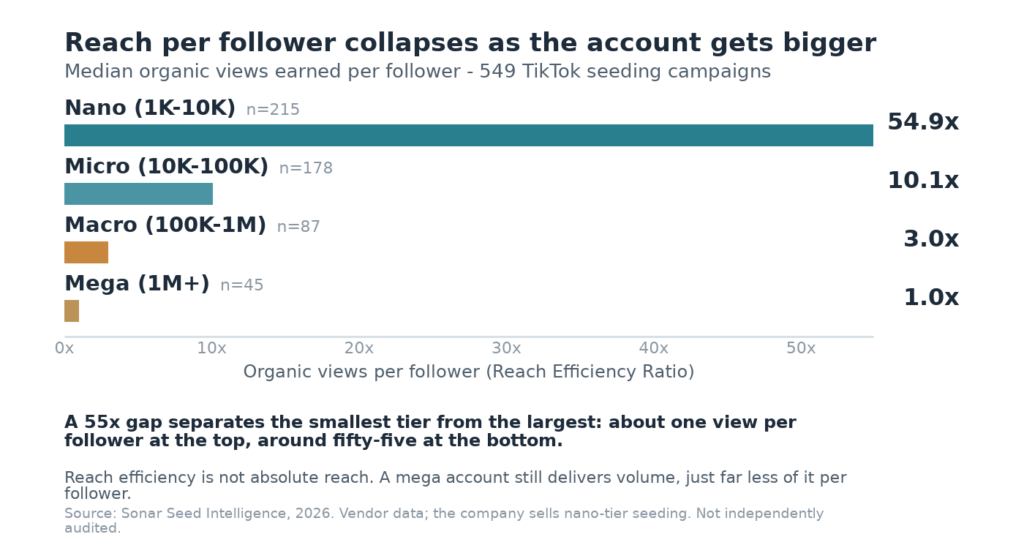
You can dismiss the specific figures if you like. Sonar Seed sells nano-tier seeding, so it has an obvious interest in nano creators looking efficient. Read the direction, not the decimal. A growing independent body of work points the same way.
The mechanism nobody prices in
Here is the part that gets missed. Every note a brand buys is entered into the same contest, and the contest is scored on response, not presence.
Xiaohongshu has never published its ranking weights. What circulates — likes worth one, saves worth one, comments worth four, shares worth four, follows worth eight — is an industry reconstruction, widely repeated but unofficial, and different versions disagree on the numbers. Treat it as a practitioner heuristic rather than a disclosed formula.
But the direction is not in dispute, and it is confirmed by what the platform does publish. Xiaohongshu has formally codified anti-duplication rules: its trading-note ecosystem regulations penalise repeated posts judged “identical or highly similar,” with thresholds like more than half of images overlapping, and enforcement includes throttling and account-level limits. In August 2026 it extended this to “low-differentiation commercial notes,” explicitly naming repeated bulk posting.
So the platform is actively suppressing the thing bulk seeding produces. Which means volume does not buy distribution. Volume buys entry into a filter designed to catch volume.
Why this compounds into decline
Now add the second half. When a brand sends the same brief to three hundred creators, three things happen in sequence, and each one makes the next worse.
The content converges. Same hook, same three features, same photo angles. Similarity is exactly what the anti-duplication rules target.
Response falls. Converged content gives a reader nothing new to react to, so high-weight signals — comments, shares, follows — dry up. Low-weight approval (likes, saves) may survive, which is precisely why dashboards look healthy while nothing happens.
The archive fills with noise. And this is the real cost. A buyer who searches the brand later finds forty variations of the same post. The floor is no longer evidence of a crowd. It is evidence of a campaign.
The third effect is the one that compounds, because search keeps serving that archive for months.
The counterintuitive finding that reframes it
If bigger accounts were simply better, the efficiency curve would slope upward. A peer-reviewed study in the Asia Marketing Journal — KCI-indexed, analysing 1,062 seeded Instagram posts from 778 Korean influencers — found the opposite shape: an inverted U. Engagement rises with follower count, peaks, then falls as accounts get very large.
The finding worth remembering is the moderator. The penalty attached to oversized accounts shrinks when the influencer is a genuine expert in the seeded category. Expertise partially rescues scale.
That single result explains most of what goes wrong. Bulk seeding selects on follower count, which is the variable with a known turning point, and ignores expertise, which is the variable that flattens the curve. Brands are optimising the wrong axis.
What this actually changes
Three practical shifts, none of them comfortable.
Stop counting notes. Count distinct arguments. Forty notes making the same point is one note, repeated — and the platform treats it that way. Forty notes surfacing different frictions are a floor.
Buy expertise before reach. The academic finding says a credible specialist outperforms a large generalist on engagement, and the vendor data agrees on direction. A category expert at 8,000 followers is not a compromise. It is the correct buy.
Treat convergence as the failure signal. If your seeding programme’s notes resemble each other, the programme is generating its own suppression. That is measurable before you spend more: sample twenty notes and check whether a stranger could tell them apart.
The uncomfortable conclusion
The reason more spend produces less result is not saturation of the audience. It is saturation of the content, and the platform now enforces against it explicitly.
Which flips the usual budget conversation. The question is never how many creators. It is how many genuinely different things you can get said — and whether the people saying them have any reason to be believed.