Why a Voucher Redeems at 57% and Not 85%
Somewhere between the tap that buys a discounted set meal and the moment someone actually sits down to eat it, roughly two out of five vouchers stop existing. They aren’t refunded in fury or reviewed in anger. They simply expire, like a gym membership in miniature.
The usual explanation is audience quality: content audiences are casual, search audiences are serious. That isn’t wrong, but it explains the who and skips the why. The mechanism is plainer and more physical. Redemption is a function of distance, and the distance that matters is time.
A voucher is bought at one moment and consumed at another. Everything that decays happens inside that interval. Call it the time–distance rule.
Three things go wrong in there, and none of them are about the creative:
- The plan moves. A voucher bought on Tuesday night competes with weather, a friend’s counter-proposal, and a better offer that appears on Thursday.
- The constraints bite. Weekday only. Not valid on holidays. Two-person minimum. Fine print is read after the purchase, not before it.
- Abandonment is free. A refund costs nothing, so an unused voucher costs its buyer almost nothing. The default is forgetting.
If that is the mechanism, it makes a prediction you can actually test: anything that shortens the interval, or drags the purchase closer to the moment of need, should lift redemption without touching the offer.
The data obliges, from four directions.
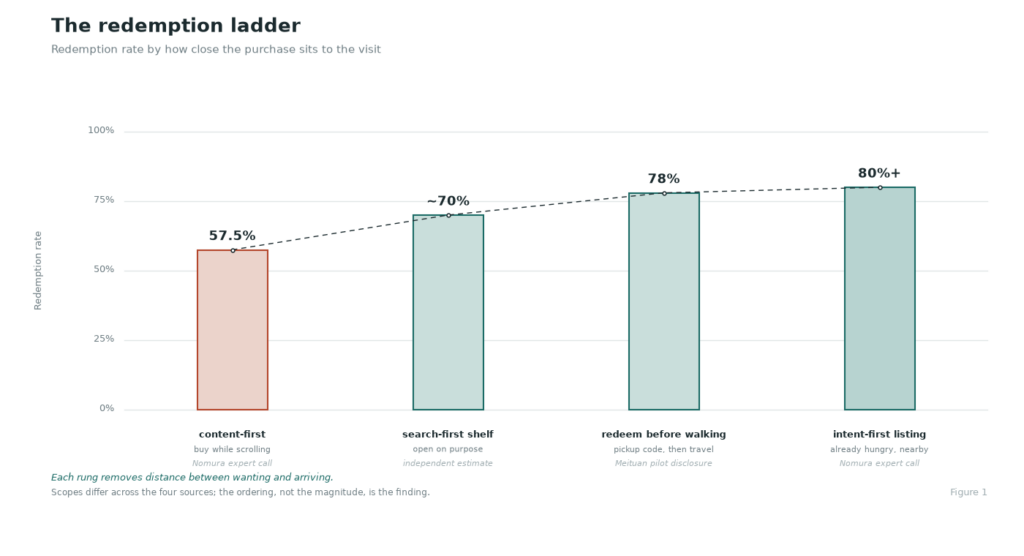
People buying inside a content feed, in a moment when they don’t need anything, redeem at 57–58%. Move the identical inventory onto a shelf where users arrive already looking, and it lands near 70%. Put the redemption itself before the journey — order, pay, take a pickup code, then travel — and a Meituan pilot reported 60% climbing to 78%. Sell to someone who opened an app because they were hungry and already nearby, and it runs above 80%.
Four products, four different incentive structures, one monotonic line. It is not a controlled experiment, and the scopes differ, but the direction is far too consistent to be noise.
Then there is the part nobody wants to say out loud. Platforms get paid on what is booked. Merchants live on what is redeemed. Those two numbers are separated by exactly this interval, which means the party with the clearest view of the leak has the weakest reason to plug it. Selling more vouchers is a growth story. Telling a merchant that 43% of them never arrived is a churn story.
So the fixes stay quiet, and they are cheap: a pickup code that merges the two moments, a same-day reminder, a nudge two hours before the validity window shuts, a rebooking offer timed to when the person actually eats.
Which brings the real question into focus. Not “how deep should the discount go”, but how many days sit between your customer’s purchase and your customer’s visit? Measure that interval once, honestly. If it is counted in days, you are not running a promotion. You are running an attrition test with a discount stapled to it.