Why the Agency Layer Stays Thin: The Fixed Cost Behind a Variable Fee
Every foreign brand eventually asks the same question about its Chinese livestream partner. The volume is enormous, the commission is a real percentage, so why does the agency keep behaving like a business with no cash?
The answer is not greed, and it is not incompetence. It is a structural mismatch that sits inside the contract itself, and once you see it, a lot of otherwise strange agency behaviour becomes legible.
The Two Ledgers Nobody Reconciles
An operator runs two books at the same time, and they are indexed to different numbers.
The first is the revenue book. Commission is charged on settled sales — the orders that survive the return window, arrive, and stay bought.
The second is the cost book. Shifts are staffed against orders placed — the headline volume that appears on the dashboard at 11 p.m., before anybody has sent anything back.
In a category like womenswear during a promotion, those two numbers can differ by a factor of three. The agency is paid on 35 units and staffs for 100: the same six-hour shifts, the same three seats in the control room, the same traffic desk bidding into the room, the same aftercare queue fielding the questions that arrived at minute 200.
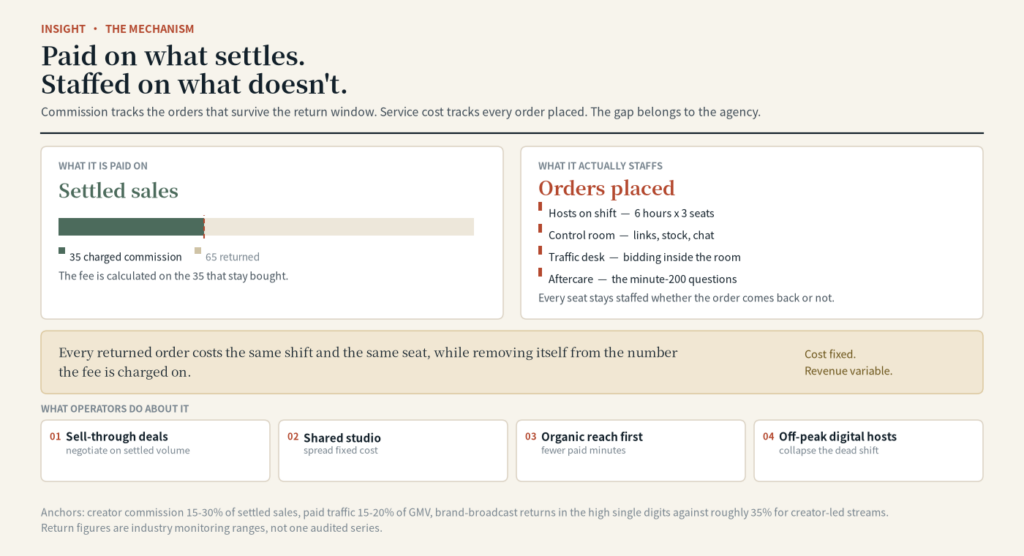
The cost is fixed. The revenue is not. That single sentence explains most of the industry’s behaviour.
What This Predicts (and What It Doesn’t)
Once you accept the mismatch, several things stop looking like mysteries.
It explains why operators push price. Commission is a percentage of a shrinking base. The fastest way to grow the base is to discount, which grows volume and destroys the brand’s margin — and the agency’s, eventually. An operator doing this is not being lazy. It is responding rationally to a badly shaped incentive.
It explains why good operators negotiate on sell-through. A partner who insists on settling against net volume is not being difficult; they are trying to make their own cost book and revenue book point at the same number. That insistence is a signal of operational maturity, not of aggressive legal counsel.
It explains why the studio gets shared. Running one room for four brands is not a service compromise. It is the only way to spread a fixed cost across a variable fee. The agency that reuses infrastructure survives; the one that builds bespoke sets per client does not.
The Part That Surprises Western Buyers
Here is the discovery that tends to land hardest. The obvious fix — pay the agency on orders placed, so the incentive lines up with the dashboard — makes things worse.
Pay on orders placed and you have just paid for returns. The agency’s revenue rises with exactly the behaviour that destroys your margin, and the return cost lands entirely on you. The mismatch is not a bug in the contract that a clever clause can fix. It is a genuine tension between two parties who are each trying to be paid for the part of the transaction they can control.
Which means the right question is not “how do we align incentives?” It is “which of us is holding the return risk, and is that price fair?” Answer that explicitly, in writing, with a number attached, and most of the friction disappears.
The honest version: in Chinese live commerce, an agency is not a vendor selling you reach. It is a counterparty taking on a slice of your operational risk at a fixed price. The ones that last are the ones that priced that slice correctly. The ones that did not are the ones that quietly stopped answering your messages in month five.