Sales Used to Pitch. Now It Answers.
Sales used to pitch. Now it has to answer. Most enablement teams are still building for the wrong moment.
There’s a scene that plays out in B2B sales every week, and it costs more than anyone puts in a report. A buyer asks a specific question — “How does your platform handle data residency in the EU when the customer’s ERP is on-prem?” — and the rep, who is smart, who has been trained, who genuinely wants to help, says: “Great question. Let me check with the team and get back to you.”
The answer existed. It was in a solution engineer’s slide from eight months ago, in a security FAQ nobody updated, in a battlecard buried on page 40 of a shared drive. The rep couldn’t reach it in the ninety seconds that mattered. So the buyer got a promise instead of an answer, and the moment cooled.
That’s the real failure of B2B sales enablement, and it isn’t a content problem. It’s a retrieval problem dressed up as one. Which is why the fix isn’t more decks.
1. The Library Was Never the Problem
For twenty years, enablement meant production. Build the deck, build the battlecard, build the one-pager, put it in the portal, train the rep on where to find it, and hope.
Hope is doing a lot of work in that sentence.
The industry has an entire vocabulary built around assets — content adoption, asset utilization, library coverage. Those metrics measure whether the library got opened. They do not measure whether the buyer moved. And in a market where the buyer increasingly does the first two-thirds of the work alone, an asset-utilization dashboard is a very precise instrument pointed at the wrong question.
1.1 The metric nobody can trace
You’ve seen the number: roughly 65% of marketing-created sales content is never used by sales. It anchors decks, vendor pitches, and budget requests. It is also, on inspection, folklore.
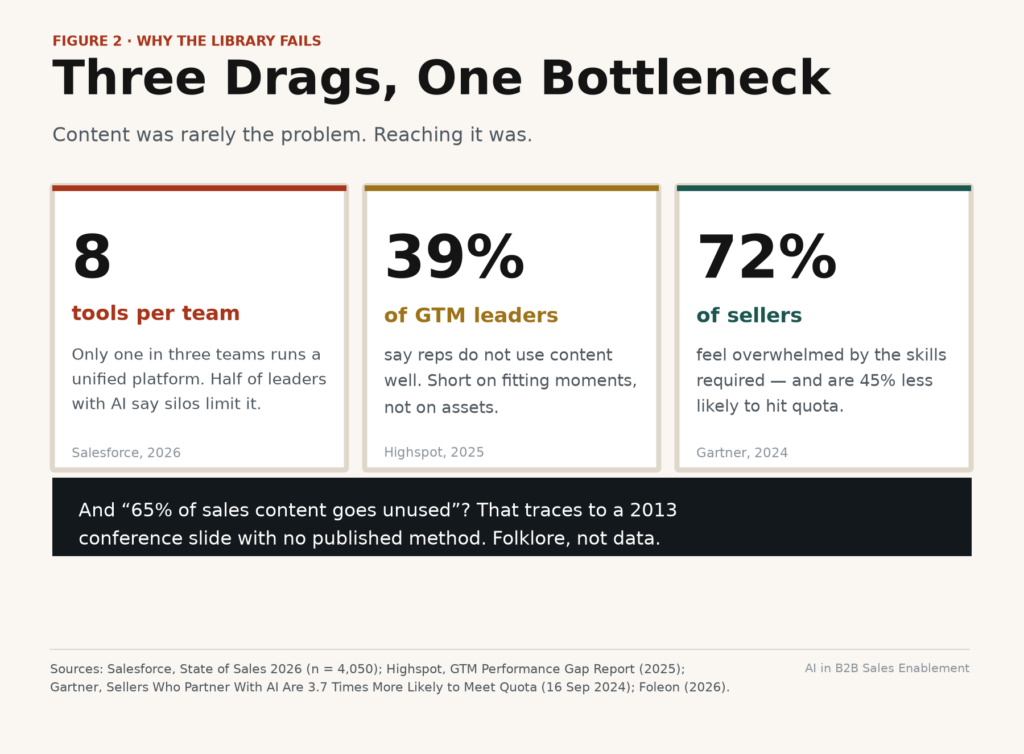
Trace it back and you land on a 2013 conference presentation. The methodology was never published, the firm that produced it was absorbed into another analyst house, and that house does not maintain the figure. It has survived thirteen years on repetition alone. The more honest version of the finding is narrower: Highspot’s 2025 research found 39% of go-to-market leaders say their salespeople don’t use content effectively. That’s a real signal, and it says something different — not that reps ignore good material, but that the material isn’t reaching them at a moment when it fits.
I’m not arguing the waste isn’t real. I’m arguing that misdiagnosing it points your budget at the wrong fix — better tagging, a bigger portal, more assets for the same pile — when the actual constraint is per-moment relevance.
1.2 What the buyer is actually doing now
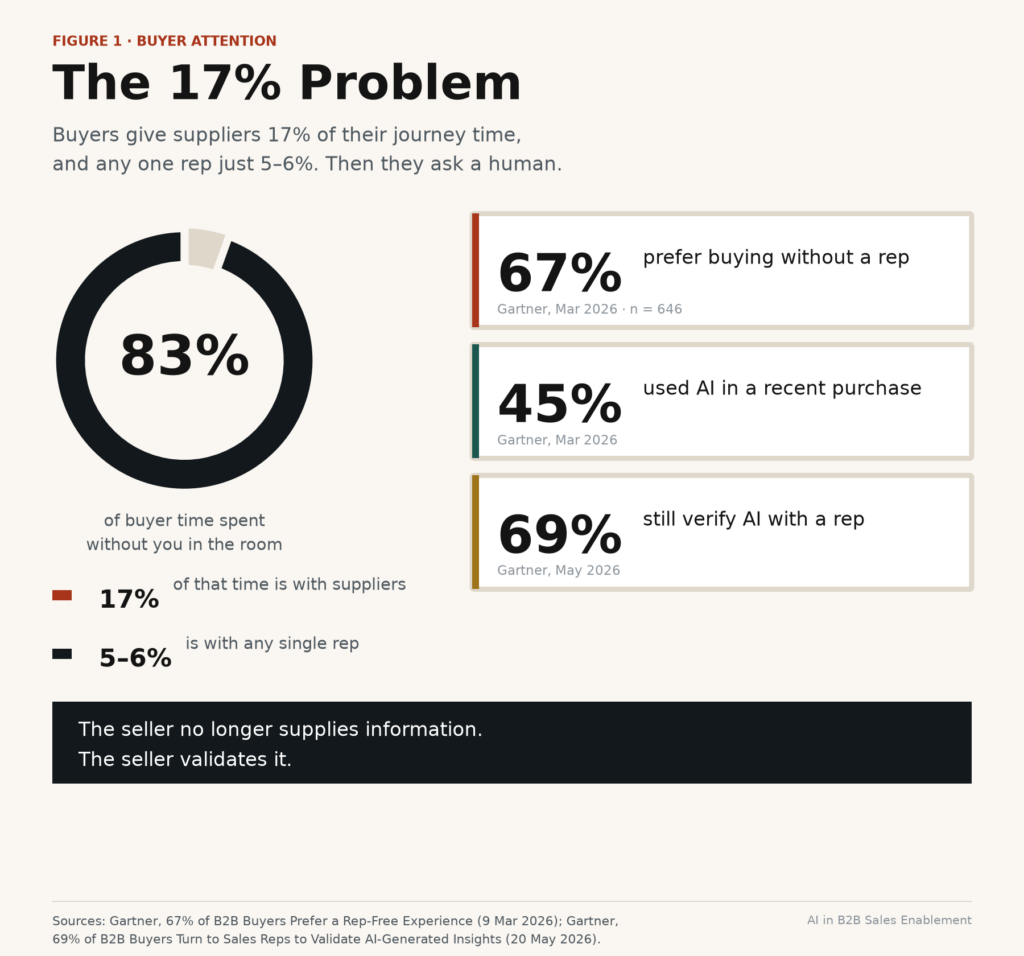
Gartner’s March 2026 survey of 646 B2B buyers found that 67% prefer a rep-free buying experience, and 45% used generative AI during a recent purchase. Buyers now move through roughly seven information sources per deal.
But here’s the part that gets skipped, and it’s the whole story. In the same body of research, Gartner found that 69% of buyers still prefer to validate AI-generated insights with a human rep. And buyers were more likely to say they’d encountered misleading information from generative AI (51%) than from a salesperson (49%).
Read those two findings together and the role snaps into focus. The buyer no longer needs you to be the source of information. The buyer needs you to be the confirmation.
That’s a demotion if you’re attached to pitching. It’s a promotion if you understand what confirmation is worth. Gartner’s own framing is “value clarity” — a buyer’s clear understanding of how a solution improves outcomes in their specific role and business context. Buyers who reach that clarity are twice as likely to report a high-quality deal.
Doubling the odds of a high-quality deal isn’t a branding outcome. It’s a revenue outcome, and it depends on whether the rep could answer well in the moment.
2. Why a Perfect Deck Loses to a Mediocre Answer
Let’s be honest about the mechanics. Even with a well-built library, three structural drags make retrieval expensive.
Tool sprawl. Salesforce’s 2026 State of Sales, drawn from 4,050 sales professionals across 22 countries, found teams running an average of eight standalone tools, with only about one in three operating on a unified platform. Half of sales leaders using AI say siloed systems delay or limit it. Eight tools is eight places an answer might be, and eight places it might not.
The trust gap. Highspot’s figure — 39% of GTM leaders saying reps don’t use content effectively — is usually read as a rep behavior problem. It reads better as a trust problem. When a rep can’t verify that the deck reflects today’s pricing or this quarter’s positioning, sending nothing feels safer than sending something wrong. Stale content doesn’t just go unused; it teaches reps to stop looking.
Capacity. Gartner’s survey of 1,026 B2B sellers found 72% feel overwhelmed by the number of skills the job requires and 50% by the amount of technology. Sellers who feel overwhelmed are 45% less likely to hit quota. You cannot bolt a ninth tool onto a team that is already drowning in the first eight and call it enablement.
2.1 The deadline problem
There’s a second-order cost that rarely makes it into the business case: speed.
The classic speed-to-lead research is old enough to vote, and worth citing carefully. A 2011 Harvard Business Review audit of 2,241 companies found an average first response time of 42 hours, with 23% never responding at all. Firms reaching a prospect within an hour were roughly seven times more likely to qualify a decision-maker than firms waiting one hour longer. The companion 2007 analysis of InsideSales platform data — 15,000+ leads, 100,000+ call attempts — put qualification odds 21 times higher at five minutes versus thirty. That second study is vendor platform data analyzed by an academic and was presented at a summit rather than published in a journal, so treat it as directional. The 2011 HBR paper is the load-bearing citation.
Now transpose it. A rep who says “I’ll get back to you” is running the 42-hour average inside a live deal. A rep with a grounded answer runs the five-minute version. The mechanism is identical; the difference is whether retrieval takes ninety seconds or two days.
3. The Unit Changes From Slide to Sentence
Here is the conceptual move that matters, and it’s smaller and stranger than the vendor category name suggests.
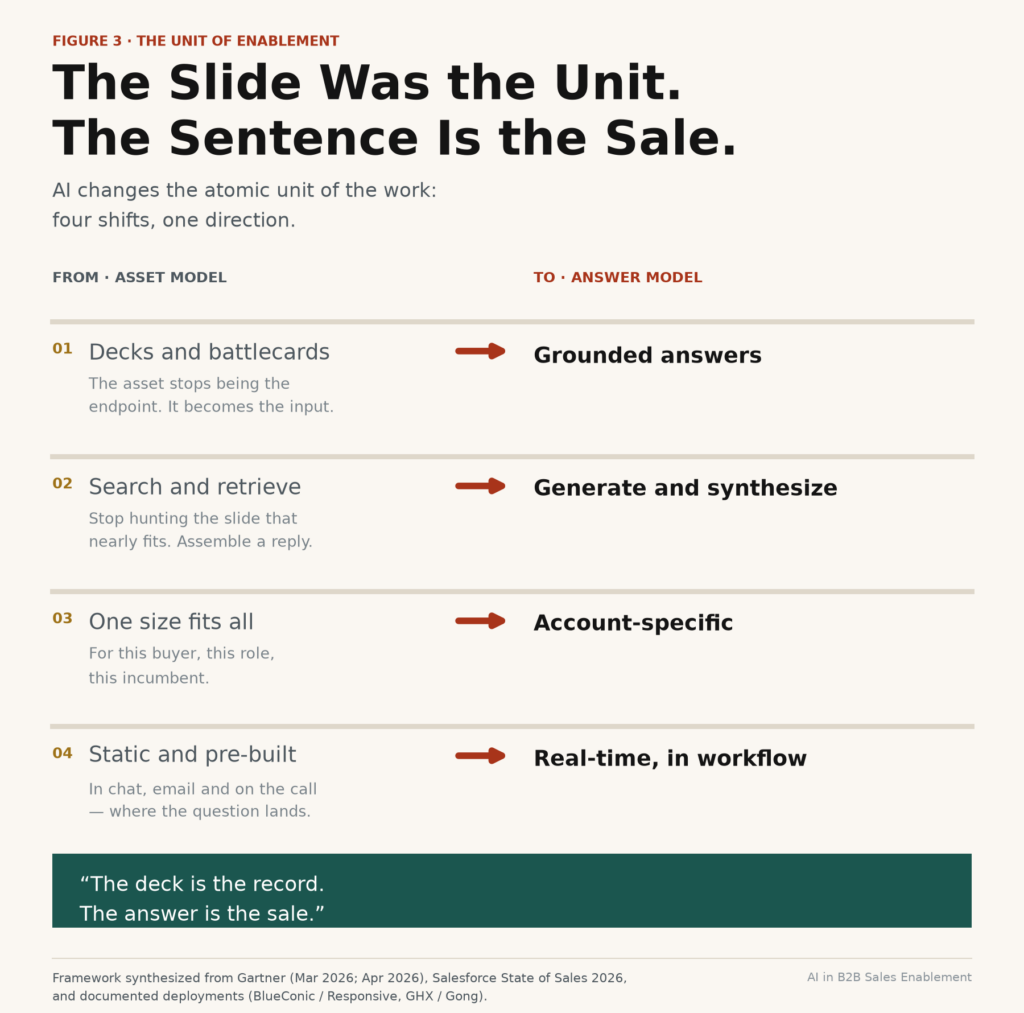
Traditional enablement optimizes the asset. AI enablement optimizes the answer. The atomic unit of the work flips from a slide to a sentence. Four shifts follow.
From retrieval to synthesis. Instead of hunting for the slide that approximately addresses the question, the system assembles a response from the approved corpus. That’s a different computational act, and it’s why keyword-search libraries plateau. Tribble’s own comparison draws the line bluntly: searching a library gives you incremental improvement; generating a first draft gives you a step change in throughput.
From generic to account-specific. A battlecard is written for a competitor. An answer is written for this buyer, in this role, with this objection, against this incumbent. Personalization stops being a quarterly content project and becomes a default property of the output.
From pre-built to in-the-moment. The answer appears where the question happens — in chat, in email, in the CRM record, on the call. Gartner’s guidance is explicit that enablement should be embedded in sellers’ “systems of action,” automated within existing workflows, specifically to reduce tool switching.
From static to governed. Grounding turns content into a permissioned corpus with citations. The model can only say what the business has approved it to say — which is, counterintuitively, the feature compliance teams care about most.
4. What This Actually Buys You
Strip away the category language and four things improve.
Time-to-answer. The “let me check” gap closes. This is the least glamorous benefit and the one buyers notice most, because it’s the difference between a conversation and a follow-up email.
Ramp. New reps stop memorizing decks and start querying a corpus. GHX, working with Gong, reports new hires reaching command of their book of business in about two weeks instead of roughly three months — an 85% reduction in ramp time. It’s a vendor case study, so calibrate accordingly, but the mechanism is credible: the institutional knowledge that used to live in a tenured rep’s head became searchable on day one.
Consistency under compliance. Grounded answers draw from approved messaging, so the twentieth rep says the same substantiated thing as the first. For regulated categories — financial services, healthcare, anything with a disclosure requirement — this is the difference between scale and exposure.
Competitive responsiveness. Objection handling stops being a document you read before the call and becomes something that surfaces during it. That’s not a small change in kind. The battlecard walks into the conversation instead of waiting in a tab.
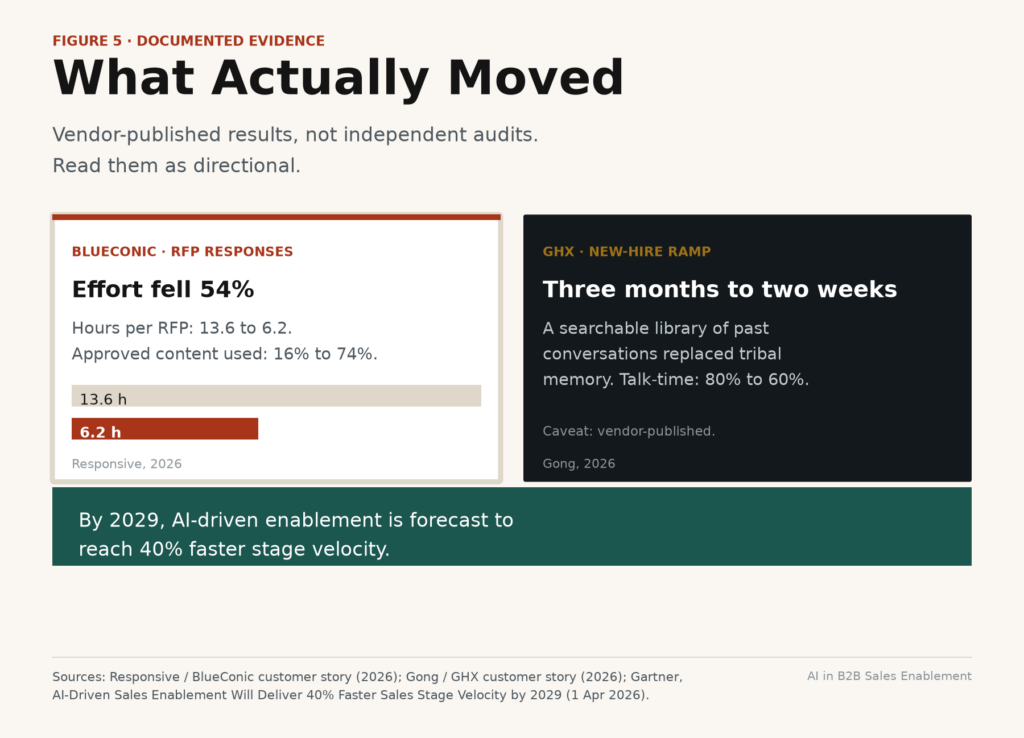
Gartner’s forecast puts a number on the aggregate: by 2029, organizations with AI-driven enablement functions will achieve 40% faster sales stage velocity than those using traditional approaches. That projection comes from a survey of 227 chief sales officers conducted in late 2025 — a sample worth noting, since it’s leadership sentiment about a capability, not a measured outcome.
5. The Playbook: From Library to Answer Factory
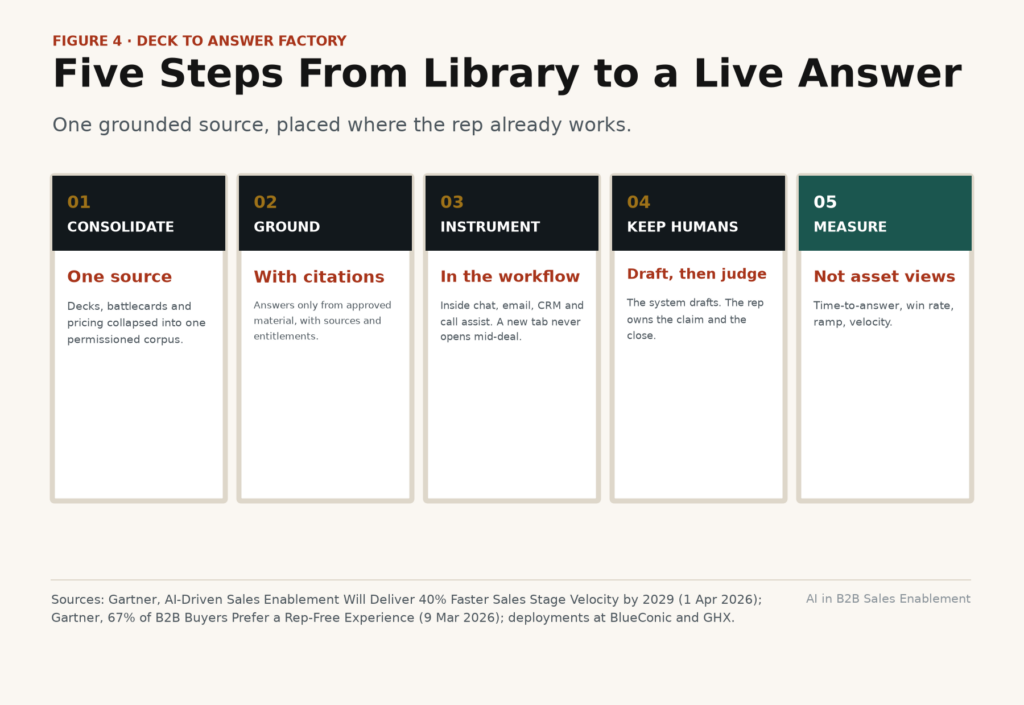
Five steps, in order. Skipping any one of them is how this becomes a demo that nobody uses.
5.1 Consolidate before you generate
One governed source. Decks, battlecards, pricing rules, objection handlers, security answers, reference architectures, past proposal responses — collapsed into a single permissioned corpus. The BlueConic story is instructive precisely because its first move wasn’t AI. It was a multi-week cleanup: identifying and removing duplicate and outdated Q&A pairs, rewriting for consistency, then building dashboards to see what people searched for and didn’t find. Only after that did AI drafting work.
Forty PDFs behind a search box is not a knowledge base. It’s a filing cabinet with a language model bolted on.
5.2 Ground it, and mean it
Grounding is a governance decision, not a prompt. The system answers from approved material, surfaces its source, respects entitlements, and declines when the corpus doesn’t cover the question. “I don’t have an approved answer to that” is a feature. A confident wrong answer in front of a buying committee is the single fastest way to lose the deal and the trust.
5.3 Instrument the moments, not the portal
Put the assistant where reps already are: the email client, the CRM record, the meeting. Gartner’s buyer research is unambiguous that static collateral can’t carry influence in autonomous buying moments, and the seller-side corollary is that a tool requiring a new tab requires a behavior change nobody has time for. Adoption is not a change-management problem you solve with a launch email. It’s a design problem you solve by removing steps.
5.4 Keep humans on judgment
The system drafts. The rep owns. Especially on pricing exceptions, legal commitments, security attestations, and anything a procurement lead will hold you to in writing. The reason is not sentimentality about salespeople. It’s that the buyer’s stated preference — 69% wanting to validate AI output with a human — is a market signal about where trust is manufactured. Automate the recall. Never automate the accountability.
5.5 Measure outcomes, not views
Asset views measure whether the library opened. Track time-to-answer, win rate by segment, ramp time for new cohorts, and deal velocity by stage. Then compare against a holdout. If you can’t show a difference between reps with the assistant and reps without it, you have bought a very expensive autocomplete.
6. Where It Breaks
Every one of these failure modes is common, and each has a specific countermeasure.
Hallucination in the deal. An AI answer that’s wrong in front of a key buyer is worse than no answer, because it’s confident and it’s quotable. Countermeasure: retrieval-only generation, mandatory citations, and a human signature requirement on high-stakes categories. Confidence scores that route low-certainty answers to a person are worth more than a marginally faster draft.
Knowledge rot. Answers are only as good as the corpus. Stale pricing, superseded compliance language, or two conflicting versions of the same claim will poison the output, and they will do it invisibly. Countermeasure: assign ownership per content domain, expire assets on a schedule, and review what the system couldn’t answer — those gaps are your roadmap.
Judgment atrophy. Over-automate and reps stop forming a point of view, which is precisely the capability you’re charging for. Countermeasure: keep reps in the drafting loop, coach on the reasoning rather than the wording, and audit whether juniors can defend an answer they didn’t compose.
Adoption theater. This is the classic enablement death. The tool ships, the training happens, usage spikes for three weeks, then reps drift back to memory and the last email thread. Countermeasure: measure weekly active use per rep against deal outcomes, and kill the tool if the correlation isn’t there. A dead enablement platform is not neutral — it’s a tax on attention.
7. What to Do Monday
If you run enablement and you want a starting sequence that doesn’t require a budget cycle:
Pick the twenty questions your buyers ask most often and your reps answer worst. Measure current time-to-answer on those twenty, honestly. Consolidate the approved answers into one governed place, with owners and expiry dates. Ground a retrieval system on that corpus and wire it into the two surfaces where those questions actually arrive. Run it with ten reps against ten who don’t have it. Then look at win rate and time-to-answer, and decide.
That’s a two-week experiment, not a transformation program. And it will tell you more than any vendor demo, because it answers the only question that matters: did the buyer get a better answer, faster?
The Takeaway
B2B sales enablement spent two decades industrializing the production of assets for a buying journey that has largely stopped happening. Buyers now do most of their research alone, prefer to, and then turn to a rep for confirmation. That is not a smaller role. It’s a narrower, later, higher-stakes one.
The winning move is not a bigger library. It’s one grounded source of truth, an assistant that answers from it inside the tools reps already use, humans holding judgment and the close, and a measurement system pointed at time-to-answer, win rate, and ramp rather than downloads.
The deck is the record. The answer is the sale.