Information Is Free. Accountability Isn’t. What China’s Knowledge Paywall Actually Proved.
China built an industry around charging people for knowing things. Then its three biggest players filed the paperwork that reveals what buyers were actually paying for.
Picture the transaction. You hand over 199 yuan. In return you receive thirty audio lectures, roughly twelve minutes each, delivered by someone who has spent a decade inside the subject. The files land in your phone, queue up neatly, and wait. Most of them keep waiting.
That exchange — money for comprehension — became an industry in China at a scale no other market has matched. It has a name. Zhishi fufei: paying for knowledge. Dedao’s courses, Zhihu’s paid answers and Salt Membership, Ximalaya’s audio subscriptions, columns, bootcamps, tipping buttons. Expertise itself became a product, sold on a marketplace, priced by the minute.
The interesting question isn’t whether the market got big. It did. The interesting question is whether it ever sold what it claimed to sell. And for that, you don’t need punditry. You need the filings.
What China actually built
Dedao launched in 2016, the child of Luo Zhenyu, a former CCTV presenter who had already turned a weekly book-club show into a one-man media brand. The app did something new: it commissioned courses the way a publisher commissions books. A scholar writes the syllabus. An editor rebuilds it for a listener on a subway. The result ships as a fixed product with a fixed price, not a feed.
Zhihu went the other way, monetizing the answer rather than the course. Paid Q&A arrived in 2016, Live followed, and in 2019 the company wrapped everything into Salt Membership, a subscription that unlocks paywalled answers and columns.
Ximalaya took audio, spread across 459 content categories, and built the subscription business that eventually made it the largest paid-audio platform in the country by revenue.
Put those three side by side and you see the shape of the whole thing. This was platform-led industrialization, not creator-led craft. Content was scoped, edited, quality-controlled, and merchandised. In the West, Substack and Teachable let a thousand individuals charge their own audiences directly. In China, a handful of companies built the factory, the shelf, and the cash register, then rented shelf space to experts.
The ambition shows up in the audience numbers. iiMedia Research counted roughly 93 million users of paid knowledge in 2016, 530 million in 2022, and forecast 640 million for 2025. By its count, about 610 million Chinese consumers were buying some form of paid knowledge in 2024. Read that as a promise: half the country, paying to learn.
The headline number, and why you should hold it loosely
The market-size story is usually told in one breath. From 2.65 billion yuan in 2016 to 112.65 billion in 2022 — a seventy-fold jump — with 280.88 billion projected for 2025.
Here is the awkward part. Divide revenue by users and you get a number nobody checks.
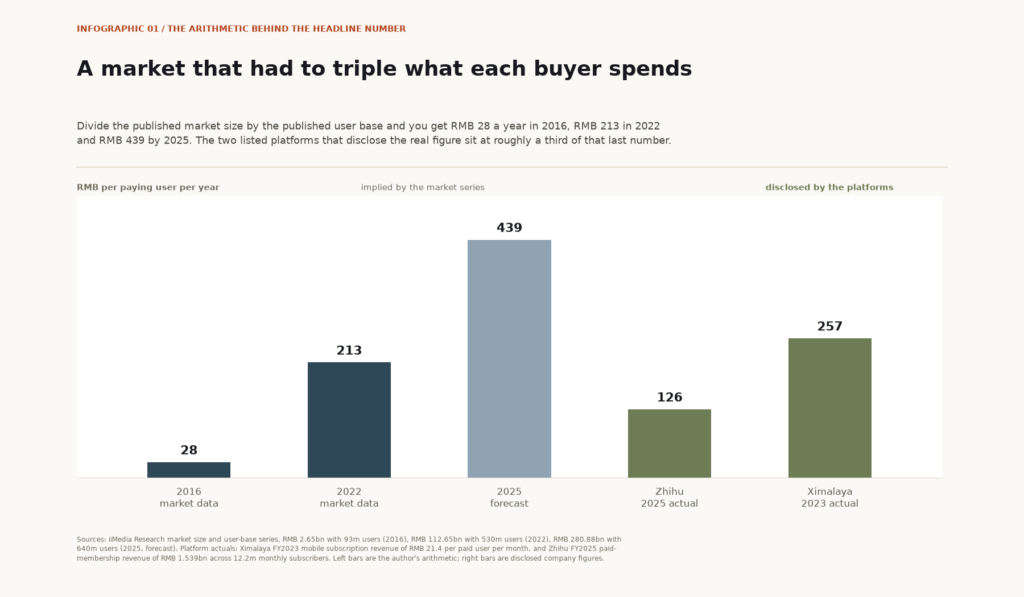
Twenty-eight yuan per user in 2016. Two hundred thirteen in 2022. Four hundred thirty-nine by 2025. To hit that last number, every Chinese buyer of paid knowledge would have to more than double their annual spend in three years, at a moment when every platform’s own disclosed per-user revenue is flat or falling. Ximalaya’s mobile subscription revenue per paid user was 21.4 yuan a month in 2023, which works out to about 257 yuan a year. Zhihu’s paid membership revenue of 1.539 billion yuan across 12.2 million average monthly subscribers in 2025 implies roughly 126 yuan a year per person.
Now do the other sum. Add the three leaders’ most recent disclosed subscription or course lines — Dedao’s 843 million yuan of total revenue in 2021, Zhihu’s 1.76 billion of paid membership in 2024, Ximalaya’s 3.19 billion of subscription revenue in 2023 — and you get something in the region of 5.8 billion yuan, or about five percent of the 2022 headline market. Different years, different scopes, so treat the arithmetic as directional. The direction is unmistakable. Whatever the 112.65 billion is counting, it is mostly not the thing Dedao, Zhihu, and Ximalaya sell.
That isn’t fraud. It’s definition inflation. Paid knowledge in the Chinese statistical sense sweeps in vocational training, exam prep, paid Q&A, audio, columns, community fees, and anything else with a paywall attached. Which means the industry’s favorite number describes a category, not a business. Any honest reading of the experiment has to start from the companies, because the companies are the only ones who had to reconcile a bank account.
Why it works at all: the four things people actually buy
Strip away the marketing and paid expertise sells four distinct goods. None of them is information.
Time. Someone read the hundred books so you can hear about the ten pages that matter. You are paying for another person’s hours of reading, compressed into your commute. This is the oldest and most defensible line in the business, because the alternative isn’t free — it’s your weekend.
Identity. Buying a course is a way of telling yourself who you are. The finished track, the certificate, the shelf of covers in the app: these are receipts for a self-image. Dedao understood this before anyone. Its customers weren’t buying economics. They were buying membership in the class of people who study economics.
Embodied trust. The teacher sells, not the syllabus. Buyers trusted Luo Zhenyu’s taste in teachers long before they trusted any particular course, and they bought a specific professor’s voice because that voice had already earned authority somewhere else. Expertise travels through people. It doesn’t travel through PDFs.
Company. The cohort, the group chat, the weekly check-in, the assignment that gets marked. Paid knowledge borrowed the accountability of a classroom and sold it back without the classroom.
Keep those four in mind, because every failure in this story is a place where the seller drifted back to selling the fifth thing — facts — which was always free.
The attendance problem
In 2021, Dedao’s listing file disclosed 49 million registered users. It also disclosed average daily active users: 632,400.
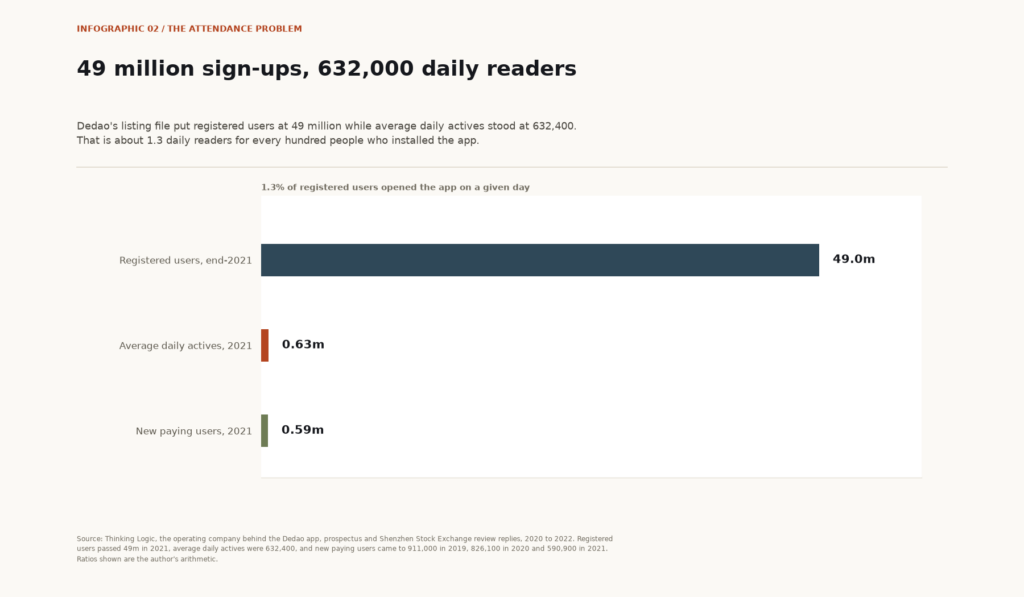
Sit with that ratio for a second. Out of every hundred people who installed the app, one and a bit showed up on any given day. At the first-quarter 2020 mark, the company had 21.35 million cumulative registrations and 5.63 million cumulative paying users — about a quarter had paid at least once. Average revenue per paying user was 231.93 yuan in 2019. So the model worked, in the narrow sense that people did pay, and paid a meaningful amount.
But look at the flow rather than the stock. New paying users were 911,000 in 2019, 826,100 in 2020, and 590,900 in 2021. The pipeline narrowed by a third in two years, well before the wider market cooled. And iResearch’s 2018 study of the sector found that even mid-to-upper-tier paid products averaged only about a 30 percent repurchase rate.
This is the structural flaw nobody likes to put on a slide. A course business depends on you finishing the thing and then buying the next thing. If you never finish, the second purchase doesn’t happen, and the customer you acquired with real marketing money becomes a one-time transaction. The sale succeeds where the value doesn’t materialize. Every subsequent quarter inherits that debt.
Case one: the company that invented the category, then left it
Dedao’s parent, Thinking Logic, went public in everything but outcome. Revenue was 627.9 million yuan in 2019, 674.6 million in 2020, and 843.3 million in 2021, at a gross margin around 44 percent. That is a genuinely profitable business by the standards of content. It filed for a ChiNext listing in September 2020 and spent twenty-three months answering regulator questions before withdrawing in August 2022.
The numbers inside that filing are more interesting than the withdrawal. Revenue fell 14.9 percent in 2019, and the core online knowledge business fell 18.75 percent that year. Read that again: the flagship product line shrank in year four, in the middle of the boom everyone remembers.
The 2021 recovery didn’t come from more courses. It came from offline seminars, which grew 95.6 percent, and from a product the company described as training camps, whose revenue rose 187.3 percent. That was 2021. The pivot from content to service is not a 2025 reaction to AI. It’s in the paperwork from 2022, buried under the growth table.
Since then, the interesting movement has been off the platform and back onto the people. Luo Zhenyu now runs a history-and-humanities account with daily video posts; his co-founders built their own channels in adjacent niches. When a platform stops being the best place for its founders to publish, the platform has told you something about platform economics: authority doesn’t aggregate. It stays attached to the human who earned it.
One caution here. A widely circulated claim says Dedao’s paying users collapsed from 1.65 million to 330,000. I could not trace that to any disclosure, filing, or credible report, and the company has largely stopped publishing user figures. Treat the number as a screenshot, not a statistic. The absence of disclosure is itself the more honest signal.
Case two: when the paywall learned to sell stories instead of expertise
Zhihu is the clearest test case in the entire sector, because it is the only one publishing audited numbers every quarter.
In 2024 it reported 3.599 billion yuan of revenue, with paid membership contributing 1.763 billion. Monthly active users fell 21.2 percent to 83 million. It also recorded its first quarterly non-GAAP profit in the fourth quarter. In 2025, revenue dropped 23.6 percent to 2.749 billion, paid membership fell 12.7 percent to 1.539 billion, advertising fell 32.3 percent, and everything else fell 37.9 percent.
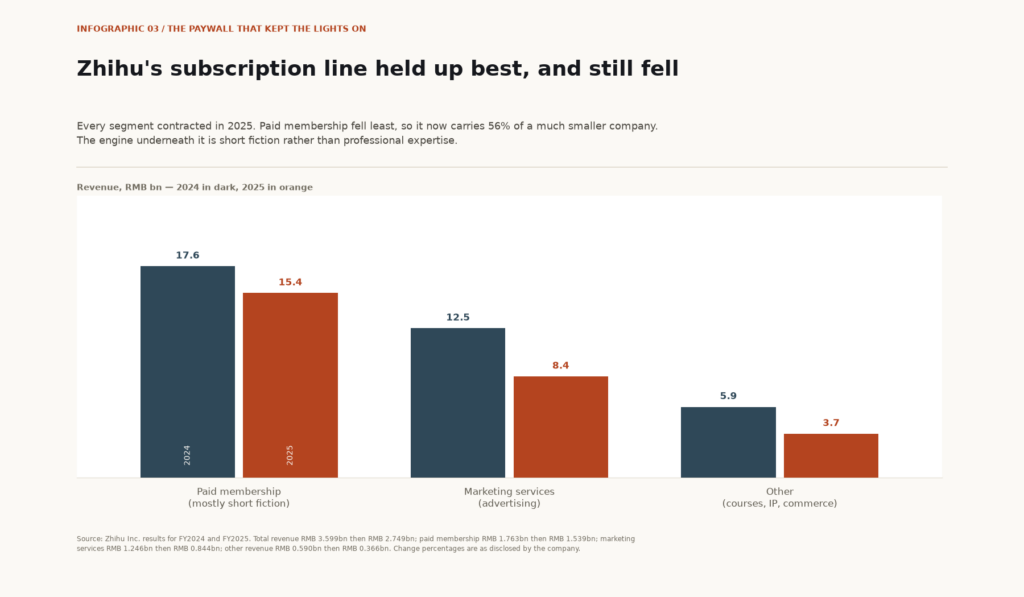
Note how that profit was made. Total operating expenses fell 19 percent; cost of revenue fell 22.3 percent; gross margin slipped from 60.6 to 59.9 percent; a 126 million yuan goodwill impairment landed; and the GAAP net loss widened from 169 million to 195 million. The company bought its profitability with subtraction. Shrinking into profit is a legitimate strategy and a very clear admission about where growth went.
Then there’s the product question, which is the one that matters for anyone trying to learn from this. Salt Membership’s growth engine turned out to be short fiction. Zhihu launched a dedicated short-story app in 2023, and by most accounts the subscription base is now driven by serialized narrative, not by professional answers about how to price a SaaS contract. Average monthly subscribers peaked around 15 million in 2024 and stood at 12.2 million at the end of 2025. Revenue per subscriber works out to roughly ten yuan a month.
So the largest paid-knowledge subscription in China, at the moment it finally became profitable, was mostly selling entertainment. That is not a moral failing. It is the market answering the question the outline poses: when you charge for knowledge, buyers say no; when you charge for a good story, they say yes. Ten yuan a month for fiction is a fair price. Ten yuan a month for insight turns out to be a hard sell.
And the detail that should genuinely worry the category: in the same period, Zhihu’s own AI answer product grew monthly actives by more than 260 percent, with next-month retention up about 83 percent. The paywall platform now gives away synthesis in one tab and sells stories in another. The synthesis tab is the one growing.
Case three: the biggest one sold itself
Ximalaya is what the category looked like when it was working. It built the largest paid-audio subscription business in China, with 303 million monthly users across all surfaces and 15.8 million mobile paying users in 2023.
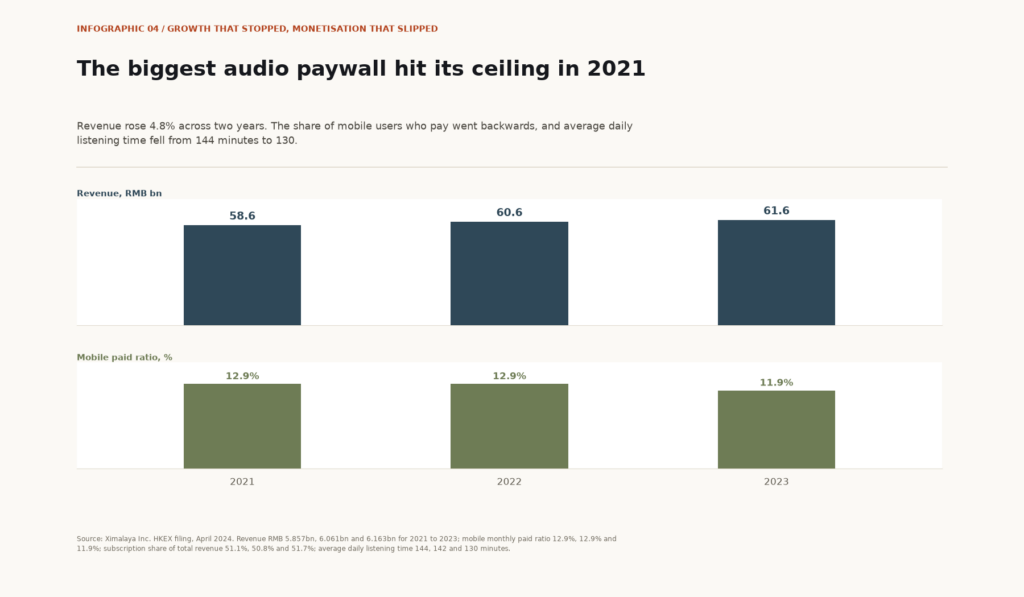
Revenue went 5.857 billion, 6.061 billion, 6.163 billion across 2021 to 2023. That is 4.8 percent of growth in two years, for a company that had been doubling not long before. Subscription held steady at just over half of revenue. What slipped was the thing that predicts the future: the share of mobile users who pay fell from 12.9 to 11.9 percent, and average daily listening time dropped from 144 minutes to 130.
There is a genuinely good number in there too, and it deserves airtime. Retention among auto-renew and annual subscribers was 75.9 percent, and 72.3 percent of paying users were on those terms. People who commit for a year stay. The problem was never churn. It was the size of the base and the price of the seat.
Then, in June 2025, Tencent Music agreed to buy the company for 1.26 billion US dollars in cash plus up to 175 million of its Class A shares — roughly 5.6 percent of the acquirer. Chinese regulators cleared the deal with conditions in May 2026, and it closed on 18 May 2026. Ximalaya became a wholly owned subsidiary. The reported consideration works out to something close to half the valuation the company carried in its 2021 funding round, when it was described as being worth more than four billion dollars.
A company that files repeatedly for its own listing and instead ends up as a division of a music platform is not a failure. It is a verdict about multiple. Subscription audio in China grew into a real business with real retention, and the public market still wouldn’t pay for it at the price its private investors had agreed on.
The AI undercut
Here is where the story stops being about Chinese consumer habits and becomes universal.
China’s official statistics put generative AI at 602 million users as of December 2025, up 141.7 percent in a year, with 42.8 percent penetration among internet users. Compare that to the paid-knowledge audience. Roughly the same size. One of them costs money, and one of them is free.
Then there’s the mechanic itself. A large multi-month panel study published in 2026 tracked the same people across search engines and standalone AI assistants, and found that 34.1 percent of sessions involving an assistant contained no external web step at all.
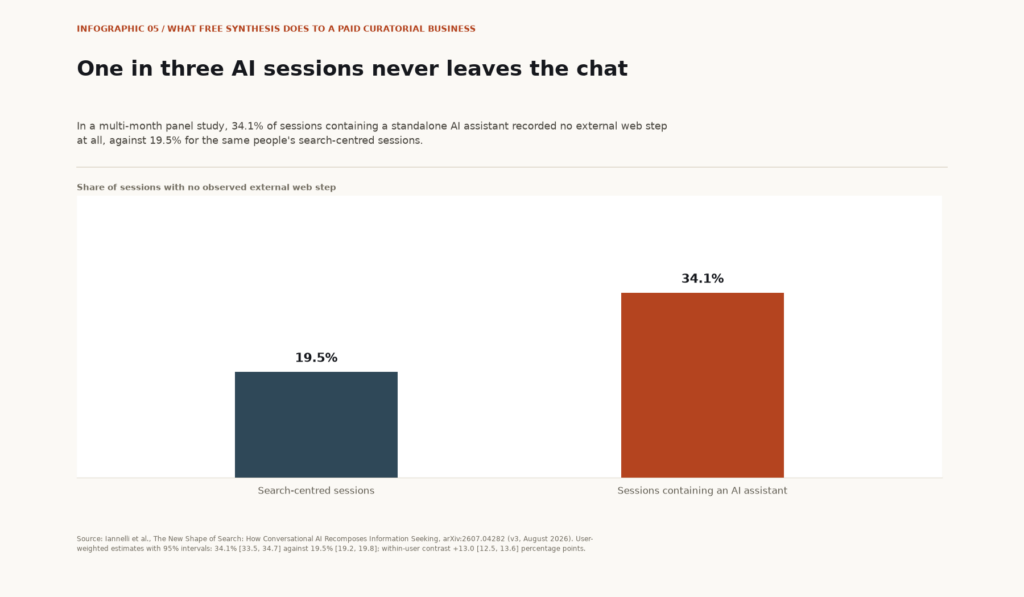
That number is the whole substitution thesis in one line. A third of the time, the question gets answered and the journey ends inside the dialogue. Nothing gets opened. Nothing gets visited. No one gets paid.
Now aim that at the paywall’s best product. The single most valuable thing a curator sold was the compression: someone read a hundred sources and handed you the ten percent that mattered. That is a prompt now. Not a good prompt, not always an accurate one — but free, instant, and available at the exact moment the question forms. The premium that paid for the editor’s salary was the premium on synthesis, and synthesis just collapsed in price.
What AI cannot do is notice that you skipped week three.
The counter-evidence: where selling expertise still works
It would be lazy to conclude that paid expertise is dying. In the same years the Chinese platforms stalled, Substack went from one million paid subscriptions at the end of 2021 to two million in 2023, four million in late 2024, and more than five million by March 2025, raising a hundred million dollars at a 1.1 billion dollar valuation and turning cash-flow positive.
The difference is structural, and it explains almost everything. Substack’s paid subscriptions attach to a named writer with a direct relationship to a named reader. China’s paid knowledge attached to a platform that sat between them, standardized the product, and kept the relationship. Platform-mediated expertise has to justify a toll. Person-mediated expertise just has to be worth the price.
The other place paid expertise keeps working is where the buyer is purchasing an outcome rather than an artifact — professional certification, advisory retainers, coaching with deliverables, B2B training with a measurable before and after. Nobody in that market asks whether information is free, because information was never what they bought.
What survives
Sort the category by what the customer is actually paying for, rather than by what the seller is shipping, and the map gets simple.
| What’s being sold | What the buyer receives | Pressure from AI | Durability |
|---|---|---|---|
| Raw information | Facts, definitions, explainers | Total | Effectively zero |
| Synthesis and curation | The relevant ten percent | Severe | Collapsing |
| Structure and sequencing | A path through a subject | High | Thinning |
| Accountability | Someone notices you didn’t show up | Low | Holding |
| Access | Rooms, people, introductions, deals | Very low | Premium |
| Transformation | Changed behaviour, verifiable outcome | Very low | Premium |
Read the table downward and the last three rows are the business. Read it upward and you are looking at the part of the industry that has already been repriced to zero.
What this means for brands and marketers
The mechanics are worth stealing even though the content model is worth abandoning. Tiered membership, paywalled depth, live access, community, tipping — this is a monetization architecture, and it transfers cleanly to any brand with an audience. What doesn’t transfer is the assumption that people will pay for your expertise because you have expertise. They won’t. They’ll pay for a seat at your table.
Four moves follow.
Price the outcome, not the asset. If the deliverable is a document, the price is a document’s price. If the deliverable is a working pricing model by the end of six weeks, the price is a consultant’s price.
Sell the room, not the file. Cohorts, office hours, peer review, and a human who remembers your name are the parts of your expertise that a chatbot cannot replicate, and they are also the parts customers describe when they explain why it was worth it.
Make the AI the free tier and the human the paid tier. The synthesis goes out free — that’s the top of your funnel now, whether you like it or not. The accountability, the access, and the judgment go behind the wall, because those are the things a model has no incentive to fake well.
Measure completion and repeat purchase, not downloads. Downloads are a marketing metric. Repeat purchase is the only honest test of whether you sold time, or accidentally sold a PDF.
And one warning worth printing on the wall. If your expertise product is a synthesis of publicly available information, you are now in direct competition with a free product that is faster, broader, and more patient than your team. You will lose that competition on price, and you will lose it on speed. Compete where the machine is structurally absent.
Risks and honest caveats
The data has gone dark. Dedao stopped disclosing user figures after its listing collapsed. The most-quoted decline statistic in Chinese media has no traceable origin. Anyone building a thesis on that number is building on a screenshot, which is why this piece leans on filings and audited accounts instead.
The repurchase math is brutal. Knowledge is close to a one-time purchase. You learn a subject once. A model that needs a returning customer is fighting the nature of its product, and no amount of community-building fully fixes that.
Quality contamination is real and documented. By early 2025, researchers quoted in state media were describing unqualified instructors, exaggerated claims, nested fee structures, and weak recourse for buyers who felt misled. Industrialization lowered the cost of production faster than it raised the cost of being wrong.
The cultural ceiling may be lower than the narrative. Paying for knowledge never became a default habit the way paying for entertainment did. The growth charts were always narrower than the story told about them.
And my own caveat. Market-size estimates for this sector vary by a factor of several depending on what gets counted, which means any single figure is an argument about methodology rather than a measurement of demand. Where I could not verify a widely repeated claim, I left it out.
What to watch next
Three signals will settle the argument faster than any forecast.
Watch whether any Chinese paid-knowledge company starts disclosing completion and repeat-purchase rates. The continued absence is the most informative disclosure available.
Watch whether the accountability layer gets productized as a paid feature rather than a free perk — scheduled human contact, verification of work, a named person who is answerable for your progress.
Watch Zhihu’s fiction-and-licensing line against its membership line. If short fiction keeps outperforming professional answers inside the country’s most prominent knowledge platform, the category has already answered the question in its own P&L.
Watch what Tencent Music does with 15.8 million paying audio subscribers. Bundling them into a music subscription is the natural move, and it would confirm that paid audio was never a knowledge business at all — it was a content library waiting for a bigger library.
Conclusion
So: does selling expertise work? Conditionally, and the condition is narrower than the industry would like.
It works when expertise is packaged into time saved, identity purchased, trust transferred, or accountability provided. It fails when it tries to sell facts, because facts were never scarce and are now freely synthesized. The headline market number was never measuring the thing the founders believed they were building. The filings were.
What the experiment actually proved is more useful than a verdict on one country. Information was always packaging. The price held for exactly as long as the packaging carried something the buyer couldn’t get elsewhere — a teacher they trusted, a cohort that expected them, a change they could point to afterwards. AI removed the cost of packaging in about three years. What’s left is the part that was human all along: someone who knows the subject, knows you, and won’t let you quietly stop.
That was the product. It always was.