China PR: The Evolution of the Press Release in the AI Era
Everyone in Chinese PR has heard the same story by now: the journalist is being bypassed, the press release now speaks directly to the model, and the release has quietly become the answer. It is a clean narrative. It is also, on the evidence, wrong in one important way.
The journalist was not bypassed. Journalism remains the largest single source category in AI citations — 22% of everything the major models link to as of October 2026, against 1.1% for press releases themselves. What actually changed is subtler and more useful: the release stopped being a pitch and became infrastructure. It is the dated, structured, verifiable document that makes everything built on top of it — the news story, the blog post, the product page — easier for a machine to trust.
That is a less romantic story than “the release became the answer.” It is also the one you can build a practice on.
What Everyone Gets Wrong About Press Releases and AI
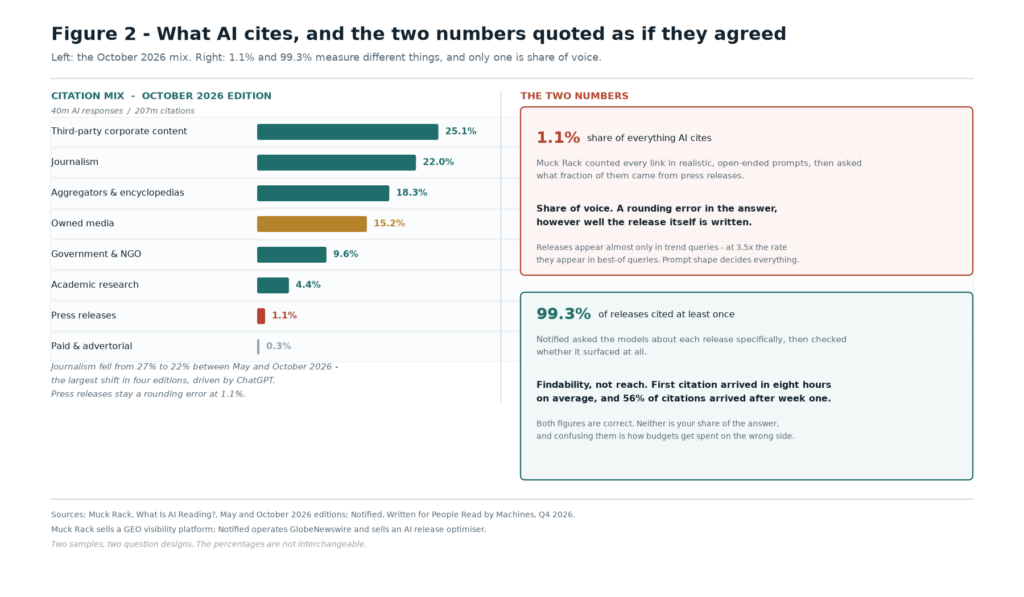
Here is the number that circulates in every pitch deck: 99.3% of press releases get cited by ChatGPT or Claude. Notified tracked more than 8,000 GlobeNewswire releases distributed in a single week in May 2026 and found an average time to first citation of just eight hours, with 17% of citations landing in the first day.
Now here is the other number, from Muck Rack’s October 2026 analysis of 40 million AI responses and 207 million citations: press releases account for 1.1% of what AI actually cites.
Both are correct. They are answering different questions, and the gap between them is where a great deal of money gets wasted.
Notified asked the models questions specifically about each release — what did this company announce — and checked whether the release surfaced. That measures findability. Muck Rack counted every link inside ordinary, realistic prompts and asked what share came from releases. That measures share of voice.
A release that is findable 99% of the time and worth 1% of the answer is not a channel. It is a citation source with a very specific, very limited job.
An independent dataset makes the gap even sharper. BuzzStream’s Citation Labs analysed roughly 4 million citations across ten industries and put press releases at 0.32% of news citations — and newswire copy specifically at 0.21%. Three separate research teams, three different samples, one consistent conclusion: wire copy is a tiny slice of what models quote.
Confusing findability with share of voice is not a small analytical slip. It is the difference between spending on distribution and spending on placement, and it explains why so many teams bought “GEO for press releases” packages in 2026 and could not show what they received.
What the Press Release Used to Be For
Three jobs, historically. Only one of them is gone.
The first was announcement: a dated, on-the-record statement that something happened. That job is intact and arguably more valuable than ever, because a machine needs a canonical version of an event.
The second was a pitch to a reporter — raw material for someone who would select, verify and rewrite it into a story. That job is not gone either, but its economics have collapsed. Muck Rack’s State of PR 2026 found 49% of PR professionals pitching more than 20 journalists per campaign, 71% reporting low response rates, and 61% citing shrinking media lists in relevant beats. The pitch still works. There are just far fewer people left to pitch.
The third job, borrowed credibility, is the one that broke. In the old chain, the journalist absorbed the reputational risk. If a claim was wrong, the byline carried the consequence. That arrangement is now optional rather than automatic, and the release has to carry its own authority.
The 2026 Chain: One Document, Two Audiences
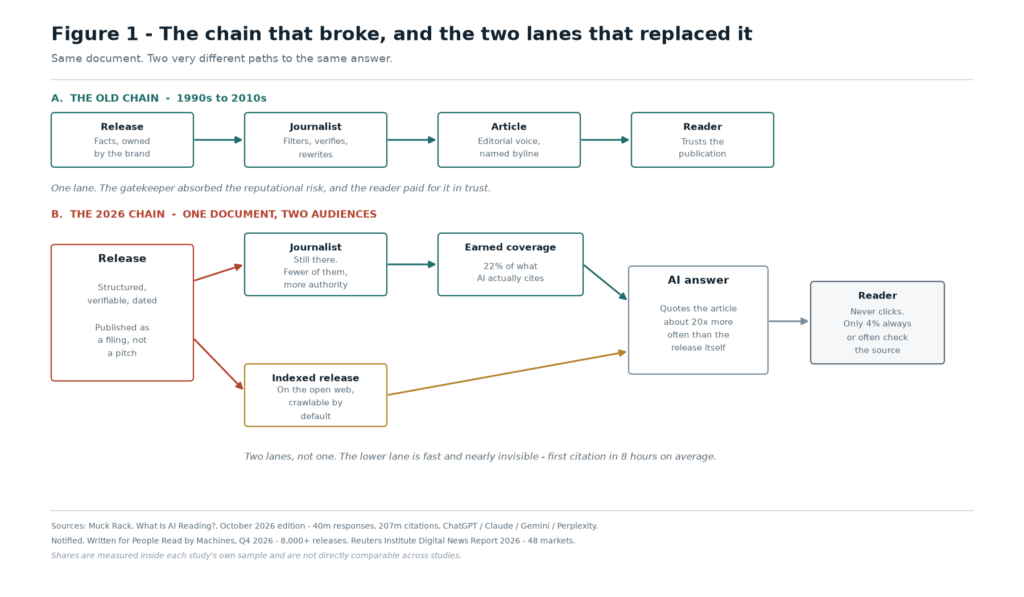
Look at the lower lane in that diagram, because it is the one that feels new and is actually the least productive. The release is published, indexed, crawlable, and the model finds it within hours. It gets cited. And then it gets cited again, and again — Notified’s later work found 56.4% of citations arriving more than a week after publication, up from 48.4% just months earlier. Releases have staying power.
They just do not have volume. The upper lane still does. A reporter’s write-up of the same announcement is treated by the model as independent verification, and independent verification is what gets quoted. Twenty-two percent of cited links are journalism; 25.1% is third-party corporate content; 18.3% is aggregators and encyclopedias; 15.2% is a brand’s own media. Releases and paid advertorial together account for under 1.5%.
One finding deserves more attention than it gets. Notified found that owned content — a newsroom, blog or campaign page — was twice as likely to be cited in the first 30 days when it was supported by a press release. That is the release’s real mechanism: not competing with the story, but making the story verifiable.
Why China Is a Different Problem
Everything above is a global pattern. China adds three complications that no Western playbook covers.
The soft-article economy was already a machine-readable build
Chinese PR did not arrive at “content as a machine-readable asset” in 2026. It arrived there around 2015, through 软文 — soft articles, paid placements dressed as editorial. That market is large and largely unmeasured by Western analysts; CIPRA’s 2025 survey put China’s PR industry at 87.33 billion RMB, growing 4.1%, which has now trailed GDP growth for four consecutive years, with the top 30 firms growing revenue 2.1% while profit fell 6.4%.
Which means Chinese PR teams have a head start on the mechanic and a liability on the ethic. The mechanic — publish structured, fact-dense text on domains that get crawled — is exactly what GEO rewards. The liability is that soft articles were built to look independent, and the one thing a model is increasingly good at is noticing when they aren’t.
Five models, five diets
This is the part that breaks every “one content strategy” assumption. Chinese assistants do not share a source pool; they inherit one from whoever owns them.
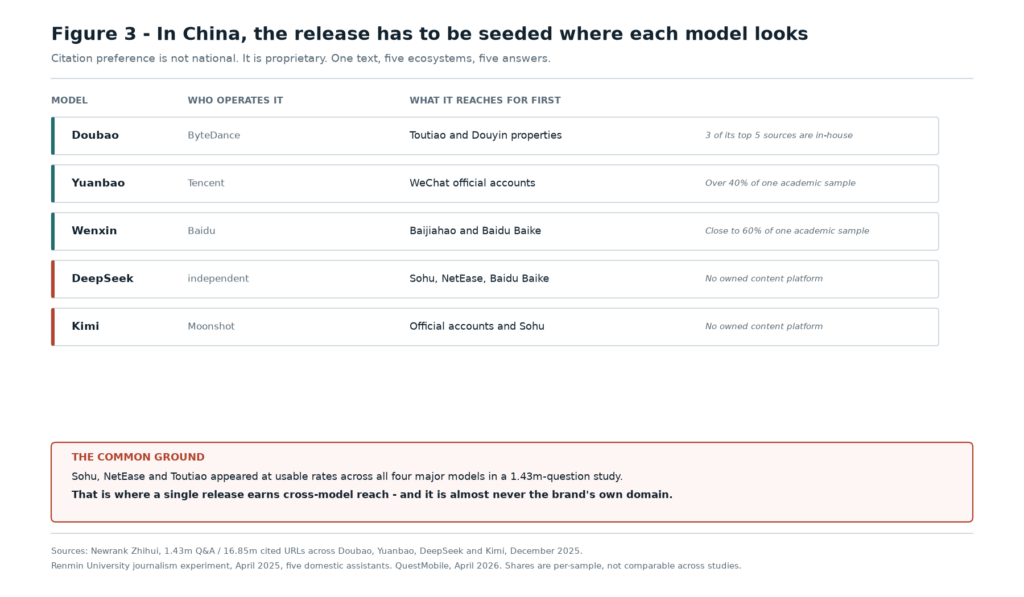
A study of 1.43 million questions and 16.8 million cited URLs across Doubao, Yuanbao, DeepSeek and Kimi found the diets sharply divergent: Doubao leans on Toutiao and Douyin properties, with three of its top five sources inside ByteDance’s own ecosystem. An earlier academic experiment at Renmin University found Yuanbao pulling over 40% of its citations from WeChat official accounts and Wenxin taking close to 60% from Baijiahao and Baidu Baike.
The practical consequence is uncomfortable for anyone whose career rests on the corporate website. Your .com is authoritative to you and peripheral to the answer. QuestMobile put AI-native app users at 446 million by March 2026 — 461 million by April, at 180 minutes per person per month — and almost none of those people are reading your newsroom.
A very large industry with a very thin growth rate
Set 87.33 billion RMB of industry revenue against 230,000-plus valid press card holders nationwide and you can see the squeeze. The budget is not growing quickly. The gatekeepers are not multiplying. The only variable with room to move is whether the work reaches the answer directly.
What the Release Actually Has to Do Now
Structure is not decoration
Notified’s Q4 2026 analysis is the most concrete work anyone has published on this, covering 26,670 English-language releases and more than 850,000 citation events. The lifts are large and boringly specific.
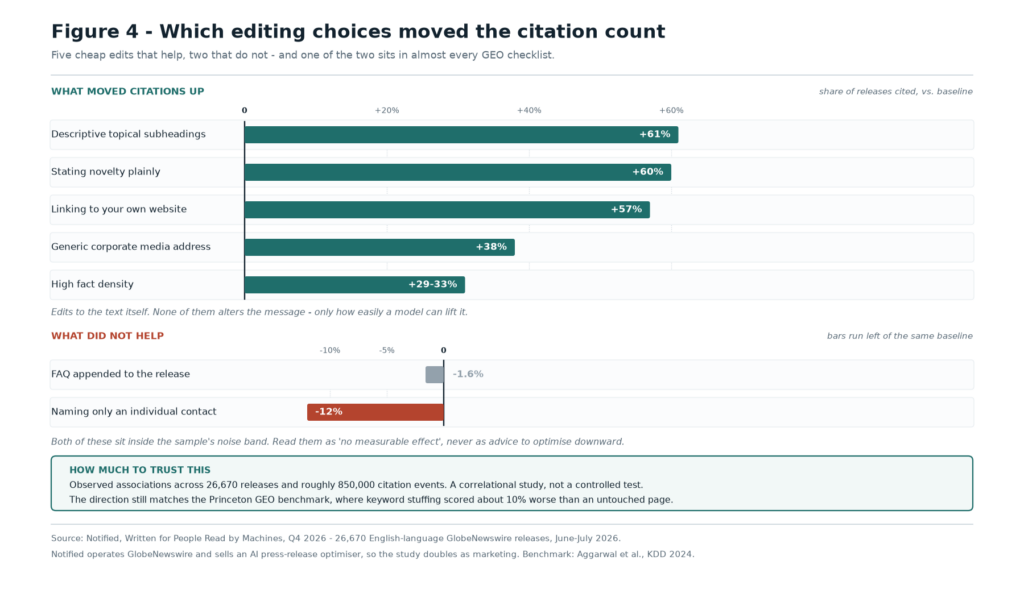
Descriptive subheadings — “Key Findings,” “Financial Highlights” — associate with 61% more citations. Saying plainly that something is new associates with 60% more. Linking to your own site: 57%. High fact density: 29% to 33%. Even something as unglamorous as a generic media@ address beat naming a single individual by a wide margin, presumably because a corporate address reads as institutional rather than personal.
And the trap: appending an FAQ section did nothing. Slightly negative, in fact. Everyone’s GEO checklist has FAQ at the top of it, and the largest dataset available says it is decoration.
These are associations, not a controlled experiment, and Notified sells an AI Press Release Optimizer whose users generated 15% more citations on average — a figure from the same company’s own research. Take the direction, discount the magnitude. The direction happens to match the one genuinely rigorous study in the field: Princeton’s GEO benchmark, which found statistics, quotations and cited sources lifting visibility by up to about 40%, while keyword stuffing performed roughly 10% worse than an untouched page. That last finding should be pinned to every content brief in the industry.
Answer-shaped, not narrative-shaped
Here is a test you can run this afternoon. Take your last three releases and read the first paragraph. If it opens with a company self-description — “a leading provider of integrated solutions” — you have written a document that answers no question anyone asked.
Models retrieve passages, not narratives. A passage that answers how much something cost, who the customer is, what changed and when, is liftable. A passage that sets a scene is not. This is why the highest-performing releases in Muck Rack’s sample carried roughly twice the statistics and far more bullet points than releases that never got cited.
Publish it as a filing, not a leak
There is a quiet structural point buried in the distribution data. Press material published on a brand’s own domain rather than syndicated across a wire network accounted for about 3% of citations overall in BuzzStream’s analysis — and 18% on ChatGPT specifically. Syndicated copies were several times less likely to be the version credited.
Models deduplicate near-identical pages and tend to credit whichever version they crawled first. If your release exists in nine places and none of them is yours, you have handed the canonical version to someone else.
The Part Nobody Wants to Say Out Loud
The journalist’s verification was not a formality. It was the accountability layer, and it is now optional.
When a release is the thing the model reads, an over-claim becomes a fact with a citation attached. Note the asymmetry the Reuters Institute documented in its 2026 Digital News Report: trust in news has fallen to 37% globally, its lowest recorded level, while only 20% trust what they get from an AI chatbot about news. Yet among people who use chatbots for news, trust runs much higher than the aggregate — and only 4% say they always or often click through to check the original source.
So: low general trust, high in-use trust, near-zero verification. That is the exact condition under which a confident, well-formatted, wrong release does the most damage. And the damage now attaches to the brand, not to a newsroom.
China has moved faster on the formal side of this than most markets. The CAC’s labelling measures took effect 1 September 2025, requiring both visible and metadata-level identification of AI-generated content, with enforcement running hard — over 5.6 million pieces of content removed and 49,000-plus accounts actioned in a single campaign. Separately, the Internet Advertising Measures have required since May 2023 that knowledge-style content carrying a purchase link be marked as advertising; enforcement produced 3,058 soft-article violations in the first year alone. The industry regulated itself too: CIPRA’s guideline for generative AI in PR practice, effective 1 January 2026, requires a generate-verify-correct review chain and places final responsibility for AI-assisted output on a named professional.
The gap is not rules. It is that a press release rarely carries a purchase link, so it sits outside the ad-labelling regime while doing very similar persuasive work on a non-human audience.
How to Actually Measure This
Stop measuring placements. They were always a proxy; now they are a bad one.
Muck Rack’s 2026 State of PR found 73% of practitioners calling GEO at least somewhat important, and 29% saying nobody in their organisation owns it. Nearly four in ten are not measuring it at all. That is not a technology gap. That is an org-chart gap.
A working measurement loop, in order of usefulness:
Fix a set of twenty category questions your buyers actually type. Record which brands appear, which domains are cited, and whether those domains are yours, a journalist’s, or a platform’s. Repeat on a schedule and store the raw answers — screenshots are not a dataset.
Then compare against your coverage log. Look for the disagreements: a claim that appears in your release but never in an answer, a competitor named where you are absent, a platform that cites you nowhere. Those disagreements are your briefing list.
Watch one number above all others: whether the sources cited next to your brand are migrating toward domains you can influence. That is the leading indicator. Brand mentions follow.
Where This Goes Next
Three predictions, with confidence levels attached.
The release becomes a filing system, not a campaign. Teams will maintain a canonical, permanently hosted announcement archive on their own domain — structured, versioned, linked from every syndicated copy. Reasonably confident; the deduplication behaviour makes it inevitable.
Soft articles and press releases converge into one category, and it gets labelled. The distinction between paid placement and owned announcement will not survive contact with a machine that reads both identically. Expect disclosure norms, not just ad rules, to reach the release.
Chinese PR firms sell GEO as an operating capability, not a service line. The 2026 pattern of agencies standing up GEO desks is early. The firms that win will be those who can show a client which of their claims the models are repeating and which are being quietly dropped.
The Takeaway
The press release did not learn to talk to machines instead of reporters. It learned to do something harder and less flattering: it became the substrate. The reporter still writes the story that gets quoted roughly twenty times more often than the release ever will. But the release is what makes that story verifiable, what anchors the blog post that gets cited twice as fast, and what gives the model a dated, structured, citable version of events when nobody writes the story at all.
Write it for the machine, by all means — subheads, numbers, named sources, your own domain. Just don’t believe it has replaced journalism. It has replaced the press kit. That is a smaller prize, and it is real.