The Margin Behind the Mega Sale: What China Actually Pays for Attention
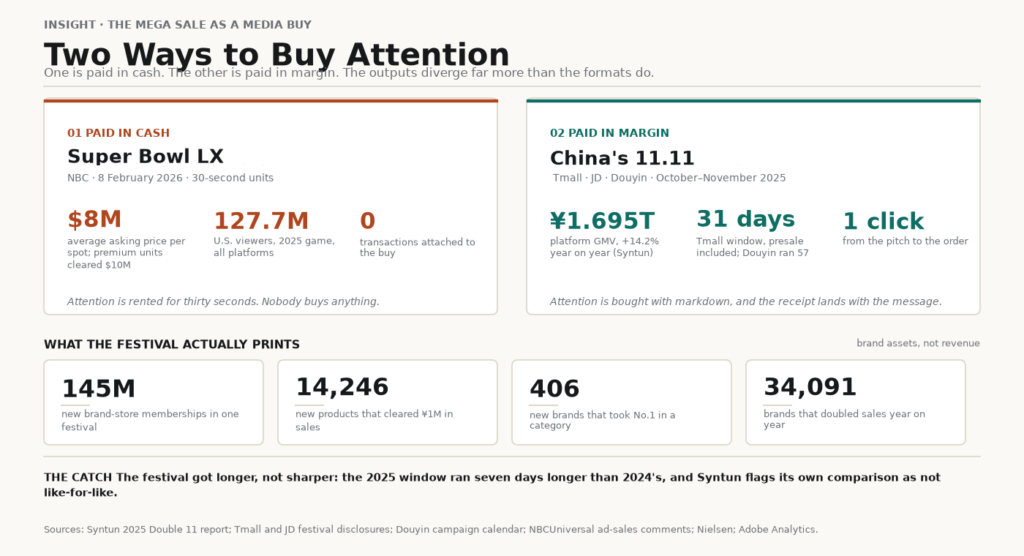
Syntun put this year’s 11.11 at ¥1.695 trillion. The figure that should stop an overseas marketer is smaller: 406.
The Number a Discount Event Cannot Produce
On Tmall, 406 new brands took first place in a trend category, 26 of them past ¥100M. Another 14,246 new products cleared ¥1M in sales. A full third of the items that crossed ¥100M were launches, not carry-over hero SKUs.
Read that against the usual Western reading of 11.11 — a price war with a countdown clock — and it stops making sense. Price wars reward whoever is cheapest, and a brand eighteen months old is almost never cheapest. Something else is being bought here.
The Evidence Sitting in an Index
The cleanest test comes from the China Online Consumption Brand Index, built by Peking University’s National School of Development with its digital-finance centre and Sun Yat-sen’s business school, and first published through Xinhua in May 2025. It tracks whether online buyers drift toward branded goods or away from them. The index lifts in both festival quarters, the autumn one more than the spring one. And the researchers state the core result plainly: during the festivals, unbranded goods, bottom-tier labels and quality brands all cut prices at once — yet quality brands’ relative sales rose more.
One disclosure belongs here. Tiantian, Alibaba’s marketplace unit, supplies the technical support, and the data is Tiantian’s alone. Read it as a strong signal from an interested party, not a neutral verdict.
Why the Ritual Makes the Markdown Safe
Here is the mechanism. Cut a price by 20% on a Tuesday in March and buyers update what they think you are worth. Cut it by 20% on the same date, every year, for seventeen years, and they update their calendar instead. The CBI team reaches the same place from the numbers: a decade of fixed festival timing taught shoppers to expect the markdown, so the discount stopped reading as repositioning and started reading as occasion. Reference price survives because the calendar absorbs the damage.
What the Slot Costs, and What It Prints
A thirty-second unit in Super Bowl LX sold at roughly $8M on average, with premium positions clearing $10M. The previous game drew 127.7M U.S. viewers across all platforms. Zero transactions attached.
China runs the same trade in a different currency. No brand wires the platform a media fee; it hands over its pricing power for a few weeks and takes back a national moment. The markdown is the CPM.
The Catch: You Can Stretch the Calendar, Not the Punch
Tmall’s 2025 window ran 31 days. Add Douyin’s Mid-Autumn run and it reaches 57. Syntun’s +14.2% lands on a period seven days longer than last year, and Syntun itself flags the comparison as not like-for-like.
Brand advertising runs on compression: one room, one hour, one message. Spread the room across five weeks and the margin bill stays while the moment leaves. What remains is a long discount wearing festival clothes.
How to Buy the Moment
Own hours, not a season
Pick 72 hours inside the window. Put the launch, the story and the distinctive assets there, and let the rest of the calendar run as logistics.
Measure the print, not the receipt
New memberships, branded search in the 30 days after, repeat rate in the 90. Those three tell you what the brand kept. GMV only tells you what the discount did.
Fund it from the brand line
If the festival is a media buy, it belongs in brand budget with a fixed flight date — and you defend that date the way you defend any other buy.
In the West, the brand ad and the sale sit on two lines of the P&L and you pay twice. In China they were built as one line and settled in margin. That arbitrage holds exactly as long as the festival stays a festival.