Why AI Checkout Failed in the West and Became the Default in China
Walmart ran the cleanest test anyone has run on AI shopping, and it failed in a way that explains the entire market.
From November 2025, roughly 200,000 Walmart products were buyable inside ChatGPT without leaving the conversation. Five months later, Walmart pulled the plug. Purchases completed in the chat converted at about a third the rate of purchases where the shopper clicked through to Walmart’s own site. Daniel Danker, the executive who ran the experiment, called the experience unsatisfying and told investors it would be gone within a month. OpenAI retired Instant Checkout shortly after.
That result is usually read as a verdict on AI commerce. It is actually a verdict on infrastructure.
The gap is real, and it is wide
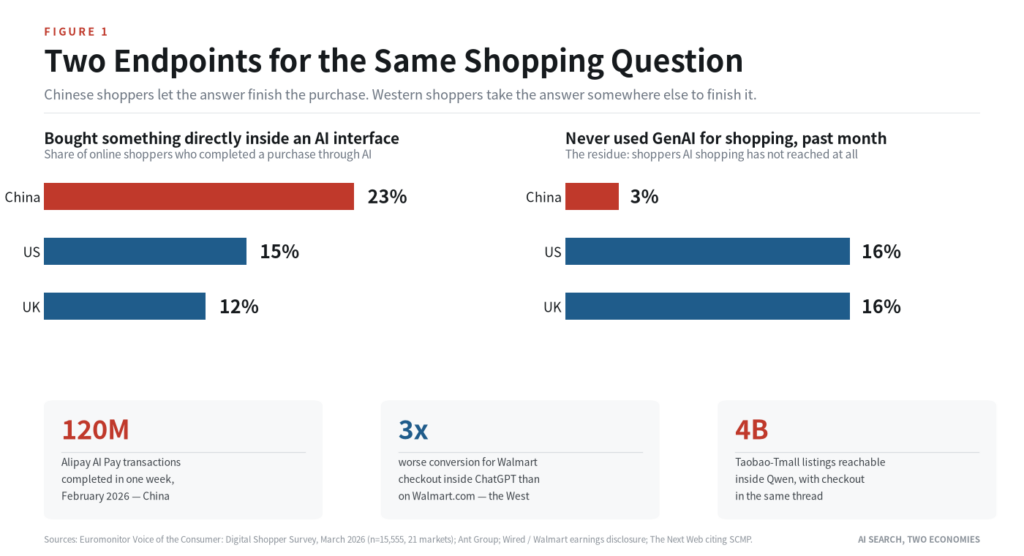
Euromonitor’s March 2026 survey of 15,555 shoppers across 21 markets puts the two endpoints side by side. In China, 23% say they have bought something directly through an AI interface. In the US it is 15%, in the UK 12%. Flip the question and the gap widens: only about 3% of Chinese shoppers had not used generative AI for shopping in the past month, against roughly 16% in both Western markets.
Same technology, two different endpoints. Shanghai asks, gets an answer, and the answer closes. Seattle asks, gets an answer, and goes to Amazon.
Why: the rails were already there
The tempting explanation is that China’s AI is better at commerce. It isn’t. The explanation is duller and much harder to copy. Taobao, WeChat, Meituan and Douyin were already stores, with payment, logistics and after-sales inside one app. When Qwen was wired into Taobao’s four billion listings and Alipay’s checkout, the AI inherited a closed loop it never had to build. Alipay’s AI Pay cleared 120 million agent transactions in the week of 5–11 February 2026 alone.
ChatGPT inherited the opposite. It arrived as a layer floating above a retail web that lives in separate apps with separate checkouts. Walmart’s three-times gap is not a bug in the model. It is what happens when the answer and the transaction sit on opposite sides of a wall.
What the West lost instead
Here is the part that gets missed. The West did not lose the purchase to AI. It lost the decision.
Fractl and Search Engine Land measured 1,010,848 high-volume keywords through April 2026 and found the fastest collapse was not at the top of the funnel, as everyone expected. It was the middle. Comparison queries — “best CRM for small business,” “X vs Y” — fell 36%, against 19% for informational and 34% for transactional. Those are precisely the questions a chatbot answers cleanly. AI became the decision engine and left the checkout where it stood.
The number brands should actually fear
Only 5% of purchase journeys end directly inside an AI tool. That is the figure people quote, and it makes AI commerce sound like a rounding error. The number sitting next to it matters more: 18% of consumers have bought something on an AI recommendation without checking it anywhere else.
For those buyers, the brand never received a search, a comparison page, or a click. It received an order, or it received nothing.
That is the real exposure. Not that AI will sell for you — that AI will decide without you, and you will never see the moment it happened.
Where this leaves you
Optimizing to be cited and optimizing to be bought are now two different jobs, and most teams are staffed for only one. Being the answer is table stakes. Being the answer that is purchasable wherever the answering happens is the position China has already built and the West is still arguing about.