Every Other Growth Metric Adds. This One Multiplies.
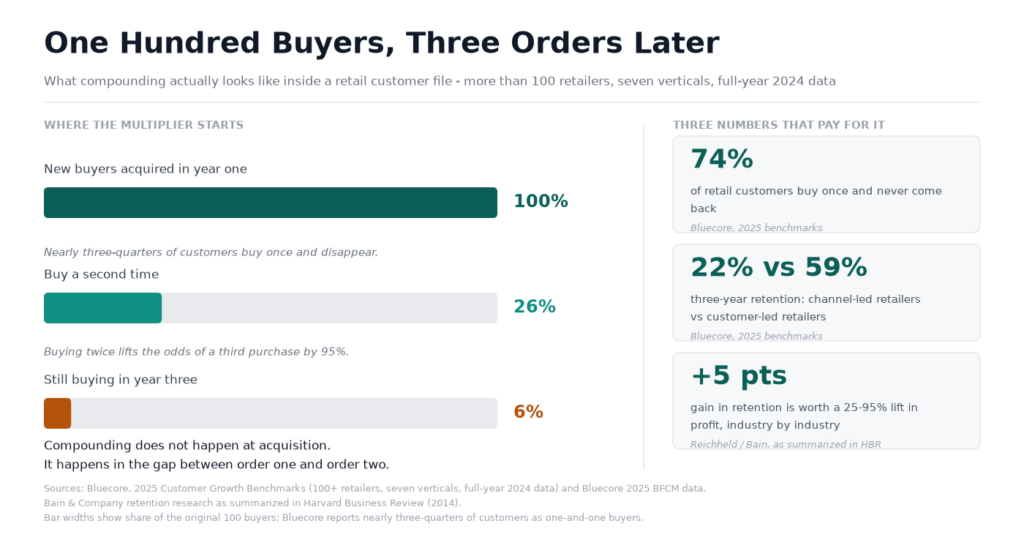
Ask a growth team for its dashboard and you get acquisition: CAC, ROAS, new customers, blended payback. Ask what share of last year’s buyers bought again and the room goes quiet. That quiet is expensive: dashboards refresh the flow every morning and bury the stock in a cohort table nobody opens. Bluecore’s benchmarks, built from more than 100 retailers across seven verticals over a full calendar year, put average retention at 27.4% and three-year survivorship at 6%. Start with 100 new buyers and six are still buying three years later. Bluecore sells retail marketing software, so treat its figures as large-sample vendor research rather than an audit.
Why the second order is the hinge
Nearly three-quarters of retail customers buy once and disappear. Then something flips: once a shopper buys twice, Bluecore found the likelihood of a third purchase rises by 95%.
A claim, then an experience
The mechanism is not the discount. A first purchase is a bet on a claim, a second is a bet on an experience. The ad did the persuading the first time; the product did it the second. So the customer now holds evidence instead of hope, which is why active buyers place 57.6% more orders and spend 69.2% more than new ones. Same catalogue, same prices, different history.
Adding versus multiplying
Acquisition is a flow: each new customer is plus one, and that plus one starts eroding the moment the order clears. Re-purchase is a stock. It behaves like capital, earning or decaying whether or not anyone looks at it.
Twenty-two percent versus fifty-nine
Retailers that run on channel metrics average 22% three-year retention. Retailers organised around customer movement average 59%. One is a treadmill with a marketing budget. The other is a flywheel with an engine.
Why this surfaced this year
Three markets noticed the arithmetic at once.
China’s member math
Tmall’s 88VIP tier passed 64 million members in June, spends roughly nine times what non-members do per year, and drove more than 70% of top-brand sales in last year’s Double 11.
Software’s retention ceiling
McKinsey’s study of 55 B2B software companies found top-quartile valuations paired with 113% net revenue retention, against 98% at the bottom, where new business spends its first quarter refilling a leak.
The holiday inversion
In Bluecore’s 2025 Black Friday and Cyber Monday data, 53% of orders came from repeat buyers, up from about 47% a year earlier, while new-customer orders fell to roughly 35%.
The objection that deserves an answer
Retention pays next year and you need this quarter. Fair. But postponing the compounding metric is rarely a one-quarter decision. The base you did not re-engage is the base that churns, the CAC you avoided never appears in the plan, and churn can quietly cancel growth work that is technically working.
What changes on Monday
Give re-purchase rate the same standing as CAC and read it cohort by cohort, not blended. Fund the second order deliberately: the post-purchase message almost nobody sends, the replenishment reminder, a reason to return that is not another coupon. Then report repeat revenue beside new revenue, so the treadmill and the flywheel stop looking identical in the deck.
Every growth metric adds. One multiplies. How many came back is how you tell which one you are running.