Half the Internet Is Now Machine-Written. Almost None of It Ranks.
In January 2014, Mark Schaefer published a post called Content Shock and made an argument that sounded like heresy at the time: content supply was growing faster than anyone’s ability to consume it, so the marginal return on one more blog post had to fall. Ten years later he looked half right, half ignored. Budgets kept flowing to content that couldn’t justify itself.
Then AI arrived, and the flood stopped being a metaphor.
It isn’t that machines learned to write well. It’s that they made competent free. Grammar-perfect, factually plausible, entirely interchangeable prose now costs roughly nothing to produce, which means it’s worth roughly nothing to read. We built an economy on the assumption that acceptable work had value. That assumption just died.
What content shock got right, and the one thing it missed
Schaefer’s original post is worth rereading, because it was never really about attention spans. It was about a supply curve crossing a hard ceiling. Americans were consuming about 10 hours of content a day, up from 7.4 in 2000, and there are only so many hours in a life. Meanwhile the amount of available web content was doubling every 9 to 24 months depending on which study you believed.
His conclusion was economic, not cultural: when supply explodes and demand is fixed, the price of attention rises. Since the content itself is already free, you pay in production quality, in promotion, in distribution. Deep pockets win, entry barriers climb, and eventually the cost-benefit flips.
Two of those three predictions landed. The third is where he was wrong, and it’s the interesting part.
Schaefer assumed scarcity would force quality up. What actually happened is that most companies responded to rising costs by producing more of the same thing, cheaper. Volume was the only lever they knew how to pull. For a decade, the content industry ran a strategy that its own data contradicted.
The second flood: when average became free
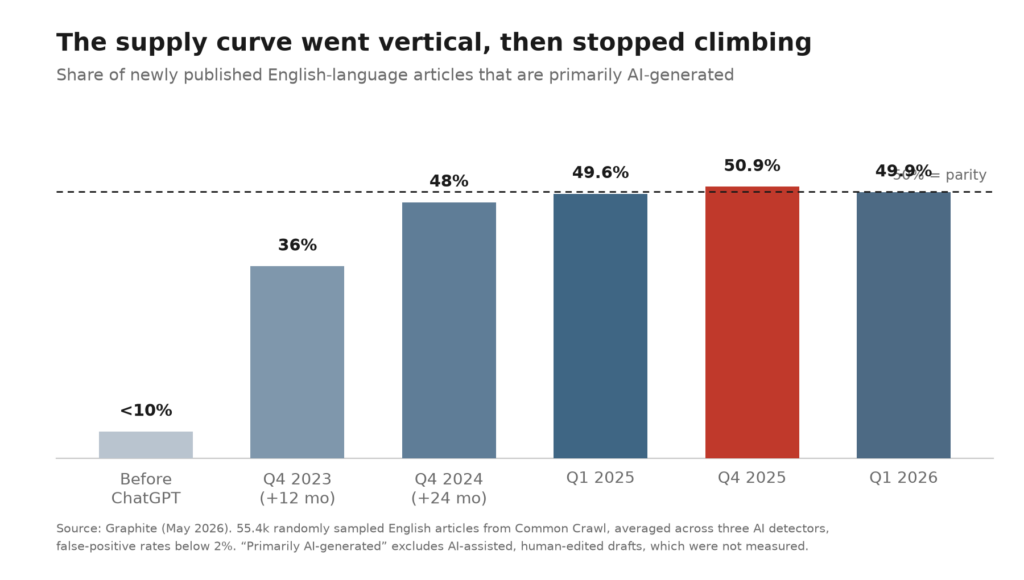
Here’s the number that should end the debate. Graphite, a growth agency that publishes its methodology and opens its raw data, sampled 55,400 randomly selected English articles from Common Crawl and ran each through three independent AI detectors. In May 2026 it reported that about 50% of newly published online articles are primarily AI-generated — dead even with human output.
The trajectory matters more than the level. Twelve months after ChatGPT launched, the share hit 36%. Twenty-four months in, 48%. It crossed human output in Q4 2025 at 50.9%, then settled at 49.9% in Q1 2026. The curve didn’t keep climbing. It flattened.
Why? Graphite’s own hypothesis is the most useful sentence in the report: practitioners discovered that pure AI articles don’t perform in search. Which brings us to the strange part of this story.
The web is half machine-written, and search barely notices
Run the same detection against what actually ranks, and the picture inverts.
Graphite’s companion study found that 86% of articles ranking in Google Search are human-written, and only 14% AI-generated. On ChatGPT and Perplexity, 82% of cited articles are human. Among pages sitting at position one, just 7% were primarily AI-generated.
Ahrefs reached a compatible conclusion with a much bigger sample: 600,000 pages across 100,000 keywords, analyzed in July 2025. About 86.5% of top-20 pages contained some AI content, but the correlation between how much of a page was AI-written and where it ranked was 0.011 — statistically indistinguishable from zero. Google neither punishes nor rewards AI content. It just doesn’t care how the sausage was made.
So we have a paradox that should reframe the whole argument: half the web is now machine-written, and almost none of it is winning. The flood isn’t drowning good content by outcompeting it. The flood is drowning good content by burying it — and by making readers distrust the category.
Why “average” is a specific, diagnosable thing
Average content has fingerprints. You know them the moment you see them.
It opens with a definition nobody asked for. It stacks three adjectives where one would do. It reaches a conclusion that was visible from the subheading. It has a voice, but the voice belongs to no one — a statistical average of every marketing blog ever published, smoothed into paste.
Call it AI-flattening. Models are trained to produce the most probable next token, and the most probable next token is, by construction, the consensus. Ask a model for a point of view and it will often hand you a balanced summary of everyone else’s. That’s not a bug you can prompt away. It’s the shape of the tool.
And there’s a deeper mechanism at work. In 2024, a team led by Ilia Shumailov published a paper in Nature showing that when generative models are trained recursively on their own output, they suffer model collapse: the tails of the distribution disappear first, then variance collapses entirely, and the model converges on a narrow, degraded version of reality. Training on 10% real data alongside generated data limited the damage but didn’t eliminate it.
Now read that as a metaphor for the content market, which is how it’s already being used. When most new text is generated from the consensus of old text, the tails vanish. The weird, specific, unfashionable, hard-to-verify ideas — the ones that occasionally turn out to be right — get smoothed out of the corpus. What’s left is a very large, very clean, very boring middle.
The three-way squeeze
The economics of average are getting squeezed from three directions at once, and it’s worth separating them because most commentary blurs them.
One: supply is infinite. Covered above. Fifty percent and holding.
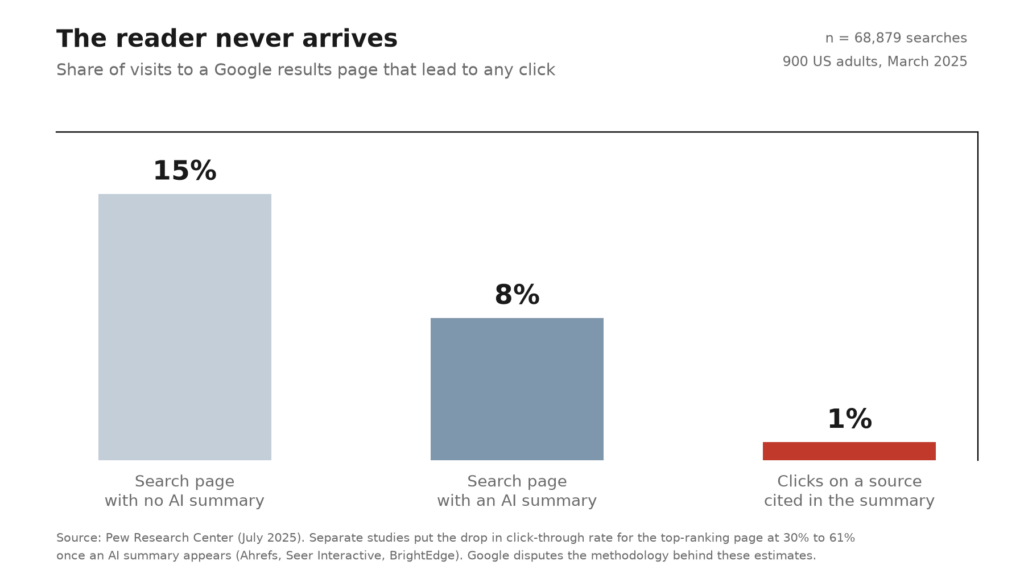
Two: distribution is shrinking. This is the part content strategists underestimate. Pew Research Center tracked 68,879 Google searches by 900 US adults in March 2025 and found that when an AI summary appeared, users clicked a traditional result 8% of the time, versus 15% when no summary appeared. Only 1% clicked a source cited inside the summary. SparkToro and Datos had already shown 58.5% of US Google searches ending without any click at all.
Publishers are now reporting the bill. Ziff Davis told analysts in November 2026 that organic Google referrals to CNET, IGN and PCMag fell about 37% year over year — after a 23% decline the year before, a two-year drop above 50%. Its CEO said the company is “not planning on a search recovery.” Its content appeared inside AI Overviews and AI Mode roughly 2.7 billion times in a quarter, close to ten times its click volume. Ten units of visibility for one unit of traffic.
That ratio is the whole content economy in one line.
Three: trust is falling. Emplifi surveyed more than 1,600 US and UK consumers in January 2026 and asked which content types feel authentic. Search results scored 66%. Customer reviews, 63%. AI-generated content came last at 31%. The Harris Poll, working with the 4As and Infillion, found that 78% of consumers say AI makes ads feel less authentic, 73% would be less likely to trust an ad they suspected was AI-made, and 63% would be less likely to buy from the brand behind it.
Cashew Research added a sharper detail in August 2026: 87% of consumers now assume brand content is at least partly AI-generated, and only 13% are confident they can tell. Which means the question stopped being “can they detect it?” and became “what proof do you have that a human was involved?”
The experiment that should worry every content team
In September 2026, Harvard Business Review published a study by Adam Peruta, run with Ipsos: 20 video ads from major brands, half original human work and half generated entirely by AI from briefs reverse-engineered from the originals. Three thousand US consumers rated them.
Consumers couldn’t reliably tell which was which. Only about a quarter identified the AI versions.
And the AI ads still lost. On average they scored 14% lower on short-term sales potential and 17% lower on long-term brand equity. One explanation the researchers offered: 49% of the human films relied on storytelling; only 30% of the AI replicas did. Machine production drifted toward product demonstration and pretty shots, and quietly dropped the narrative.
Sit with that for a second. The work passed every visible test. It looked finished. It was approved, shipped, and it underperformed in a way no dashboard would surface for eighteen months.
What actually survives the flood
Four things, and none of them are new. What’s new is that they’ve become the only things.
A position someone can disagree with. Average content takes no stance, because a stance is a risk. That’s exactly why a stance is now the cheapest form of differentiation available. If a competitor could publish your article from the same prompt, you haven’t published anything.
Specificity that can be checked. Real numbers, named customers, actual failures, dates, prices. Not “many companies report” but “eleven of the fourteen we asked, and here’s the spreadsheet.” A model can invent a plausible statistic; it cannot invent a dataset.
Evidence that a person was there. First-person experience, documented process, a name attached to the claim. Emplifi’s data says authenticity is now the entry ticket, not the differentiator: 79% prefer authentic brands, which means the other 21% are the only ones you can win by being slick.
Compounding depth. The narrow set of pages that earn links, citations and returning readers for years. Not volume — density.
The citation math favors scarcity, not scale
Here’s a data point that inverts the usual advice. Search Engine Land analyzed a citation set from Gauge in July 2026: 301 pages that AI systems actually cited, carrying 1,075 citations across seven verticals. Only eight pages qualified as primary research — original data with methodology on the page.
Those eight pages, 2.7% of the set, earned 8.4% of the citations. Per-page density: 11.3 citations for primary research versus 3.4 for everything else. Roughly 3.3 times.
The caveat is real. It’s one vendor-adjacent sample, and 75 of those 90 citations came from a single cluster — cloud data warehouse benchmarks. Strip that out and original research barely registers. Which is itself the finding: originality pays when it answers a comparison a buyer is actually making. A benchmark nobody can replicate is a moat. A definition anyone can paraphrase is not.
The arithmetic that killed the volume play
Orbit Media has surveyed content marketers every year since 2014. In its 2026 edition, 1,042 respondents: 13.9% say their blog delivers strong results. For a decade that number lived between 20% and 30%. It was 26% in 2022.
In the same survey, 92.4% use AI. Average post length fell to 1,312 words from a 2023 peak of 1,427. Average production time fell to 3 hours 20 minutes from 4 hours 10 minutes in 2022 — about 50 hours saved per writer per year.
And AI use correlated with nothing. Users and non-users were equally likely to report strong results. Non-users were simply more likely to report disappointing ones. AI, in Orbit’s framing, is table stakes: it doesn’t make you more likely to win, it makes you less likely to lose.
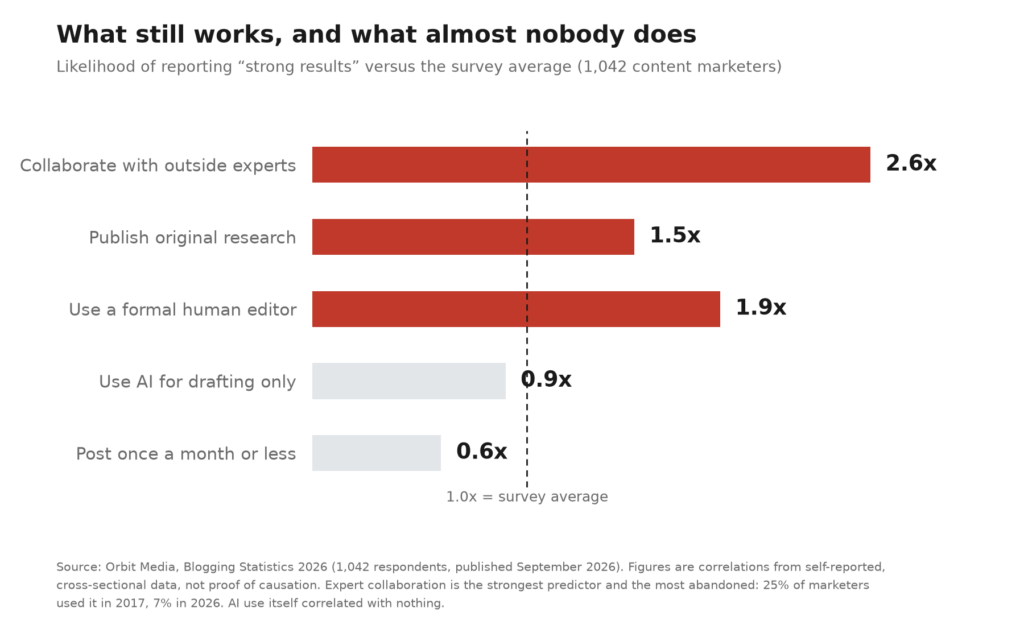
Meanwhile the practices that did correlate with results all declined. Expert collaboration is the strongest predictor in the dataset — 2.6 times the benchmark — and adoption collapsed from 25% of marketers in 2017 to 7% in 2026. Publishing original research raises the odds of strong results by about 50%; fewer people do it. Formal human editing beats the benchmark by nearly double, while AI-only editing reports the worst results of any method.
Put those two charts side by side and you get the entire strategic situation: the tactics that work are being abandoned precisely as they become more valuable, because AI made it easy to skip the struggle.
Where AI actually belongs
Not as the voice. As everything behind the voice.
Use it to read twelve reports before you read one. To draft the outline you’ll throw away. To pressure-test your argument by asking it to steelman the other side. To turn a webinar transcript into a page, or a page into a sequence of emails. To check whether your draft sounds like the two hundred articles already ranking for that phrase — which, honestly, is the most underrated use of the technology: as a detector of your own averageness.
The Content Marketing Institute’s 2026 B2B research makes the division of labor brutally clear. Of 1,015 marketers, 95% use AI, 89% for content creation. Reported productivity gains: 87%. Reported quality gains: 58%. Reported performance gains: 39%. And 12% say quality actively fell.
Then look at the budget question. Asked where they’d increase investment in 2026, 45% named AI tools. Nine percent named people.
The CMI report’s own metaphor is better than anything I’d write: if AI is oxygen, people are the lungs. You can buy the finest air purifier on earth. Without lungs it does nothing.
The hardest decision is the one nobody budgets for
The highest-value content decision available to most teams right now isn’t what to publish. It’s what to not publish.
Killing the average piece is genuinely difficult, because at the moment of decision it looks fine. It’s on-brand. It’s accurate. It has a keyword. It took a day instead of a week. Every individual signal says ship it.
The aggregate signal says otherwise. One more interchangeable page doesn’t just fail to help; it dilutes the pages that do help, trains your audience to skim you, and teaches your own team what your standard is. Google formalized a version of this in March 2024, when it replaced its “spammy automatically generated content” policy with scaled content abuse — explicitly covering mass-produced pages “no matter whether content is produced through automation, human efforts, or some combination.” The policy targets the purpose, not the tool. Publishing at scale to manipulate rankings is the violation, whoever types the words.
That’s the tell. If your content plan reads like a ranking-manipulation strategy with a brand voice layered on top, you’re not in the content business anymore. You’re in the arbitrage business, and the arbitrage is closing.
Steelmanning the volume defenders
Fair is fair. Two objections deserve real answers.
“Content compounds.” True historically: a mediocre page from 2019 could still earn trickle traffic in 2023. It no longer holds, because the compounding was always a function of ranking, and ranking now depends on being the thing an answer engine wants to summarize. Ahrefs’ near-zero correlation is the evidence: there’s no volume dividend left to collect. Average pages don’t compound; they accumulate.
“You can’t tell what’s average from the inside.” Also true, and worth taking seriously. Everyone believes their own work is the exception. That’s precisely why distinctiveness has to be an operating bar rather than a self-assessment — a written test the piece must pass before it’s allowed out the door. Assume average until proven otherwise.
The synthesis is narrower than either camp wants. Volume still has legitimate uses: spec pages, long-tail support, documentation, anything where the reader’s need is transactional rather than persuasive. What died is volume as strategy — the belief that more output produces more outcome. The new shape is distinction at the surface, cheap volume underneath, and a strict wall between them.
What a reset looks like in ninety days
Three moves, in order of difficulty.
Audit for redundancy, not for quality. Pull your last hundred pages. For each, ask: could a competent competitor have written this from public information? The ones where the answer is yes are your candidates. Not because they’re bad — because they’re replaceable.
Move budget from production to provenance. Reinvest the hours AI saves into things a model cannot generate: two customer interviews, one proprietary dataset, one named expert who will say something on the record. Orbit’s numbers say this is where the return lives, and almost nobody is doing it.
Put a human editor in the path, permanently. Not a proofreader. Someone whose job includes the sentence “this section says nothing.” Orbit’s data puts formal human editing at nearly twice the benchmark. AI-only editing is the worst-performing method in the survey.
What we still don’t know
Three honest gaps.
Nobody has a clean measure of AI assistance — the draft-then-edit workflow most serious teams actually use. Graphite’s detection counts primarily-AI articles and explicitly excludes assisted ones, which means the 50% figure is a floor, not a ceiling. The most common way of working is invisible in the data.
Second, the causality is unproven everywhere it matters. Orbit’s survey is self-reported and cross-sectional; teams with more resources do more original research and report better results, and selection effects are doing some of the work.
Third, the traffic collapse is being measured by parties with interests. Google disputes Pew’s methodology. Ahrefs, Seer and BrightEdge all sell tools that benefit from the narrative of decline. The direction is consistent across every independent measurement — but the precise magnitude is contestable, and anyone quoting a single number as settled is overselling.
The takeaway
Content shock came back, and this time the flood is made of competence. Fifty percent of new articles are machine-written, half of search ends without a click, and readers have started assuming everything is artificial until proven otherwise. The scarce resource is no longer content. It was never attention, either — attention was always the symptom. The scarce resource is a reason to believe a specific person made this specific thing for a specific reader.
The brands that win the next three years won’t be the ones that publish the most. They’ll be the ones with the discipline to publish the least average — and to kill everything that isn’t.