The Invoice Nobody Sends: What a Free Inference Actually Costs
In eighteen months, regulators have won nearly every fight they picked. The FTC took up to $2.5 billion from Amazon over a cancellation flow. California fined two retailers for cookie toggles that refused to be symmetrical. Consent enforcement has not been this loud in a decade. And inference — the part where a model concludes something you never disclosed — has kept getting cheaper, wider and quieter. That is not a contradiction. It is a cost structure.
Asking Is a Cost Centre. Inferring Is a By-Product.
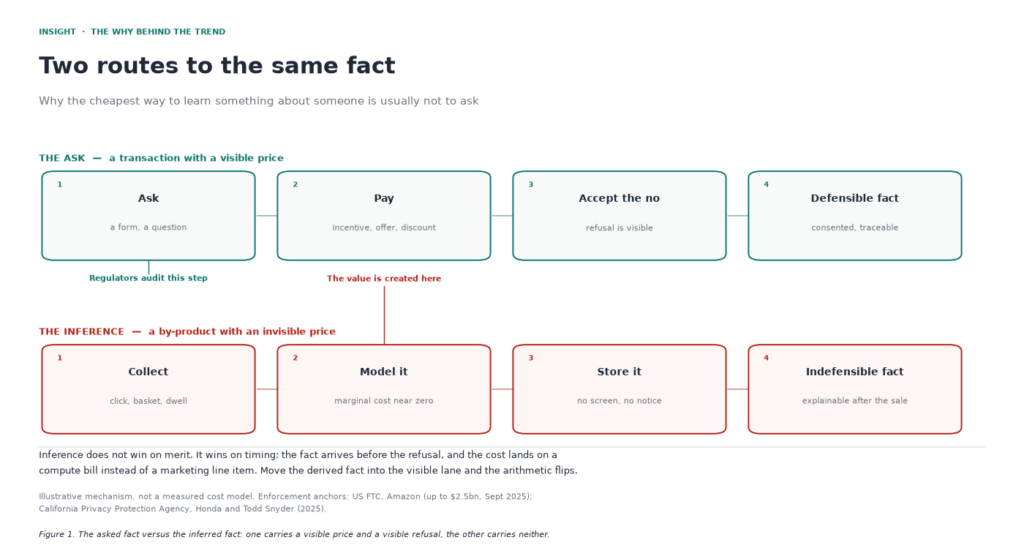
To learn a fact by asking, you buy attention, design an incentive, run a form, absorb refusals, and store an answer you can defend in a hearing. Every step has a line item and a number a finance director can interrogate.
To learn the same fact by inference, you reuse signals you already collect for other reasons and pay for a model run. Once the pipeline exists, the marginal cost of one more conclusion collapses toward zero — the expensive part was building it, and someone else already paid for that.
So the cheapest route to any fact is rarely to ask. It is to deduce. Better copywriting does not change that arithmetic, and neither does a friendlier banner.
Three Asymmetries That Keep It That Way
Timing. The ask pays before it earns: incentive first, fact later, refundable if nobody bites. Inference earns first — a sale, a price, a ranking, a recommendation slot — and pays later, only if someone notices.
Visibility. A question is an interface. A model is a pipeline. You can screenshot an interface in a hearing; nobody has ever audited a pipeline by looking at it. Which is precisely why enforcement keeps landing on the front door while the derivation continues in the basement.
Accountability. A refusal at the ask is a data point you are obliged to honour, that day, in a system built to record it. A refusal at the inference is a complaint you have to survive — after the fact, after the quarter closes, usually after the campaign has already been optimised against it.
None of this is an accident of implementation. It is the reason the practice survives the fines: the fine prices the visible step, not the invisible one.
What to Do With an Arithmetic You Cannot Argue With
If inference is structurally cheaper, “stop inferring” is not a strategy anyone will actually follow. The playable version is duller and more effective: move the cheap fact into the visible lane.
Disclose the derived attribute where it is used, not in a policy nobody opens. Refuse to build the sensitive ones at all — the inference you never make cannot be priced against you. And make refusal as easy as agreement, because symmetry is the one design choice that costs nothing and shows up in every audit.
This is not moral decoration. The cost you defer today is the cost you inherit at the settlement. Amazon’s bill was not for lying in a document; it was for engineering consent. The interface was audited because the interface was the product.
Inference will keep winning on cost. It only ever loses on trust. That gap is the most durable margin left in personalisation.