AI Didn’t Lose the Buyer. It Lost the First Job.
Here is a number that should have started an argument, and mostly didn’t.
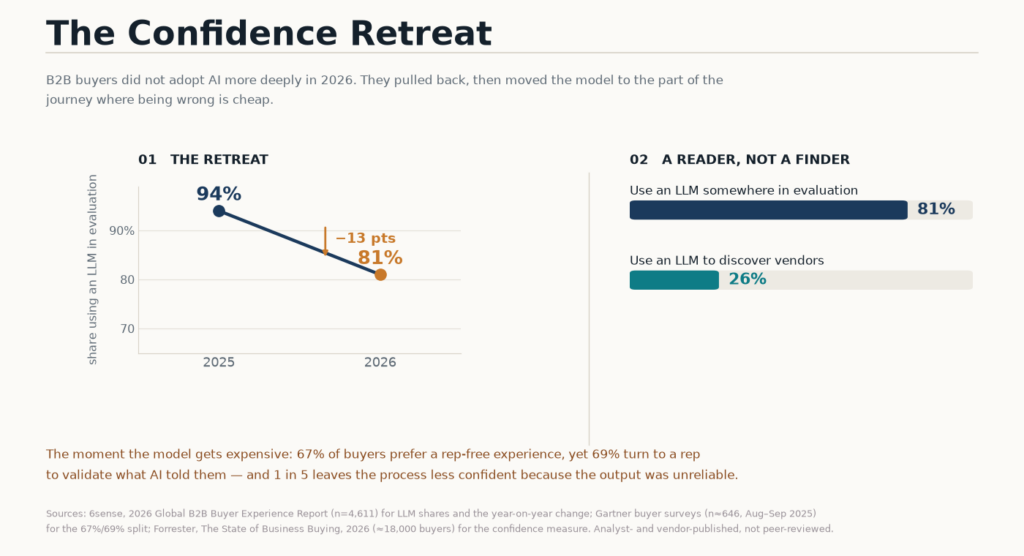
In the 2025 edition of 6sense’s buyer study, 94 percent of B2B buyers said they used an LLM somewhere in their purchase process. In the 2026 edition, that number is 81 percent. Thirteen points, gone, in the same year that every software vendor on earth shipped an AI feature and every marketing conference told you buyers now start their research with a chatbot.
The obvious read is that AI disillusionment has set in. That read is wrong, and the correction is more interesting than the headline.
The Retreat Is a Relocation
Look at where the 81 percent actually sits. Most of those buyers are not using a model to decide what to buy. They are using it to read.
In the same study, only 26 percent said they use an LLM to discover vendors. The rest lean on existing knowledge, internal discussion, and the people they already know. So AI did not lose the buyer. It lost the first job it was given, and kept a smaller, quieter one further down the funnel.
Why would a tool that demonstrably works get demoted? Because of who carries the blame.
The Blame Asymmetry
A buyer who asks a model for a shortlist and picks from it has made an original decision. If it goes badly, that decision is theirs, alone, in front of a procurement function that is already the most skeptical room in the building. Forrester’s 2026 study of roughly 18,000 buyers found one in five came out of the process less confident after encountering unreliable AI output, and the skepticism runs highest among procurement, the people who sign.
A buyer who reads a model’s summary, then confirms it with a respected colleague, an analyst, and a sales rep, has made a shared decision. The downside is distributed. The upside is unchanged.
That asymmetry is the whole mechanism. Recommendation is a high-stakes act with your name on it. Summarisation is a low-stakes act with nobody’s name on it. Given a tool that is usually right and occasionally confidently wrong, rational buyers will move it to the end of the chain where failure is cheap — not because they stopped trusting it, but because they stopped wanting to be its sponsor.
Gartner’s numbers show the same split from the other side: 67 percent of buyers prefer a rep-free experience, and 69 percent turn to a rep to validate what AI told them. Those two facts sit in the same survey, and they are not a contradiction. They are a division of labour.
The Convergence Problem
There is a second force, and it is structural rather than psychological.
When every buyer asks a similar question of similar models trained on similar content, they get similar answers. The model’s shortlist stops being a signal and becomes a floor — the same twelve vendors everyone else was already considering. A recommendation that cannot differentiate carries no information, so buyers go back to the only sources that still do: peers, analysts, and prior exposure.
Which is why the 96 percent figure matters more than the 26. Nearly every buyer keeps tracking vendors between purchase cycles. Being known before the question is asked still beats being the answer to it.