INSIGHT — The Economics Behind a Discount That Was Never a Discount
A brand team I spoke to last quarter replaced a licensed library cue with a generated one and booked the saving as a win. Two hundred dollars against four thousand. The deck said efficiency. The deck was wrong.
That gap was not the cost of production falling. Production did fall, but not by 95 per cent. The rest of the gap was compensation for something the brand had just agreed to carry: the liability for a track nobody had cleared. The saving was not free. It was a payment, made in the only currency available, for absorbing a risk that had not yet been priced.
Which is why the discount is a timing artefact rather than a structural one, and why it is already closing.
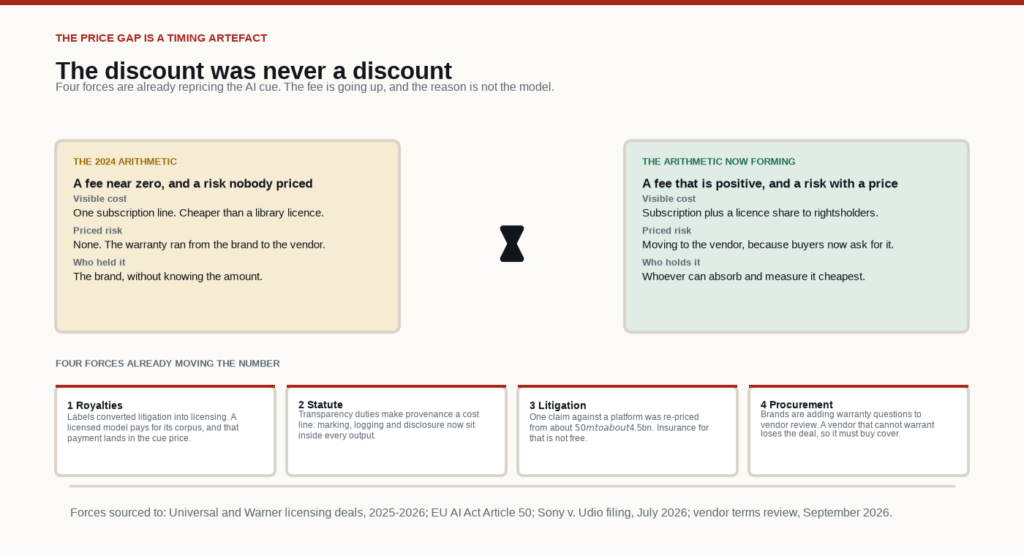
Four forces are doing the work, and none of them is about model efficiency.
Royalties land in the fee. Once Universal and Warner converted litigation into licensing, the licensed model started paying for its corpus. A licence is a cost of goods. It does not disappear at scale, and it is the one line in the stack that the vendor cannot engineer away.
Statute adds a cost line. The EU AI Act’s transparency duties made provenance a production input: marking outputs in machine-readable form, keeping disclosure records, logging what generated what. Compliance is an operations cost, and operations costs are passed on.
Litigation repriced the tail. When Sony took a claim against a platform from roughly $50 million to roughly $4.5 billion in a single July filing, it did not merely threaten one balance sheet. It priced the insurance layer under the whole category. Cover against that number is not cheap, and someone has to pay for it.
Procurement became the transmission belt. Brand legal teams now put warranty questions in vendor review. A vendor that cannot warrant non-infringement starts losing deals, which gives it a commercial reason to buy indemnity and charge for it. The moment a vendor sells protection, the discount is over.
Notice the shape of this. Three of the four forces are institutional, not technical. They arrive because rights holders organised, regulators wrote rules, and buyers started asking for warranties. That is not a pattern you can wait out. It is the normal cost structure of any market that has finished its unregulated phase.
The practical consequence is that the 2028 comparison will flatter licensed music in a way the 2024 comparison never did. Today the choice looks like four thousand dollars versus two hundred. In two years it may look like four thousand versus twelve hundred, with a disclosed term, an audit trail and a named owner — and at that spread, the cheap option stops being obviously cheap.
So the right question was never whether AI music is worth the money. It was whether you were being paid to hold a risk, and whether the payment was adequate. For most brands in 2024, nobody checked.