Willingness Is Not Adoption: Why Brand Chatbots Get Used Less Than Customers Say They Will
It is 2:40 in the morning somewhere, and a brand’s Instagram inbox is collecting a question about an order that shipped to the wrong city. Nobody is awake. By 9am there will be eleven more, one of them a public comment under a paid ad, and one a review that will sit on a marketplace page for the next four years.
That is the job now. Not posting. Not the content calendar. The inbox.
Community management used to be a person with a personality and a decent sense of timing. Then the volume curve bent, the platforms turned every comment into a support ticket, and the person became a triage clerk with a personality. This is the part of social media that artificial intelligence actually fits, and it is also the part where AI does the most damage when it is pointed at the wrong layer.
So the question worth arguing about is not whether to automate. You already have. The question is which half of the work you hand over, and which half you defend with headcount.
The inbox that never closes
Walk through a normal Tuesday at a mid-sized consumer brand. A DM about sizing. Two comments asking whether the sale stacks with a coupon. A creator asking for a shipping update on a paid partnership. A man on X who has been waiting nine hours and has started tagging journalists. A customer who posted a photo of a cracked jar and used the word disappointed in all caps.
None of these are marketing problems. They are operations problems wearing a marketing costume, and they arrive at three in the morning with a public audience attached.
The strategic reframe that makes the rest of this article readable: AI social media management is not marketing automation with a chat window. It is community automation. The output is not impressions. It is whether a specific human being feels answered.
Why always-on stopped being a nice-to-have
Three separate pieces of evidence, and they all point the same way.
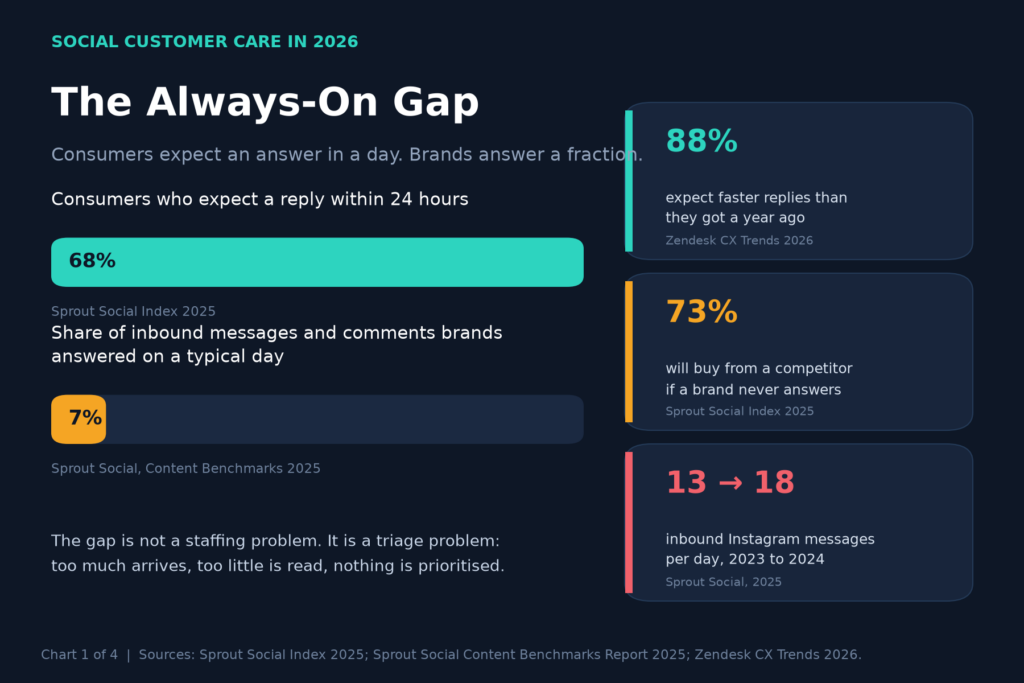
Silence has a price, and it is measurable. In the 2025 Sprout Social Index, 73% of social users said they would buy from a competitor if a brand failed to respond to them on social. Not “be annoyed”. Buy elsewhere.
The expectation window is shorter than the industry’s habits. In Sprout’s Q3 2026 pulse survey of consumers, 68% expected a reply within 24 hours, 24% within one to two hours, and 14% within the hour. Meanwhile a benchmark study of brand accounts found that the share of inbound social messages and comments answered on a typical day slipped from 8% to 7% between 2023 and 2024, even as Instagram inbound rose from 13 to 18 messages a day.
The clock is being reset by the tools themselves. Zendesk’s CX Trends 2026, drawn from more than 11,000 consumers and business respondents across 22 countries, found 88% of customers now expect faster replies than they got a year ago, and 74% expect service to be available around the clock. Whether or not that is reasonable is beside the point. That is the market you are quoting into.
There is a subtler behavioural detail worth stealing. Sprout’s Q4 2025 pulse survey found 51% of consumers who complain in public expect a public acknowledgement first, before the conversation gets moved into a DM. Answering in private feels like being managed. Answering in public is the whole point of complaining in public.
You cannot hire your way out of this
Here is the honest arithmetic. Metricool’s 2026 well-being report, based on responses from 927 social media professionals worldwide, found 75% saying they are expected to carry too many responsibilities at once, 73% working overtime often, and 46% reporting burnout or near-burnout. Close to 60% work alone. These are not lazy teams. They are under-designed teams.
Volume does not arrive evenly, either. One jewellery brand told Sprout Social that its social support volume swings between 40% and 60% depending on promotions. You cannot staff for a peak that appears without notice, and you cannot ask a human to be emotionally present at 3am on a Sunday for the eleventh consecutive week.
So the argument for AI in social care is not primarily about cost. It is about the fact that a tired human gives worse answers than a well-briefed machine on the boring 60%, and a well-rested human gives far better answers than any machine on the 5% that matters. That is the whole design brief in one sentence.
The part everyone gets wrong: willingness is not adoption
The industry keeps telling a story about demand. Customers want chatbots, the story goes, and the numbers are there to prove it. Read the same Gartner survey carefully and the story falls apart.
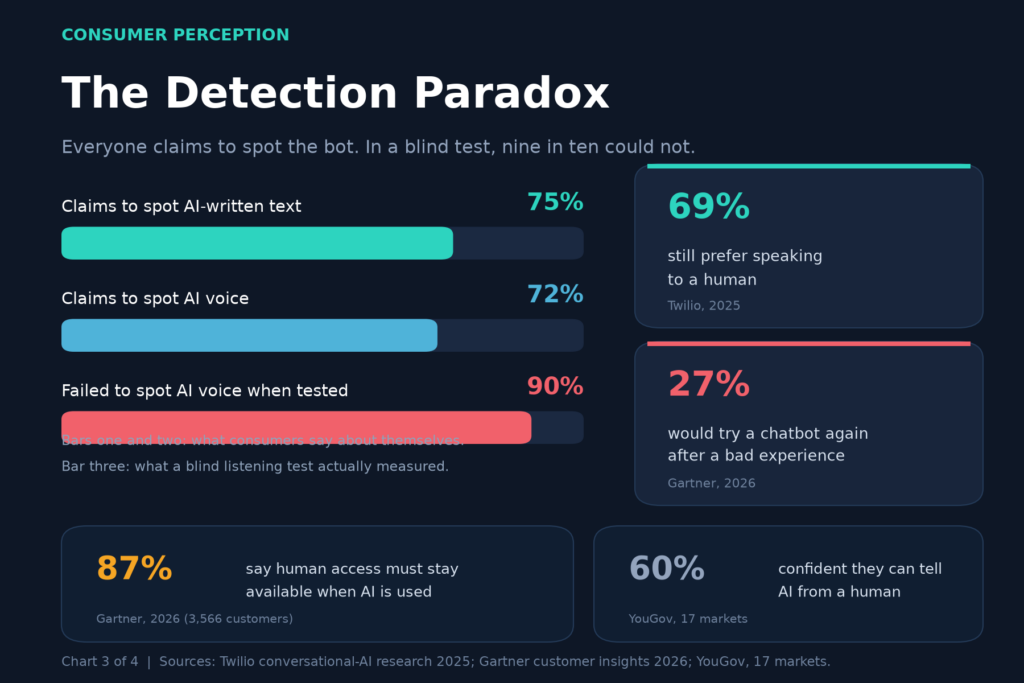
Gartner asked 3,566 business and consumer customers, in fieldwork run during February and March 2026. Forty-nine percent said they would have been willing to use a chatbot if the company had offered one. Then Gartner looked at what actually happened during their most recent service interaction: only 7% used a chatbot or digital assistant. Customers were roughly three times more likely to paste their problem into a third-party generative tool than to use the brand’s own assistant.
Willingness is a survey answer. Behaviour is a verdict.
The same survey explains why. Only 27% of customers said they would try a chatbot again after a negative experience. One bad answer does not shave a little goodwill off the relationship. It closes the channel. And 87% said access to a human must remain available whenever generative AI is in the mix. Not as an escalation of last resort, buried behind four menus. Available.
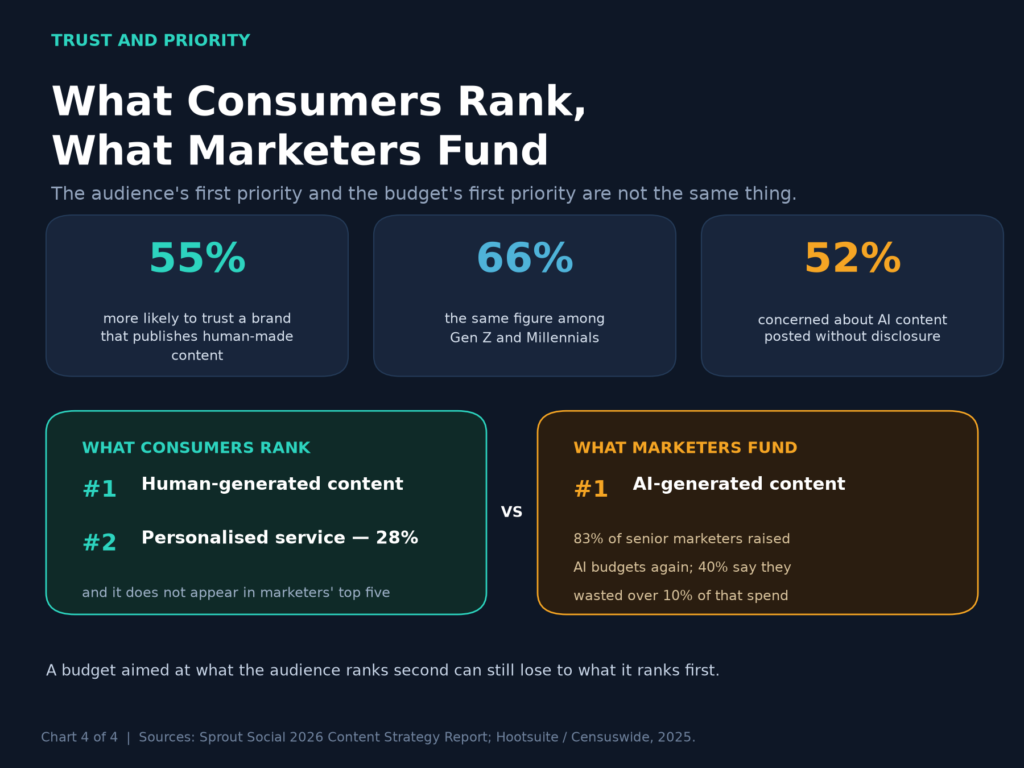
Marketers have been spending as if the constraint were technology. In Hootsuite’s research with Censuswide, 83% of senior marketers said their AI budgets had increased, while 40% said they had wasted more than a tenth of that budget on tools that did not deliver. Only 28% of social media managers trusted their current tools to reflect what was happening on social in real time, and 43% said the content they got back felt like it was built from general web data rather than from social itself.
That last number is the quiet diagnosis. A tool trained on the open web does not know your community’s running jokes, your last crisis, or the difference between a complaint and a bit. It knows the internet. Your customers are not the internet.
What to automate: the volume layer
Four jobs belong to the machine, and none of them is “being the brand”.
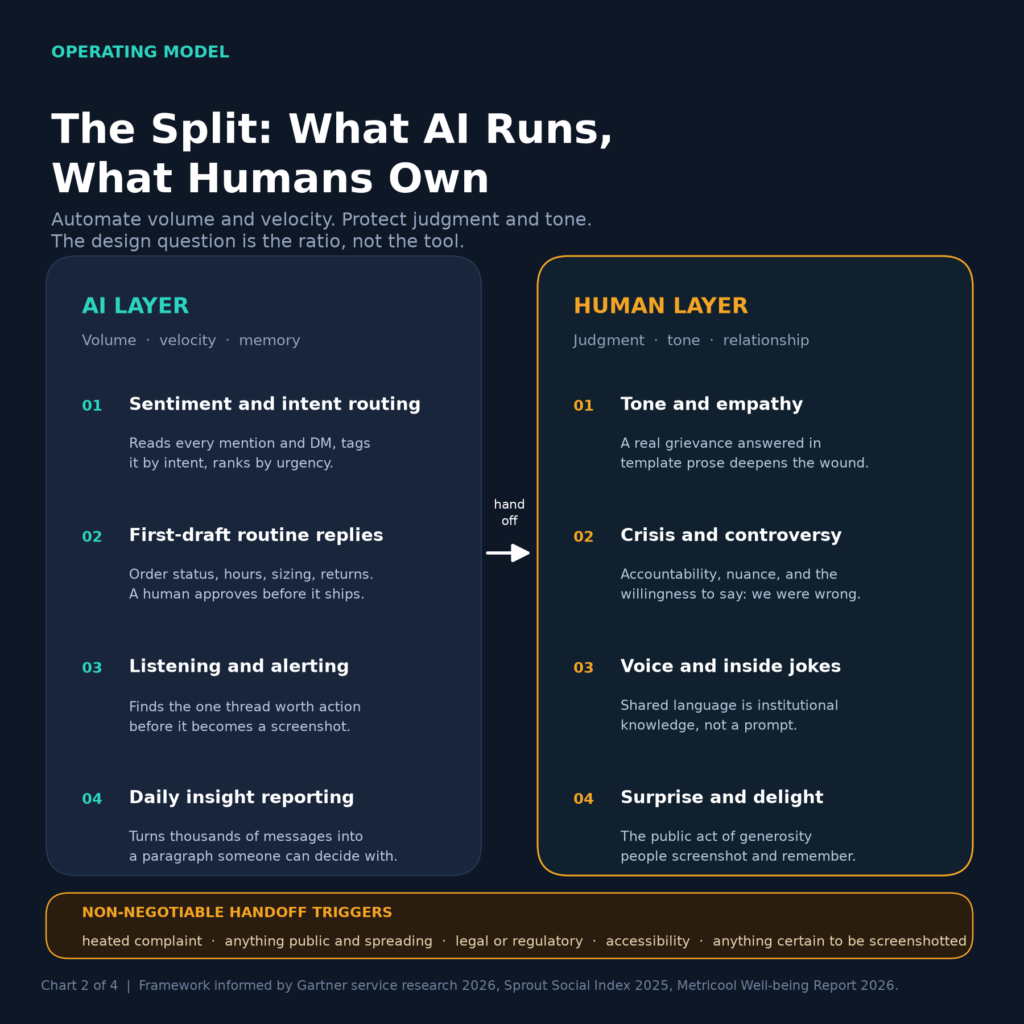
Routing. Every mention, DM and comment gets read, tagged by intent, and ranked. Complaint with heat goes up. Pre-sale question from someone with a full cart goes up. “Love this” goes into a folder that a human skims once a day for material. The point of routing is not speed. It is that a human finally sees a sorted stack instead of a firehose.
First drafts of the routine. Order status, hours, sizing charts, return windows, restock dates. This is the high-volume, low-trust tier, and it should be answered in minutes, not hours, because the intent is still warm. A human approves the first few hundred, then the approval thins to sampling.
Listening and alerting. The one thread that is about to travel. Not a sentiment dashboard, an alert with a link and a suggested first sentence.
Reporting. Thousands of messages compressed into a paragraph someone can decide with on Monday morning. “Returns questions doubled after the sizing change. The word ‘scratchy’ appears 41 times this week, up from 6.”
Two platform constraints shape all of this whether you like them or not. Meta’s messaging policy gives a 24-hour window to respond to a user message, and requires automated bots to respond to user input within 30 seconds. Design inside those walls, because the platform will hold you to them even when your team is asleep.
What has to stay human: the intimacy layer
Four things, and the boundary is emotional weight plus visibility.
Tone and empathy. A person whose grandmother died and whose flight refund was denied does not need a faster answer. They need an answer that sounds like it came from someone who understood the sentence they just wrote. Template prose at that moment does not read as efficiency. It reads as contempt.
Crisis and controversy. When something is spreading, the reply is a legal and ethical act. It needs accountability, the ability to say plainly that we were wrong, and a human signature. An AI that apologises on behalf of a company it does not work for is a headline waiting to happen.
Voice and inside jokes. Communities build a shared language over years: nicknames, running bits, the member who always posts the same meme on launch day. That is institutional knowledge. A model can imitate the surface of it and will never own it, and the audience can tell the difference even when it cannot explain why.
Surprise and delight. The public act of generosity. The refund granted with no argument. The reply that solves a problem nobody asked the brand to solve. These are the moments that get screenshotted and remembered, and they lose all their power the moment they look automated.
The peer-reviewed work here is more nuanced than either camp admits, and the nuance is operationally useful. A 2025 study of 150 US adults published in a Wiley journal found human agents produced more positive affect on satisfaction, emotional support and feeling understood, while AI assistants scored higher as problem-solvers. Different jobs, different winners.
A 2026 paper in the Journal of Consumer Behaviour went further and named the mechanism: AI chatbots produce a weaker sense of belonging than human agents, and that weakened belonging lowers purchase intention. The effect was strongest for consumers with a strong baseline need for connection. Which is another way of saying: the customers who love you most are the ones who notice the bot most.
Then there is the finding that will get misquoted at every conference this year. In a 2026 Psychology & Marketing study of service recovery, a GenAI agent generated higher repurchase intention than a human agent after a single service failure. After a double deviation, where the recovery itself failed, the human agent won. Read that twice before you build a strategy on it. AI is not better or worse than a human. It is better in the narrow case where the script is clean and the customer has been disappointed exactly once.
The detection paradox
Ask consumers whether they can spot the machine and they are confident. Twilio’s 2025 research found roughly three-quarters said they could identify AI-generated text exchanges, and 72% said the same about voice. Then Twilio tested them on voice clips. Ninety percent failed.
A 17-market YouGov survey found 60% confident they could tell a human advisor from an AI chatbot, and 28% admitting they could not. Confidence and capability are two different measurements, and only one of them is reliable.
This matters because it destroys the laziest defence available. You cannot say “our customers will know it is us, because it sounds like us.” They will not know. They will feel something and misattribute it. The bad reply gets filed under “this brand doesn’t care” instead of “this reply was automated”, and you never see the complaint because it never gets written. It just becomes a churn you attribute to price.
And the ambient mood is not helping. Pew Research Center’s 2026 survey of 5,119 US adults found 49% now use AI chatbots, while 63% say the technology is advancing too fast and 40% expect it to be bad for society. Your customers are using AI and distrusting AI in the same week. That is not hypocrisy. That is the exact emotional weather your replies are landing in.
Twilio also found 69% still prefer speaking with a human, and 78% said being able to switch to a person matters. The preference is not a rejection of automation. It is a demand for an exit.
When the bot answers a question it should not
In February 2024, the Civil Resolution Tribunal in British Columbia decided Moffatt v. Air Canada. A customer asked the airline’s website chatbot about bereavement fares after his grandmother died. The chatbot told him he could apply for a reduced rate within 90 days, including after travel. He booked. Air Canada refused the refund, pointing to a different page on its own site that said the opposite.
Air Canada argued it could not be liable for what its chatbot said. The tribunal called that submission “remarkable” and held that the chatbot was simply part of the website. The company was liable for negligent misrepresentation, and the award came to roughly 812 Canadian dollars in damages, interest and fees.
Small money. Enormous precedent. The lesson is not “don’t use chatbots”. It is that factual answers carry liability while emotional answers carry reputation, and those are two different risk profiles that should never share the same automation policy. Order status, pricing, policy, eligibility, medical or financial claims: those need a knowledge base a human has signed off, and a visible route out when confidence is low. “I’m sorry this happened, let me get a person who can fix it” is the cheapest sentence in customer service and the one AI is worst at saying.
Three ways this goes wrong in practice
The inflated containment rate. The dashboard says 71% of conversations were resolved without a human. Nobody checks whether those customers came back within seven days under a different name. Real resolution rates usually sit well below containment numbers, and the gap is the part your CFO will eventually find.
The escalation cliff. AI absorbs the easy 70%, and the remaining 30% lands on a smaller team that now handles only the hardest, angriest cases, all day. You have not reduced the emotional load. You have concentrated it, and you have quietly made the job unbearable for the people you kept.
The voice-of-customer blind spot. When machines handle the routine, humans stop reading it. The early signal of a packaging failure shows up as a small cluster of mild complaints, gets auto-answered with a cheerful template, and disappears from view. Six weeks later it is a returns crisis and nobody can explain where it came from.
The operating model: responder to editor
The role does not disappear. It changes shape, and the shape is editorial.
The community manager becomes the person who approves, personalises and escalates. Less typing, more deciding. Which of these forty drafts is actually in our voice? Which of these five threads is the beginning of something? Which customer deserves a reply that no template could produce? Taste becomes the core skill, and taste is the thing that does not scale.
Gartner’s workforce research is worth keeping on the wall while you plan. A survey of 321 service leaders in October 2025 found only 20% had actually reduced agent staffing because of AI. In February 2026, Gartner predicted that half of the companies that did attribute cuts to AI will rehire for similar functions by 2027, often under different titles. Meanwhile the same firm projects that agentic AI will autonomously resolve around 80% of common service issues by 2029, against a 2024 baseline where only 14% of issues were fully resolved in self-service.
Both things are true. The destination is real and the timeline in the pitch deck is fiction.
So build the middle version. Define the brake rules first, in writing: what AI never touches. Complaints with heat, anything public and spreading, legal and regulatory questions, accessibility issues, and anything that will certainly be screenshotted. Then govern the voice: a brand-voice document the model retrieves from, a banned-phrase list, an escalation trigger list, and a rule that says when the model’s confidence drops below a threshold it hands over with context attached rather than guessing.
Metricool’s data adds a warning label here. 72% of social professionals already use AI or automation, and the workload did not fall. If you deploy AI into a badly designed process, you get a faster badly designed process. The tool amplifies the operating model you already have, including its dysfunctions.
Measure relationships, not replies
Response time is table stakes now. Once you have cleared it, stop optimising it and start measuring what the automation was supposed to protect.
Four numbers that survive contact with a sceptical CFO:
First-contact resolution at seven days. Not “closed”. Not “deflected”. The issue stayed solved a week later.
Repeat-contact rate. The same person, the same problem, a second time. This is the metric that exposes containment inflation.
Sentiment shift on the topics you decided to fix. Pick three themes, measure the emotional temperature before and after, and report the delta rather than the volume.
Advocates activated. People who were satisfied in public and said so. That is the compounding asset, and it is the one thing an always-on machine cannot manufacture.
What to stop reporting: replies sent, average handle time, and any graph where the line only goes up because you answered more messages. Volume is the input. It is not the outcome.
The priority mismatch nobody budgeted for
Sprout Social’s 2026 content strategy research, covering more than 2,300 consumers and 1,200 marketers across the US, UK and Australia, produced the year’s most uncomfortable chart. Consumers named human-generated content as their number one priority for brands on social. Marketers named AI-generated content as a top investment area. Personalised customer service came second for consumers at 28% and did not appear in marketers’ top five at all.
The trust numbers sharpen it. Fifty-five percent of consumers said they are more likely to trust a brand that publishes human-generated content, rising to 66% among Gen Z and Millennials. Fifty-two percent are concerned about brands posting AI content without disclosure. In Sprout’s Q1 2026 pulse survey, half of Gen Z said they had unfollowed, muted or blocked a brand or creator because the content felt like AI slop.
Now apply that to replies rather than posts. A customer who has decided that undisclosed AI content is a small betrayal is not going to feel warmly about an undisclosed AI answer to their complaint. The same instinct is running. Disclosure is not a legal formality in this channel. It is the thing that keeps the interaction from feeling like a trick.
A thirty-day starting plan
Week one, measure before you buy. Pull ninety days of inbound, count how much is routine, how much is emotional, and how much never got an answer. Most teams discover that the majority of volume is four question types and the majority of damage is a small number of unanswered emotional threads.
Week two, write the two documents that actually govern this. A voice guide with examples of what we sound like and a banned-phrase list. A brake-rules document with the categories that never go to a machine. Neither document is a prompt. Both are policy.
Week three, deploy routing and drafting only. No autonomous sending. A human approves everything, and you watch which drafts get rewritten, because those rewrites are your training data and your taste, written down.
Week four, set the SLA by intent rather than by channel. Pre-sale questions get minutes. Support problems get the same day. Public complaints get a public acknowledgement before anyone slides into a DM. Then pick three relationship metrics and put them on the same dashboard as the response time, so nobody optimises one at the expense of the other.
What changes by 2027
The category will stop being “AI social tools” and become “the care stack”, because the buying decision is moving from the social team to the service organisation, and those two budgets have never met. Expect more rehiring than the headlines promised, more agentic resolution inside narrow, well-documented issue types, and a premium on people who can write well under pressure.
The scarce resource is not model access. Everyone has that. It is a documented understanding of what your community actually needs, which is a research problem dressed as a copywriting problem.
The short version
AI can give you an always-on community manager. Always-on is now the floor, not the advantage. Automate the routing, the drafting, the listening and the reporting. Keep tone, crisis, voice and generosity human, and write the handoff rules before you write the prompts. Measure resolution and sentiment rather than throughput. Because the moment a community feels answered by a machine that did not understand it, the trust you spent years accumulating starts draining through a hole nobody can see.