One in Three New Podcasts Is a Machine. Your Host Should Not Be.
Something odd happened to podcasting while everyone was busy watching video. The directory filled up.
There is a show about the definition of the word “literally.” Three separate daily surf reports, one for each coastal city. A show called “Pasta.” A show called “Cringe.” A Chuck Mangione fan podcast. Synthetic hosts, most of them produced for about a dollar an episode, arriving by the thousand every day, tuned for search results rather than for ears.
Now hold that next to the people who actually pay for audio. In Oxford Road’s 2026 poll of brand-side audio buyers — a group that includes three of the ten biggest podcast spenders in the United States — exactly zero percent reported cloning a host’s voice. Zero.
That gap is the whole story. AI can manufacture a podcast. It cannot manufacture a relationship. And this year, the market started pricing that difference with unusual precision.
The Flood Is Not a Forecast. It Already Happened.
Start with supply, because supply is where the argument usually gets lost.
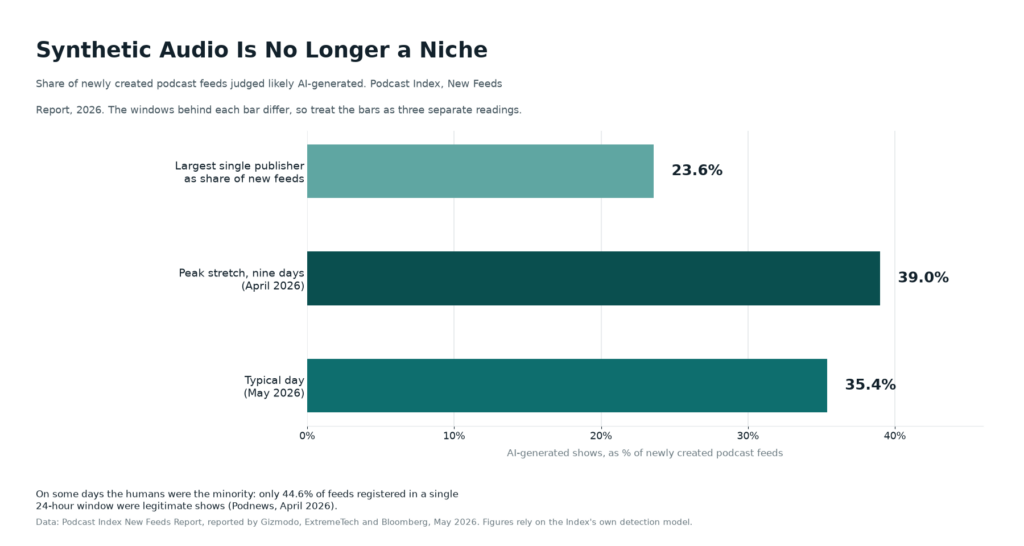
Podcast Index, the open-source tracker that updates its New Feeds Report daily, flagged roughly 35.4% of newly created feeds as likely AI-generated on a representative day in May 2026. Over a nine-day stretch in April, that share hit 39% — 4,243 of 10,871 new feeds. One publisher, Inception Point AI, accounted for 23.6% of all new feeds by itself, running more than 10,000 active shows, releasing 325 new titles in a single day and roughly 3,000 episodes a week. Another network pushed around 11,000 episodes a day across more than 400 locally branded feeds.
Those numbers come from a detection model, not a census, so treat the exact percentage as directional. The direction, though, is not in dispute. By mid-April, Podnews found that legitimate shows made up only 44.6% of new registrations in one 24-hour window. For a stretch, the humans were the minority in their own medium.
Why is this happening? Not because the audio is good. Because the arithmetic is easy. Programmatic advertising does not much care whether a person or a machine assembled the audio. A dollar of ad revenue against fifty cents of production is a working business at five listeners. Multiply that across thousands of narrow, keyword-targeted feeds and the returns accumulate. Audio stopped being expensive, and the moment a medium’s marginal cost approaches zero, its directory becomes a landfill unless somebody filters it.
A Cheap Voice Is an Expensive Problem
When the supply of “a competent host voice” collapses toward zero cost, the scarce thing becomes the one input that never got cheap: a specific person that a specific someone chooses to spend an hour with.
Edison Research’s Evolving Ear study, published in January 2026, puts weekly podcast consumption at 773 million hours, up from 170 million a decade earlier. In the same research, about one in five long-time listeners and roughly a quarter of first-year listeners had already tried an AI-narrated show. So the exposure is real. Trial, however, is cheap and acceptance is not.
What Edison’s qualitative interviews found was a line drawn with surprising consistency. Listeners were relaxed about AI doing research, editing, transcription, brainstorming, admin. They were not relaxed about AI doing “the creative stuff” or sitting behind the microphone. One respondent put it in six words that ought to be printed on every AI audio vendor’s invoice: I don’t want it doing the creative stuff.
Sixty-Six Percent Is Not a Nudge
The quantitative version of that sentiment is harder to wave away.
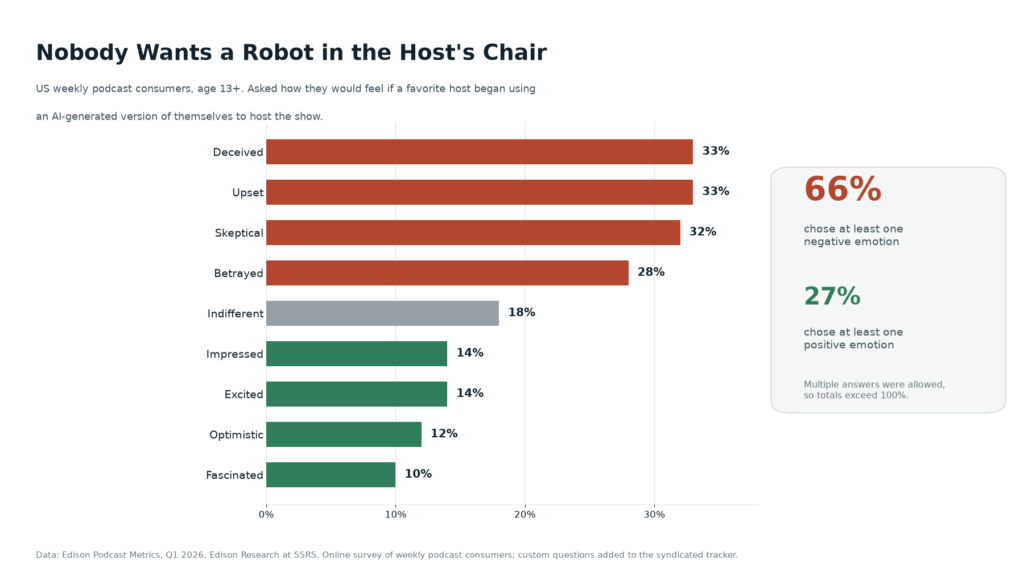
Edison Research at SSRS added custom questions to Edison Podcast Metrics in the first quarter of 2026, asking weekly US podcast consumers aged 13 and up how they would feel if a favourite host began using an AI-generated version of themselves to host the show. Respondents could pick more than one answer.
Sixty-six percent selected at least one negative emotion. Deceived: 33%. Upset: 33%. Skeptical: 32%. Betrayed: 28%. The positive end of the scale barely registers — impressed 14%, optimistic 12%, fascinated 10%, with 27% choosing any positive option at all. A further 18% said they would be indifferent.
Now the caveats, because a number like this deserves them. It is one country, one quarter, one hypothetical scenario, measured through a syndicated online tracker, and it captures stated feeling rather than actual switching behaviour. Emotions are not churn.
Even so: if two-thirds of your audience reaches for “deceived” before “impressed,” you are not managing an aesthetic preference. You are managing a contract. Podcasting’s implied deal is a person talking to you. Break it quietly and the listener does not deduct points for production quality. They deduct points for honesty.
A second Edison dataset, the Podcast Consumer 2026 report from June, points the same way: an AI voice used as host drew the lowest approval of any production application tested, and 62% of respondents called AI at least somewhat of a threat to podcast credibility.
The Same Voice, Two Different Audiences
Here is where most AI-voice strategies go wrong: they assume one audience.
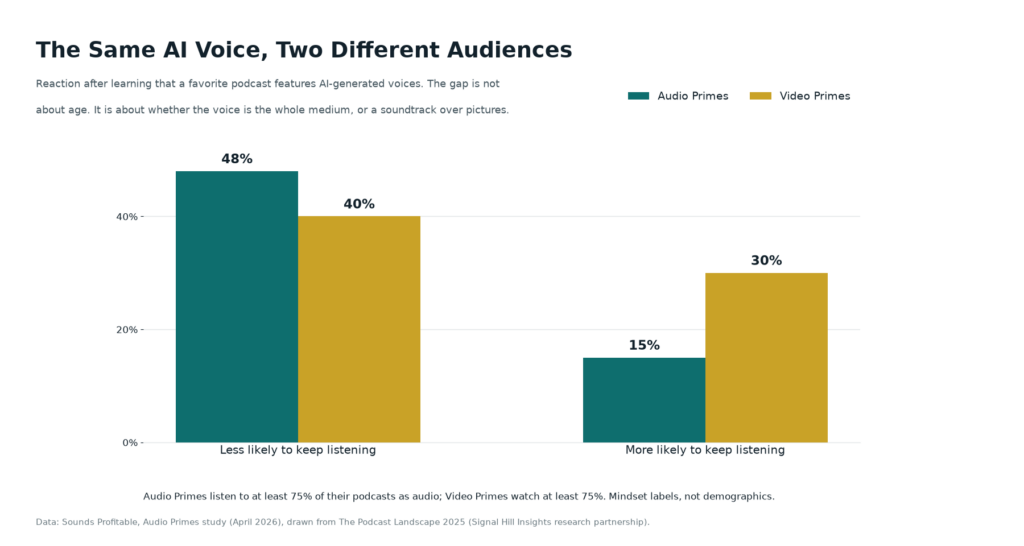
Sounds Profitable’s Audio Primes study, presented in April 2026 and drawn from The Podcast Landscape 2025 with research partner Signal Hill Insights, splits podcast consumers by behaviour rather than demographics. Audio Primes consume at least 75% of their podcasts as audio. Video Primes watch at least 75%.
Asked how they would react on learning a favourite show used AI-generated voices, the two groups diverged sharply. Among Audio Primes, 48% said they would be less likely to keep listening and only 15% said more likely. Among Video Primes, 40% said less likely — but 30% said more likely, roughly double the enthusiasm.
The explanation is almost mechanical. In audio-only listening, the voice is the entire medium. There is nothing else to look at, so a synthetic voice is not a garnish on top of the experience; it is a swap of the experience itself. Video-first audiences have spent years negotiating with synthetic faces on short-form platforms. They already own a frame for “this isn’t a real person and I don’t mind.” Audio-first listeners do not have that frame, because they never needed one.
The practical consequence: there is no such thing as a single AI-voice policy. There is a segmentation decision. Audio Primes are 22% of podcast consumers, 89% listened this week, and 71% recommend shows to other people. Small, loyal, loud — precisely the audience you cannot afford to hand to a robot.
Follow the Money: Brands Are Buying Workflow, Not Voice
If listeners are ambivalent at best, you would expect buyers to be cautious. They are more than cautious. They are explicit.
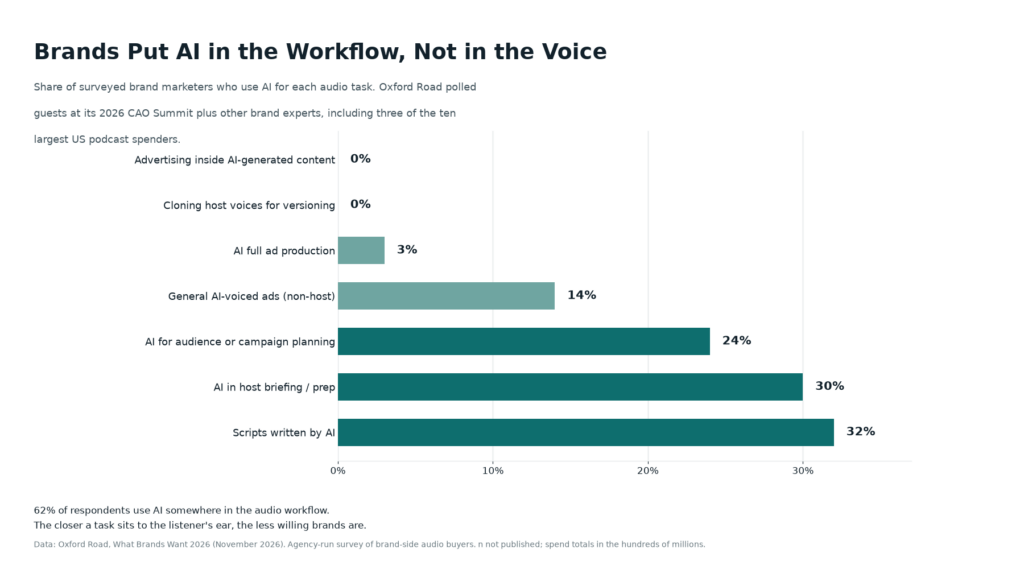
Oxford Road’s What Brands Want 2026, published in November, surveyed guests at its CAO Summit plus other brand experts, including three of the top ten US podcast spenders and respondents representing hundreds of millions of dollars in audio spend. Where AI actually shows up:
- Scripts written by AI: 32%
- AI in host briefing and prep: 30%
- AI for audience or campaign planning: 24%
- General AI-voiced ads, non-host: 14%
- Full AI ad production: 3%
- Cloning host voices for versioning: 0%
- Advertising inside AI-generated content: 0%
Overall, 62% use AI somewhere in the workflow. But look at the shape of that usage rather than the headline. The further a task sits from the listener’s ear, the more comfortable the buyer. Cheap errors get automated. Expensive errors stay human.
Read that as a revealed preference rather than an opinion poll. Nobody needs to argue about AI voices when the purchase orders already answer the question. The 0% on host cloning is arguably the most informative single figure in audio right now.
Two notes on the source, in fairness. Oxford Road is an audio agency, so its commercial interest lies in protecting the medium’s authenticity; that cuts both ways, making it alert to AI risk and giving it a reason to emphasise that risk. The surrounding numbers — 14% for generic AI-voiced ads, 3% for full production, 62% for workflow use — form a consistent shape, which is what makes the zero believable.
Context matters too. The same report found 57% of respondents naming measurement and attribution gaps among their top three obstacles, with as much as $1.15 billion held back from video podcasters by measurement alone. And budget growth is decelerating: 59% raised audio budgets in 2026, but only 40% expect to raise them again in 2027. Nervous money does not gamble on synthetic endorsements.
The Audiobook Case: Where Synthetic Voice Actually Pays
Audiobooks are the counter-example, and they are worth understanding properly, because they show what “synthetic voice done with consent and disclosure” looks like.
Who Is Narrating the Future?, published by Dosdoce.com with Frankfurter Buchmesse and Frankfurt Audio in September 2026, drew on 53 questionnaire responses — half from production studios, 36% publishers, 14% platforms and distributors — plus 32 contextual interviews, more than 85 contributors across Europe, Latin America, North America, Africa and the Middle East. It is an opt-in sample that skews toward organisations already engaged with AI, so the adoption headline deserves a raised eyebrow. It is still the best-sourced survey in audio publishing this year.
The findings that matter:
- 85% use AI in at least one production phase, but only 17% across more than six. The headline and the operational reality are two different stories.
- Real cost savings land at 20% to 50% in the second and third year, far below the 85% to 95% that vendors promote. The gap exists because vendors price isolated cost lines while production is a workflow.
- Voice quality and rights transparency (86%) and data privacy (79%) outrank cost savings (44%) when buyers pick tools. Price is not the buying criterion. Permission is.
- 90% say the industry needs more disclosure toward authors and consumers. 60% specifically want ethically licensed voice datasets and fair compensation for voice talent.
The structural finding is a “three-speed” model already in use: premium human narration for flagship titles, a hybrid mode where AI handles mechanical stages under human creative control, and fully synthetic narration for backlist, academic, niche and non-English titles that were never going to reach audio at all.
That last tier is the important one. It is not a narrator being replaced. It is a book acquiring a voice it never had. Traditional narration runs into the thousands of dollars per title, which is why most published books have never existed as audio. At synthetic cost, the long tail becomes viable. A voice that never existed got added, not displaced.
Audible’s Virtual Voice programme illustrates the same principle: more than 40,000 titles by mid-2024, more than a hundred voices across languages, every one of them labelled “Virtual Voice” in the narrator field, with a separate consent-based Voice Replica track for professional narrators who license their own voice. Label it, licence it, pay for it. That is the version of this that survives contact with an audience.
One caution on a stat you will see everywhere: the claim that AI-narrated titles are about 23% of new audiobook releases traces back to a company that sells AI narration. Directionally plausible. Not a number to put in a board deck.
The Personalization Trap
Personalization is where synthetic audio looks most exciting and behaves worst.
In December 2025, The Washington Post launched Your Personal Podcast, which generated customised audio briefings from its own journalism. Semafor obtained the internal review. Across three rounds of testing, between 68% and 84% of generated scripts failed the paper’s own publishability standard. The review’s conclusion was blunt: further small prompt changes were unlikely to meaningfully improve outcomes without adding risk. The product team recommended launching anyway, as a beta.
The errors were not exotic. Fabricated quotes attributed to real people. Real quotes attached to the wrong source. Pronunciation slips. And — the one that really rattled the newsroom — commentary inserted as though it were the paper’s own position. Editors revolted. One wrote that it was “truly astonishing that this was allowed to go forward at all.” Another called it a total disaster.
The lesson is not that AI cannot personalize audio. It can. The lesson is that personalization multiplies the surface area for error, and the binding constraint in news and claims-heavy audio is not voice quality but verification. Synthetic narration does not create accuracy risk. It removes the human who used to catch it. Take away the catch and the liability does not go away. It just arrives faster.
Disclosure Stopped Being Etiquette
In 2026, disclosure became infrastructure.
Apple Podcasts’ content guidelines are explicit. Guideline 1.11 requires creators using AI to generate audio or video — including synthetic voices, AI hosts and replicas of real individuals — to disclose it prominently in the content and in the metadata for each episode and show. Guideline 1.12 separately prohibits using AI to mislead, including fabricated news and manipulated clips.
Europe went further. Article 50 of the EU AI Act applies from 2 August 2026. Providers of generative systems must mark synthetic audio in a machine-readable, detectable format, with systems already on the market given until 2 December 2026 to comply. Deployers must disclose deepfakes and certain AI-generated public-interest text. Penalties run to €15 million or 3% of worldwide annual turnover, whichever is higher, backed by Commission guidelines published in July 2026 and a Code of Practice on transparency from June.
The industry is converging on the same point from the other direction. Ninety percent of audio producers told Dosdoce the sector needs more disclosure. Spotify introduced verification badges for human creators. RSS.com keeps AI-heavy shows out of its ad marketplace unless they clear listener minimums and pass human review. Podcast Index now exposes a flag for spam, phishing and low-effort AI in its API.
Put those together and the strategic read is simple: an undisclosed synthetic voice is no longer a matter of taste. It is a compliance exposure, a monetisation risk and a brand-safety question in one.
The Functional–Relational Test
Before any synthetic voice ships, run five questions. They take ten minutes and they resolve most of the argument.
- Is the voice the product, or the packaging? If people come for the voice, automation subtracts. If they come for the information, automation can add.
- Would a human voice have existed here at all? If no, you are adding a voice rather than displacing one — the audiobook backlist case.
- Can you disclose without destroying the effect? If the effect depends on listeners not knowing, the effect is deception.
- Do you have a verification loop? Numbers, names, quotes and claims need human review before publication, not after the complaint.
- Whose audience is this? Audio-first or video-first. The same voice carries very different risk depending on the answer.
The Playbook That Survives Scrutiny
- Never clone the host. Zero percent of the biggest spenders do it, and they are not being timid. If a voice is unavoidable, use a generic one and label it.
- Automate the back office first. Scripts, prep, research, show notes, clipping, localization. Then test the voice against retention rather than reach, and test it separately for audio-first and video-first audiences.
- Disclose in three places. In the audio, in the metadata, in the marketing. One quiet line in a show description is not disclosure; it is a legal hedge.
- Version, don’t ventriloquize. One human recording expanded into many languages and lengths is the return-on-investment story brands actually cite. The host stays the host; AI does the multiplication.
- Sell the relationship, not the technology. Consistency, community, host-led reads, fewer and better ads. In a market where competent audio is free, a person listeners return to is the only durable asset.
Where This Goes Wrong
Four failure modes worth naming before they find you.
Slop adjacency. If half the directory is synthetic chaff, associating your brand with low-effort audio becomes a brand-safety problem by proximity. Quality is the only filter that scales.
Liability follows the brand, not the tool. A misattributed quote in a synthetic read is your correction, your legal review and your reputation. The vendor’s terms of service will not absorb it.
Voice rights. Consent, scope, term, territory, training use, posthumous use. If you would not accept those terms from a narrator, do not accept them from a voice model.
The cost gap. Budget 20% to 50%, not 90%. Teams that build business cases on vendor slides end up explaining a variance to a CFO.
The Next 90 Days
- Audit. List every place AI touches your audio today. Mark the three that are listener-facing. Those three are your risk register.
- Write a one-page standard. Aligned to Apple 1.11 and Article 50, written in language a producer can follow at 11pm.
- Run one honest test. Same content, two cells: synthetic versus human, split by audio-first and video-first. Measure drop-off within the first three minutes, not clicks.
- Rebuild the ad read. Fewer, customised, host-led. Brands keep citing ad load and repetition as reasons to hold budget back; the fix is editorial, not technological.
- Paper the voice. Any synthetic or replicated voice gets a signed scope, or it does not get used.
The Takeaway
AI made audio production nearly free, and free production revealed what was actually valuable all along: a person someone chooses to spend an hour with. Three independent datasets point the same way — listeners (66% negative about an AI host), buyers (0% cloning host voices), producers (90% asking for more disclosure). The winning configuration is unglamorous and hard to market: AI in the workflow, a human in the voice, everything labelled.
Synthetic voice works where it is functional and disclosed — backlist catalogues, long-tail languages, versioning, utility audio. It fails where it is relational and hidden, which is exactly where most brands would like to use it. That is the trade. Take the cheap half, leave the expensive half alone.