Anthropic just told the industry what agents actually need — staying power, not IQ
Anthropic released two models on November 9: Claude Fable 5.2 and Claude Mythos 5.2. They’re the same underlying model wearing two different safety jackets — Fable carries cybersecurity and biology safeguards that let Anthropic hand it to every paying customer, while Mythos strips those limits off and goes only to organizations vetted through the company’s Cyber and Life Sciences verification programs.
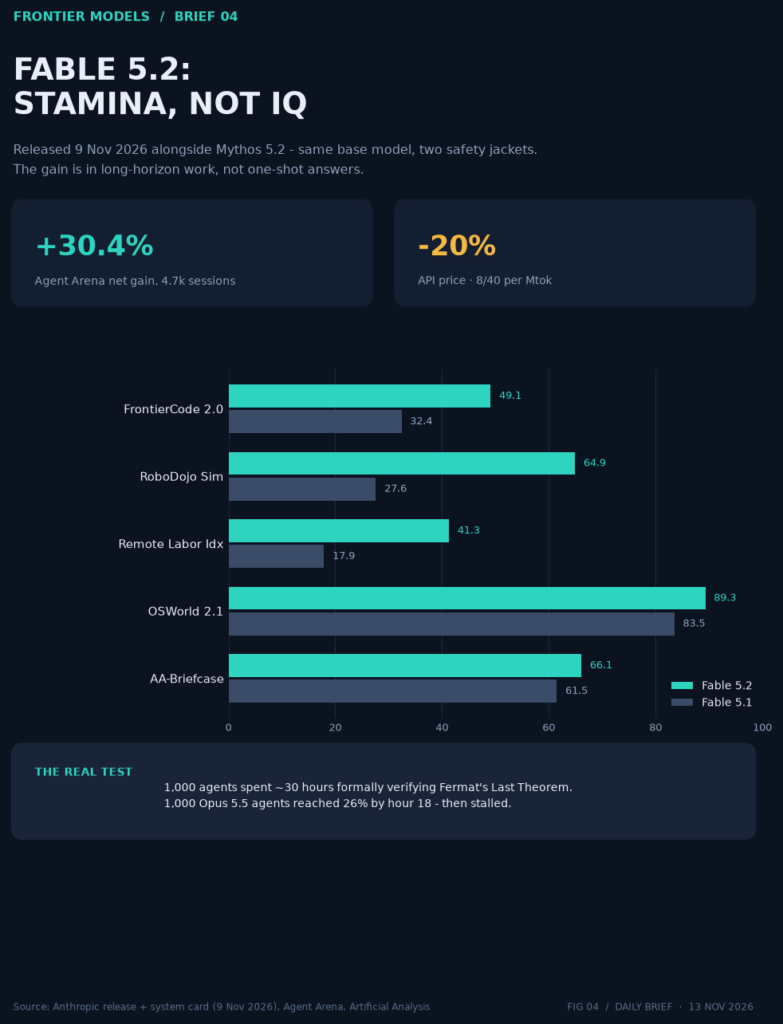
The headline number is real: Fable 5.2 shot to the top of the crowd-sourced Agent Arena with a +30.4% net improvement across roughly 4,700 real-world agent sessions, about 1.6 times second-place Claude Opus 5.5. It’s also cheaper — $8 per million input and $40 per million output tokens, down 20% from Fable 5.1 — and up to 30% faster, with an optional fast mode that runs 2.5 times quicker at double the price.
But the most interesting thing about this release isn’t a benchmark. It’s what those gains are actually about. Anthropic’s own comparison is telling: they put 1,000 Fable 5.2 agents on the task of formally verifying Fermat’s Last Theorem — translating the existing proof into machine-checkable code. By the 18-hour mark, 1,000 Opus 5.5 agents had completed 26% and then stalled. Fable 5.2 kept going for nearly 30 hours and finished.
That distinction explains the numbers perfectly. On one-shot tasks — a single answer, a quick question — Fable 5.2 barely improved. On long, multi-step jobs where the model has to remember what it did forty steps ago, correct itself, and not give up, the gains are enormous. FrontierCode 2.0 jumped from 32.4% to 49.1%; a robotics simulation benchmark more than doubled from 27.6% to 64.9%.
The honest read: Fable 5.2 isn’t smarter in the way that phrase usually means. It has stamina. For the kind of agent work the industry is betting its future on, that may matter more.