The Economics Behind Dark Patterns: Why the Cruelest Interface Is Also the Cheapest
In 2021, two University of Chicago researchers invented a product that did nothing. They called it identity-theft protection, autobilled at $8.99 a month after a free trial, and offered it to a census-weighted sample of 1,963 Americans. Then they made the exit harder to find.
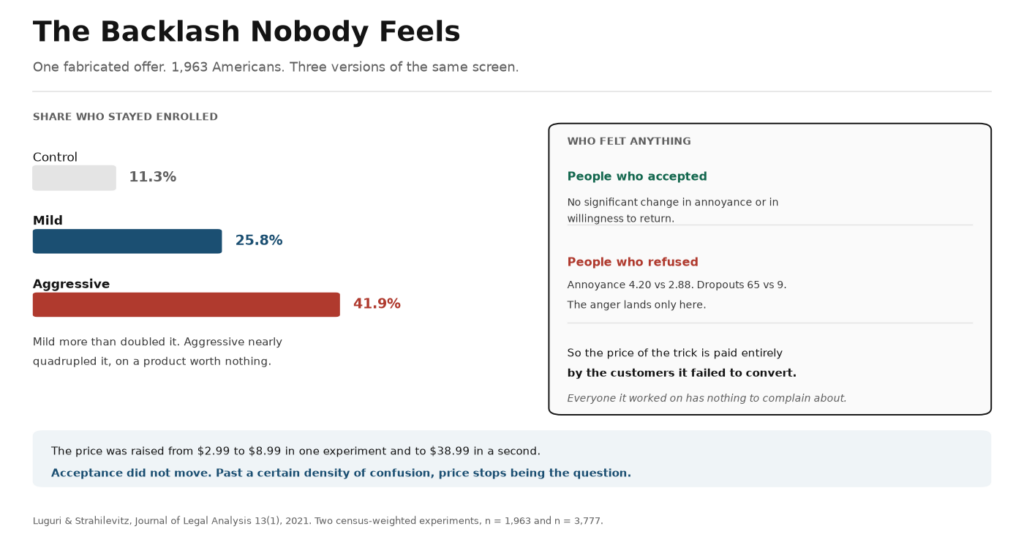
Under a neutral screen, 11.3 percent stayed enrolled. Add a preselected box and a few extra clicks, 25.8 percent. Pile on a countdown timer and two more screens of obstruction, 41.9 percent.
That is the number everyone quotes. The more interesting one arrives forty pages later.
The exit was the product all along
Among the people who accepted, 73.7 percent said they were at least somewhat likely to cancel once the trial ended. About a fifth said they definitely would.
Sit with that. Those customers were not persuaded the product was good. Nothing about the offer got better. They simply discovered, at the moment of deciding, that leaving required more effort than staying — and deferred the decision to a version of themselves with more patience.
Which means the mechanism was never conversion. It was a bet that wanting to cancel and actually cancelling happen at two different times, and that the distance between those two moments is where the money lives.
A toll booth, not a growth engine
This is the part that reframes the whole debate. If your revenue depends on the gap between a customer’s intent and their follow-through, you are not running acquisition. You are running a toll booth on your own exit, and the toll is charged to people who already told you they wanted to leave.
The Amazon settlement of September 2025 priced this at $2.5 billion — a billion in penalty, up to 1.5 billion refunded to roughly 35 million subscribers, over a cancellation flow that internal emails apparently nicknamed the Iliad. Chegg paid $7.5 million in the same year after charging around 200,000 customers who had asked to cancel. In both cases the misconduct was not the sale. It was the exit.
Why the anger goes to the wrong people
Here is the detail that should unsettle anyone still treating dark patterns as a reputational risk with a predictable price.
Aggressive patterns produced real backlash. Mild ones produced almost none. And the backlash landed almost exclusively on people who refused the offer: annoyance scores of 4.20 against 2.88, and 65 dropouts against 9. Among customers who accepted, there was no significant shift in mood and no reduced willingness to buy again.
So the harm is invisible twice over. The people it worked on do not feel worked on. The people who feel something are the ones whose conversion you lost anyway, and whose opinion your funnel has already decided not to count.
The price stopped mattering
Then the researchers did something quietly devastating. They tripled the monthly fee from $2.99 to $8.99, and in a second study pushed it to $38.99. Acceptance did not move.
Once the interface is confusing enough, the amount being charged stops being the variable. Price, the thing your pricing team agonises over, gets routed around by a form. And because these designs are validated in private A/B tests and generate no complaints, the firm learns to lean on them without ever seeing the cost — an arms race whose losers are structurally unable to report the loss.
The burden is also unequal. Education predicted susceptibility to mild patterns (b = −0.19, p = .002) and predicted nothing under the control condition. The subtle version extracts most efficiently from the people least equipped to notice.
What actually constrains it
Not ethics alone, and not immediate ROI, because the immediate ROI is real. What constrains it is accumulation: detection compounding across a customer base that has now learned the ending of this film, and a regulatory floor that has moved from principles to specifying interface elements.
Cass Sunstein’s work on sludge offers the cleaner frame. Sludge is friction that costs people what they were trying to get. The test is not whether there is friction — legitimate friction protects the person navigating it — but whether the friction protects the customer or the organisation from the customer. A cooling-off period passes. A cancellation maze does not.
The uncomfortable conclusion is that mild manipulation is close to free at the moment you ship it. That is exactly why restraint has to be argued from something other than the current quarter.