The Wage That Refused to Fall: The Economics Behind the Junior Marketing Job
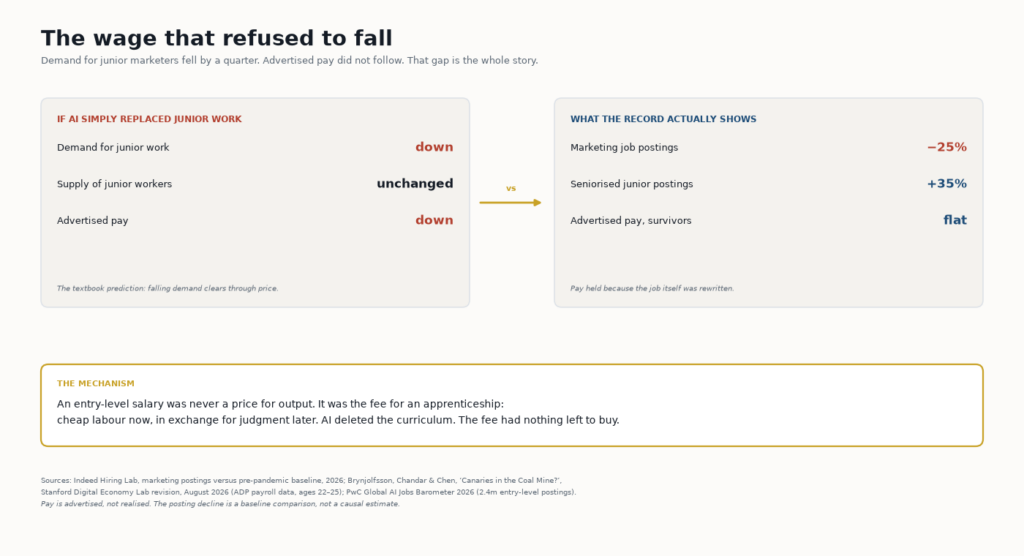
Here is the paradox, stated plainly. Marketing job postings in the United States sit roughly 25% below their pre-pandemic level, according to Indeed Hiring Lab. At the same time, entry-level roles in the most AI-exposed occupations have become harder to get: for workers aged 22 to 25, employment in those roles now runs about 19% below where it would be if it had tracked their less-exposed peers, up from 15% a year earlier.
Put those two facts together and you get something economists would normally expect to be self-correcting.
If demand for junior marketing work has fallen by a quarter, the price of junior marketing work should have fallen too. That is not a controversial claim—it is the first thing a supply-and-demand diagram tells you. Excess supply clears through price. Salaries come down. Employers hire again at the new, lower rate. The market finds a floor.
That did not happen. Advertised pay held.
The gap is the story
So we have a market with one quarter less demand, no visible reduction in the supply of people wanting in, and flat prices. Something in that sentence has to give, and the honest answer is that one of my assumptions was wrong. The salary being advertised was never purely a price for junior output.
Consider what an entry-level marketing salary actually buys. Not much, in pure output terms. A junior marketer writes worse copy than a senior, buys media less efficiently, and needs reviewing. On a strict output-per-dollar basis, you would not hire them at all.
What you were buying was optionality. You paid a modest wage now to have a trained, culturally embedded person available in three years. The routine work was the mechanism by which that person learned, and the salary was the fee for admission to the curriculum.
AI removed the curriculum and left the salary.
Why the job got rewritten instead of eliminated
Here is the part that makes this more than a lament. Employers did not lower the bar and hire cheap juniors at reduced rates. They raised the bar and hired fewer people.
PwC’s 2026 analysis of 2.4 million US entry-level postings found that junior roles demanding traditionally senior capabilities—judgement, leadership, stakeholder management—grew 35% since 2019. Entry-level roles that did not get what PwC calls “seniorised” fell 10%. Among the most AI-exposed entry-level roles, job adverts are seven times more likely than the least exposed to ask for senior skills.
That is a strange outcome if you think of AI as a labour substitute. It makes perfect sense if you think of AI as a curriculum substitute. The employer no longer needs someone to do the routine work, because the routine work is done. What the employer still needs is someone who can decide—and decide is not a skill you can hire at junior rates just because the tools got better.
So the job title stayed and the content moved up. Twenty-two-year-olds are being asked for capabilities that used to take ten years to accumulate, because the ten years of routine work that built those capabilities no longer exists in the job.
What this does to the on-ramp
The consequence is a broken ladder, and it is worth being precise about which rung is missing.
It is not the top. Strategists, brand owners and the people who decide where money goes are fine—arguably better than fine, since PwC finds professionalised roles growing twice as fast with wage growth 42% faster than democratised ones.
It is not the middle, either. Mid-level marketers who already have judgement and a track record are being asked to orchestrate AI rather than compete with it, and that is a raise, not a redundancy.
The missing rung is the first one. The place where you were allowed to be mediocre in public for eighteen months while you developed taste.
The uncomfortable implication
Here is where I have to be honest about the limit of the argument. The Stanford authors state plainly that their result is descriptive, not causal, and that payroll data cannot isolate AI from everything else moving at once. The Indeed figure is a baseline comparison, not a causal estimate. Advertised pay is not realised pay, and the 19% gap shrinks when education is controlled for.
But the mechanism is consistent across four independent datasets—payroll records, job postings, occupational projections and a billion job adverts—and consistency across datasets built by different people for different purposes is the strongest evidence available in labour economics.
Which brings us to the real question, and it is not whether AI will take marketing jobs. It is who pays for the apprenticeship now.
Because the old arrangement was quietly exploitative and it worked. Junior marketers were underpaid relative to their contribution, and in exchange they received training that made them expensive. AI destroyed the underpayment and, with it, the training. What remains is a market that wants experienced judgement without funding the years in which judgement is made.
That is not a technology problem. It is a financing problem, and no model release is going to solve it.