The Field Behind the Decoy: How a 52-Point Lab Trick Becomes a 0.6 Percent Revenue Lift
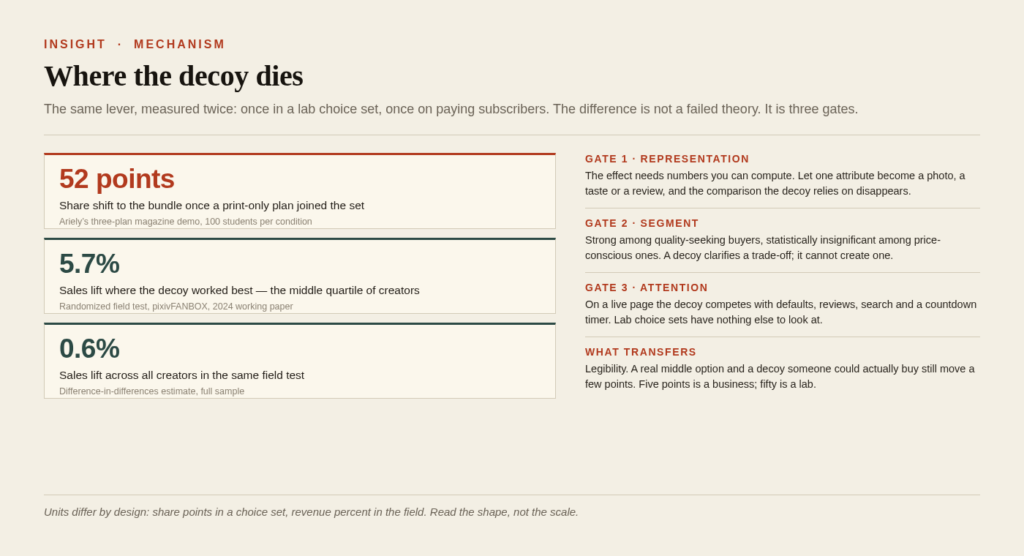
The most-quoted demonstration in pricing psychology is a magazine page. Three plans: web only at $59, print only at $125, print and web at $125. Sixteen percent of the students took the cheap plan, 84 percent took the bundle, nobody took the absurd middle option. Remove it and the bundle falls to 32 percent.
Fifty-two points of share, produced by an option nobody chose. Great story — and it is the story most pricing decks stop at. The more interesting question is what happens when the same lever runs on people spending their own money. The answer: much less, and for reasons worth knowing before you build a tier.
In 2024, three economists ran a randomized field test on pixivFANBOX, a Japanese subscription platform where creators set their own monthly plans. Creators were randomly encouraged to add a decoy — a plan that cost more and delivered no extra reward. Across the full sample the intervention lifted sales by roughly 0.6 percent: significant, and commercially trivial. In one quartile, the middle of the sales distribution, the lift reached 5.7 percent, and it came from more subscribers rather than higher prices. Same lever, a fraction of the lab effect.
Three gates explain the gap.
The representation gate. Frederick, Lee and Baskin showed in 2014 that the attraction effect lives inside stylised numeric tables — a toaster rated 7.2 on durability against one rated 5.5. Let even one attribute become perceptual, a photo of a hotel room instead of a rating, and the effect typically disappears. Real product pages are mostly perceptual: a photograph, a review snippet, a feeling about the brand. The comparison the decoy exploits is simply not there to be made.
The segment gate. It does not move everyone equally. In a 2012 study in Psychology & Marketing, the pull toward the middle was strong among quality-seeking buyers and statistically insignificant among price-conscious ones. A decoy clarifies a trade-off for someone already weighing quality. For a buyer hunting the lowest number, it is just another expensive row.
The attention gate. On a menu, context effects survive but soften. Seven years of cashier data from a German restaurant — more than 88,000 individual choices — showed a dish that becomes the compromise gaining about five points of share, with the effect ranging from nothing to total depending on the category, and insignificant for solo diners while pronounced in groups. Five points is a real business. It is also a tenth of what a three-option lab study implies.
Which reframes the job. The decoy is not a persuasion device; it is a legibility device. It pays out in proportion to how cheaply a buyer can compute the comparison, how much they care about the axis you are comparing on, and how much attention the choice set leaves them. On a real page, that means fewer attributes, one axis stated in numbers where you have numbers, a middle option that is genuinely the answer, and a decoy a rational person could actually buy.
The lab number is real. It is a ceiling, not a forecast.