The 1.4-Point Reality: Why Most Marketing Nudges Underdeliver — and Which Ones Don’t
Somewhere between the academic paper and the growth team, the word “nudge” changed jobs.
It used to describe a specific, humbling idea: that you can change what people do by rearranging the room they decide in, without lying to them, without removing their options, without charging them for the exit. Now it describes a red badge in the corner of a checkout page that says three items remain.
Those are not the same thing, and the difference is not semantic. One of them has a measurable effect that survives replication. The other has a measurable effect that survives until someone screenshots it. If you are building a marketing program in 2026 and you have been told that behavioral science gives you a menu of tricks, you have been handed a menu where half the dishes are theatre and a few are poison.
Let us separate them properly.
The Word Got Away From Us
Thaler and Sunstein meant something narrow and rather noble. A nudge changes the choice architecture so the better option becomes the easier one, while preserving freedom. No mandates. No deception. The canonical example is a cafeteria that puts fruit at eye level. Nobody banned the chips. The chips just got further away.
That definition has a built-in ethical spine, and it is precisely the spine that marketing stripped out. Once “nudge” came to mean “any psychological lever that moves a number,” the constraint disappeared. Urgency timers, fabricated stock counts, pre-checked consent boxes, a decline button labelled “No thanks, I prefer to pay full price” — all of it got filed under behavioral science, because the word had become a synonym for “we read a book once.”
There is a cost to this, and it is not abstract. When the term covers both a helpful default and a fake countdown, the helpful default gets contaminated by association. Regulators now write rules aimed at the fake countdown, and legitimate choice design gets caught in the drafting. The discipline lost control of its own vocabulary, and it is paying for that in compliance meetings.
The Replication Reckoning
Here is the part the pitch decks leave out. Behavioral interventions do work. They just work far less than the literature claimed, and the gap is now well documented.
What the two nudge-unit numbers actually say
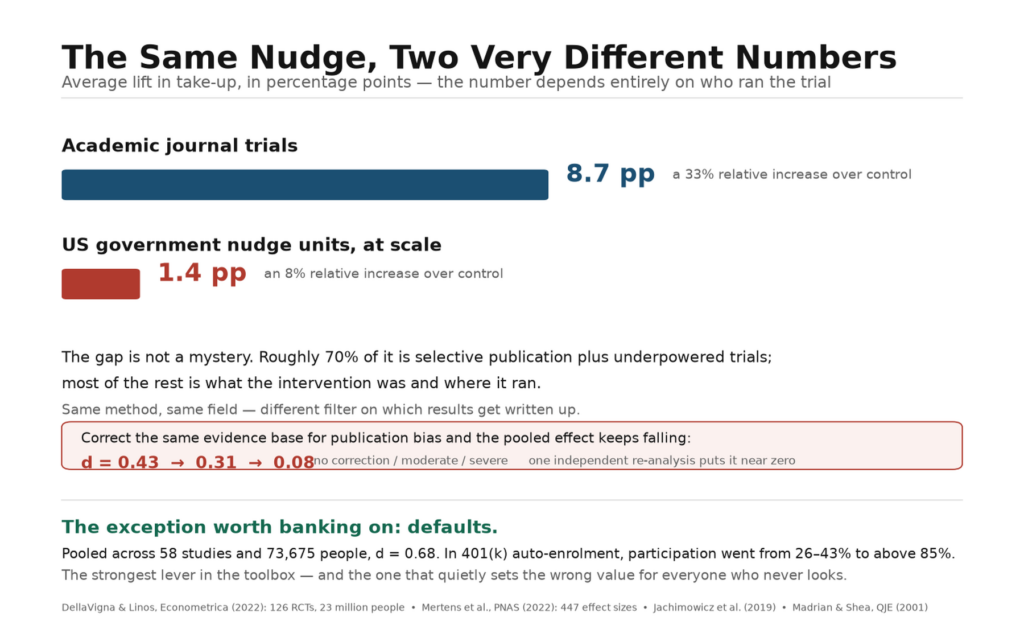
In 2022, Stefano DellaVigna and Elizabeth Linos published an analysis in Econometrica that put two bodies of evidence side by side. On one side: 126 randomised controlled trials run by two of the largest government nudge units in the United States, covering roughly 23 million people. On the other: a sample of nudge trials published in academic journals.
The academic trials showed an average take-up lift of 8.7 percentage points — a 33 percent relative increase over control. The nudge-unit trials, run at scale on real populations, showed 1.4 percentage points, an 8 percent relative increase.
Both numbers are statistically solid. The gap between them is roughly seven points, and the authors did the work of decomposing it. About 70 percent of the difference comes from selective publication compounded by underpowered trials. Most of the remainder comes from what the intervention actually was and where it ran.
Read that again, because it is the single most useful sentence in applied behavioral science: the published literature overstates the effect largely because unsuccessful trials do not get written up.
Where the effect goes when you correct for bias
The 2022 meta-analysis by Mertens and colleagues in PNAS is the one everyone cites, usually for its headline: 447 effect sizes from 212 publications, more than two million participants, pooled Cohen’s d of 0.43 — a small-to-medium effect.
Less quoted is what the same paper says about its own number. The authors found moderate publication bias, and their sensitivity analysis showed the effect attenuating to d = 0.31 under a moderate assumption and to d = 0.08 under a severe one. They also reported that with the observed dispersion, roughly 15 percent of interventions are likely to backfire and reduce the behaviour they were trying to increase.
Then three separate teams wrote to PNAS in July 2022 arguing the correction did not go far enough. One re-analysis applying bias-correcting methods to the same dataset landed at estimates between −0.01 and 0.08. That is not “small.” That is “indistinguishable from nothing.”
The honest summary is not that nudges fail. It is that the average nudge is a weak instrument whose measured strength depends heavily on who published it, and that anyone quoting a large single-study effect to justify a budget is quoting the wrong number.
The One Lever That Survives
If the aggregate is fragile, the specific is not. Defaults are the exception, and they are an unusually sturdy one.
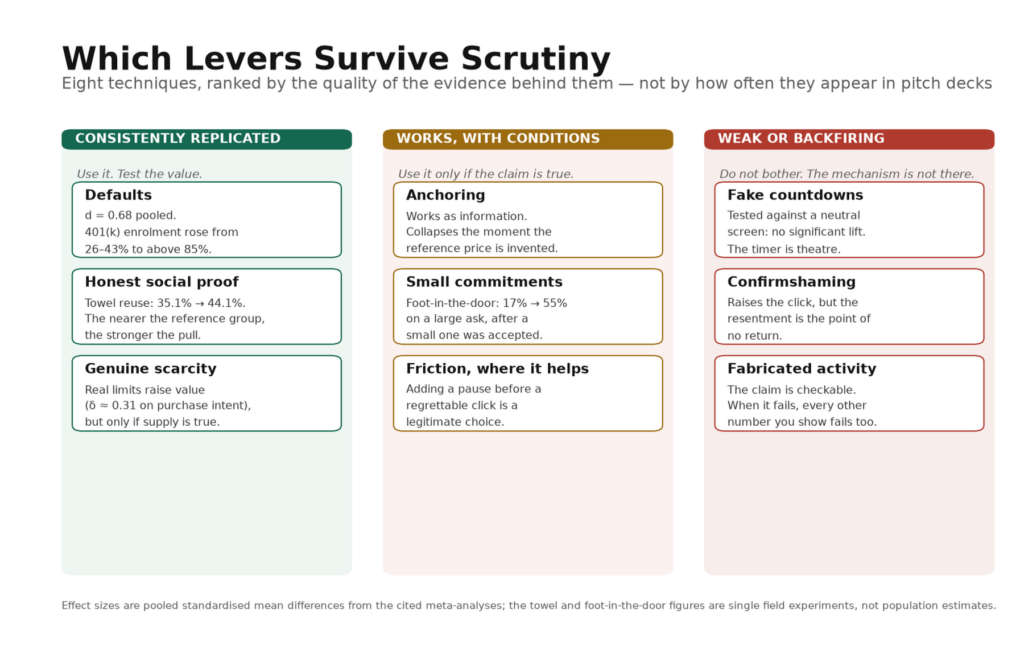
A meta-analysis of 58 default studies covering 73,675 participants, published in Behavioural Public Policy in 2019, found d = 0.68 — and, notably, found that if anything larger effects were under-reported, the reverse of the usual bias. In binary consumer decisions, the preselected option was chosen about 27 percent more often than the non-preselected one.
The field evidence is starker. When a large US healthcare firm switched its 401(k) to automatic enrolment in 1998, participation among new hires went from roughly 26 to 43 percent to above 85 percent. The Madrian and Shea paper in the Quarterly Journal of Economics also delivered the warning that makes defaults dangerous: participants anchored at the default contribution rate and the default fund, and a meaningful share never moved. The lever works. It also sets a value for everyone who never looks.
That is the whole ethics of defaults in one sentence. A default that pre-selects the option a reasonable person would want is a service. A default that pre-selects the most expensive tier, or the privacy-invasive setting, is a machine for harvesting inattention. The mechanism is identical. The judgment is about what you point it at.
Johnson and Goldstein’s organ donation comparison makes the scale visible: countries with presumed-consent defaults sat nearly 60 percentage points above countries requiring explicit consent. Nobody was forced. The form was simply arranged.
What Actually Works
Beyond defaults, the reliable set is narrower than the folklore, and each member comes with a condition attached.
Social proof, but only the verifiable kind
The classic field experiment — Goldstein, Cialdini and Griskevicius in the Journal of Consumer Research — moved hotel towel reuse from 35.1 percent to 44.1 percent by swapping an environmental appeal for a descriptive norm about other guests. The strongest version referenced previous guests in that specific room, and it produced a further jump.
The mechanism is provincial: the nearer the reference group, the stronger the pull. The condition is truth. A descriptive norm works because it carries information about what people actually do. Fabricate it and you are not using social proof; you are using a lie with a progress bar, and the lie is checkable. Note also that a 2014 replication in PLOS ONE found descriptive norms performing no better than a standard environmental message in a different hotel, which tells you what you already suspected: the effect is real but context-dependent, and it does not travel for free.
Scarcity, when the supply is real
The cookie-jar experiments from 1975 established the basics and they still hold: scarce items are rated more desirable, items that became scarce are valued above items that were always scarce, and scarcity caused by high demand beats scarcity caused by accident.
A 2022 meta-analysis in the Journal of Retailing — 416 effect sizes from 131 studies — put the purchase-intent effect at δ = 0.31 and did something more useful than a headline: it disaggregated by source. Supply-based scarcity (a genuinely limited run) works best for experiences. Demand-based scarcity works best for utilitarian goods. Time-based scarcity works best for high-involvement purchases. The lever is real, and it is specific.
None of that licenses a countdown timer that resets when you refresh. The FTC’s 2022 staff report named exactly that pattern, alongside “almost sold out” claims when supply is ample, and false statements that other people are currently viewing the item. The mechanism is not the problem. The fiction is.
Commitment, without the guilt
Foot-in-the-door is one of the oldest findings in social psychology and one of the best replicated at the level of direction. Freedman and Fraser in 1966 got 17 percent compliance on a large request made cold, and 55 percent when a small, harmless request preceded it.
The ethical version respects the sequence and drops the coercion. A “remind me later” that genuinely reminds. A preference captured because it improves the next interaction, not because it creates sunk cost. The unethical version is the same sequence with guilt bolted on, and it is the easiest dark pattern to build and the hardest to defend when someone asks why the decline button is grey.
Where the Line Sits
The industry’s working assumption has been that dark patterns convert and the backlash is somebody else’s problem. The measurement literature says otherwise, and regulators have started pricing it.
The prevalence problem
A crawl of roughly 11,000 shopping websites and 53,000 product pages, published at ACM CSCW in 2019, found 1,818 dark-pattern instances across 15 types on 1,254 sites — about 11 percent of the sample, with more popular sites more likely to carry them. The European Commission found at least one dark pattern on 97 percent of 75 leading EU sites and apps. The 2024 ICPEN sweep, coordinated for the first time with privacy regulators, found at least one on 75.7 percent of 642 sites and apps and two or more on 66.8 percent.
Not all of those are deceptive. Some are defaults. Some are friction. But the base rate matters: this is not a fringe practice you can treat as a competitive disadvantage to avoid. It is the ambient condition.
The regulatory floor is now higher than the ethical floor
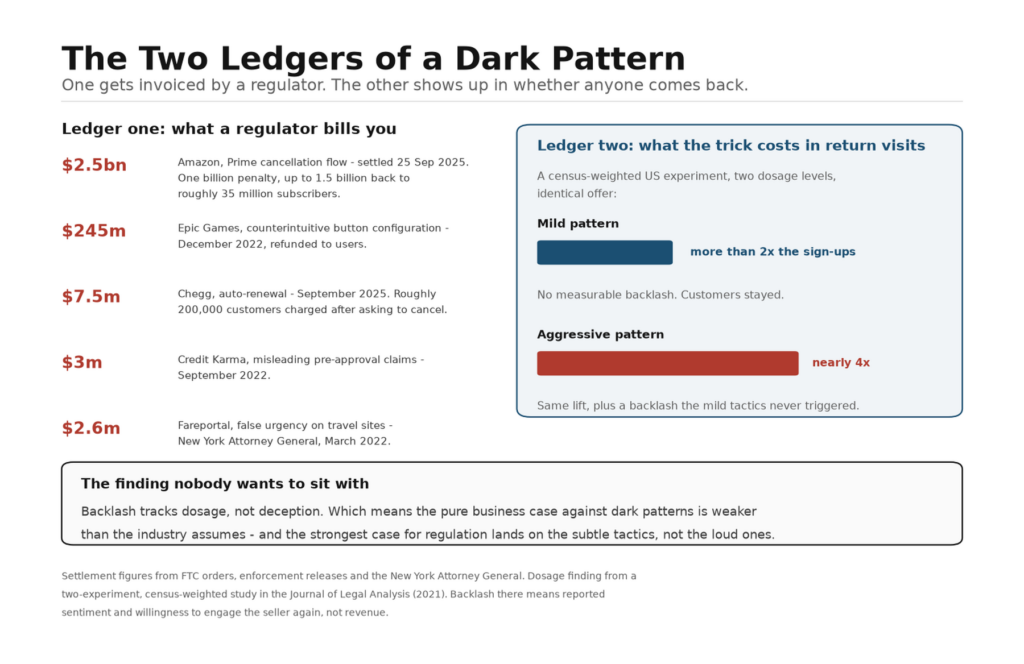
The UK Competition and Markets Authority published a taxonomy of 21 online choice architecture practices in 2022 and marked several — drip pricing, sludge, forced outcomes, complex language — as almost always harmful. The EU Digital Services Act prohibited dark patterns outright in Article 25. The enforcement record has teeth: Epic Games settled for $245 million in December 2022 over counterintuitive button configuration; Credit Karma paid $3 million over misleading pre-approval claims; Chegg paid $7.5 million in September 2025 after roughly 200,000 customers were charged post-cancellation; the New York Attorney General recovered $2.6 million from a travel operator over false urgency.
And then Amazon: $2.5 billion, settled 25 September 2025, comprising a $1 billion civil penalty and up to $1.5 billion in redress for roughly 35 million subscribers, over a cancellation flow that internal emails apparently called the Iliad. The order did not just prohibit conduct. It specified interface elements.
If your compliance team is still treating this as a European problem, the last three years have been a poor time to be away from your inbox.
The Uncomfortable Part
Here is the finding I would rather not report, because it undercuts the tidiest version of the argument.
A two-experiment study on census-weighted samples of American adults, published in the Journal of Legal Analysis in 2021, tested dark patterns against neutral interfaces. Mild patterns more than doubled sign-ups for a dubious service. Aggressive patterns nearly quadrupled them. The magnitudes are enormous by social-science standards.
Then the authors tested for backlash, and found something that complicates every “honesty pays” deck you have ever sat through. Aggressive dark patterns generated a strong negative reaction. Mild ones largely did not. Consumers did not report worse moods, did not abandon the seller, did not punish the brand — they simply chose something they would not have chosen otherwise, often without realising it.
Which produces an inversion nobody wants: the subtle patterns are both the most effective and the least punished. The loud, obvious tricks carry their own reputational tax. The quiet ones — smaller print, an extra screen, a decline link that looks like body copy — do the work and leave no bruise.
So the pure business case against dark patterns is genuinely weaker than the industry’s critics claim. Deploying mild manipulation appears to be, in the short run, close to free. What the study cannot tell you is what happens over three years, in a market where a screenshot travels faster than a press release and where the EU found dark patterns on 97 percent of the sites it checked — meaning your customers have now seen this film many times before and have learned the ending.
The argument that survives is not “manipulation does not work.” It is “manipulation works until it is noticed, and the noticing is now a matter of when.”
Sludge Is the Same Problem Backwards
One concept deserves its own heading, because it is the mirror image and most teams have never audited for it.
Cass Sunstein’s work on sludge describes the opposite of a nudge: excessive friction that stops people getting what they want. Long forms. Hidden terms. A cancellation flow that requires a phone call. Sludge costs the user time and money, and it falls hardest on people with the least of either.
The important nuance is that not all friction is sludge. Friction can be legitimate — a cooling-off period before a high-stakes purchase, a confirmation step before an irreversible action, a pause that prevents a regretted click. The test is whether the friction protects the person navigating it or protects the organisation from them.
That test is the same test as the nudge question. It is just asked from the other direction, and it catches the neglectful failures that a dark-pattern audit misses: the checkout with twelve fields, the support page that answers nothing, the unsubscribe that requires a password reset.
What to Do on Monday
Strip out the vocabulary and the practical programme is small.
The three questions
Before shipping any behavioral intervention, ask:
Would this help me if I were on the other side of the screen? Not “would I accept it” — you are not the median user, you are the person who designed it. Would a reasonable stranger, seeing the same screen, end up with a decision they would endorse tomorrow.
Is every factual claim in this interface true? The stock count, the viewer count, the “was” price, the deadline, the review average. If one of them is aspirational, you are not running a nudge. You are running a defect that will be discovered.
Is the choice still free? Can a user decline in one action, in the same medium they signed up in, without a maze? If not, you have left the definition of a nudge entirely, and you are in the territory the FTC has been billing people for.
What to measure
Conversion is the wrong sole dependent variable, and this is where most behavioral programmes quietly rot. Track the trust side alongside it: 90- and 180-day repurchase rate for cohorts exposed to the intervention versus matched controls, complaint rate per thousand orders, cancellation-flow completion without support contact, regret-driven return rate, and an unaided trust measure in your brand tracker.
If the intervention lifts conversion 4 percent and drops 180-day repurchase 6 percent, you have not found a nudge. You have found a slow leak and booked it as growth.
Also worth internalising: the domain matters more than the technique. The same meta-analysis that found d = 0.43 overall found d = 0.65 in food choices and d = 0.24 in financial decisions. A nudge that worked in one category is a hypothesis in another, not a playbook. Test in context, with enough power to detect 1.4 points rather than 8.7, or you will reproduce the publication bias problem inside your own company.
What Still Isn’t Settled
Three honest caveats.
The trust-cost claim is theoretically strong and empirically softer than usually presented. Brand trust does mediate the link between manipulative design and reduced repurchase intent in survey-based structural models, and the direction is consistent. But much of that literature is cross-sectional, self-reported, and single-market. The clean longitudinal study — same users, same brand, exposure randomised, revenue tracked for two years — has not been published at scale. Anyone telling you the ROI of ethics to two decimal places is extrapolating.
The replication debate is not closed. The PNAS exchange in 2022 ended with the original authors defending their uncorrected estimate and critics arguing for near-zero. The most defensible position sits between them and depends on assumptions about unpublished trials that nobody can verify directly.
And the regulatory picture is moving faster than the case law. The FTC’s own click-to-cancel rule was vacated by the Eighth Circuit in July 2025, and the agency has pivoted to case-by-case enforcement with design-specific injunctions. That is a less predictable environment, not a safer one.
The Short Version
Behavioral science is not a bag of tricks. It is a small set of well-evidenced levers, surrounded by a much larger set of plausible stories that did not replicate, and it sits on a continuum with a genuinely harmful end.
The levers that hold up — defaults, honest social proof, real scarcity, credible anchoring, voluntary commitment — share a structural property. They work because they carry true information about the world, or because they reduce the effort of a choice the person already wanted to make. They do not require the customer to be wrong about anything.
The ones that fail, or that get invoiced, all require a fiction: a false deadline, an invented crowd, a decline button designed to be missed. Each of them rents a click and mortgages a relationship. Some rents are cheap for a while. The 2021 dosage study suggests the quiet ones stay cheap longer than we would like. That is not a licence. It is a description of how the bill arrives — late, and attached to everything else you were doing honestly.
The discipline was never “how do we make them click.” It was: keep the facts true, keep the choice free, and measure whether they come back.