Why the Loudest Guochao Brands Earn the Thinnest Margins
Florasis built a museum in a lipstick. Laopu Gold built a workshop.
Both sold Chinese tradition to Chinese consumers in the same years, under the same cultural tailwind, to the same demographic. One contracted 21%. The other grew 167%. And the gap between them is not a story about taste, or timing, or even about which brand told a better story about China.
It’s a story about what happens to a moat when everyone can dig it.
The Wrong Explanation
The intuitive read is that Florasis got unlucky. A livestream remark in September 2023 about a RMB 79 eyebrow pencil — and the discovery that its per-gram price exceeded several international prestige brands — triggered a collapse. Sales fell 90% in 48 hours and never fully recovered.
That reads like a crisis-management failure. It wasn’t. The pricing controversy was the revelation, not the cause. Consumers had been paying heritage prices for a product whose heritage lived almost entirely in the packaging, and the episode simply made that visible in public.
Here’s the mechanism that actually governs it: a heritage position is only as defensible as the part of it a competitor cannot reproduce.
Copyable Surface, Uncopyable Process
Any brand can put a lattice pattern on a compact. Any brand can license a museum IP, commission a Miao-inspired collection, or name a shade after a poem. Those moves are cheap, fast, and — critically — available to every competitor simultaneously.
So they don’t hold value. When everyone can do a thing, the thing becomes table stakes, and the premium migrates away from it. That is exactly what happened to the aesthetic layer of guochao: it commoditised, in public, at speed.
What doesn’t commoditise is process. Laopu’s goldsmithing techniques carry intangible cultural heritage status — filigree, inlay work, court-era methods. Those are not a licensing deal. They are decades of accumulated skill held by a limited number of craftspeople, and you cannot buy that capability the way you buy a design file.
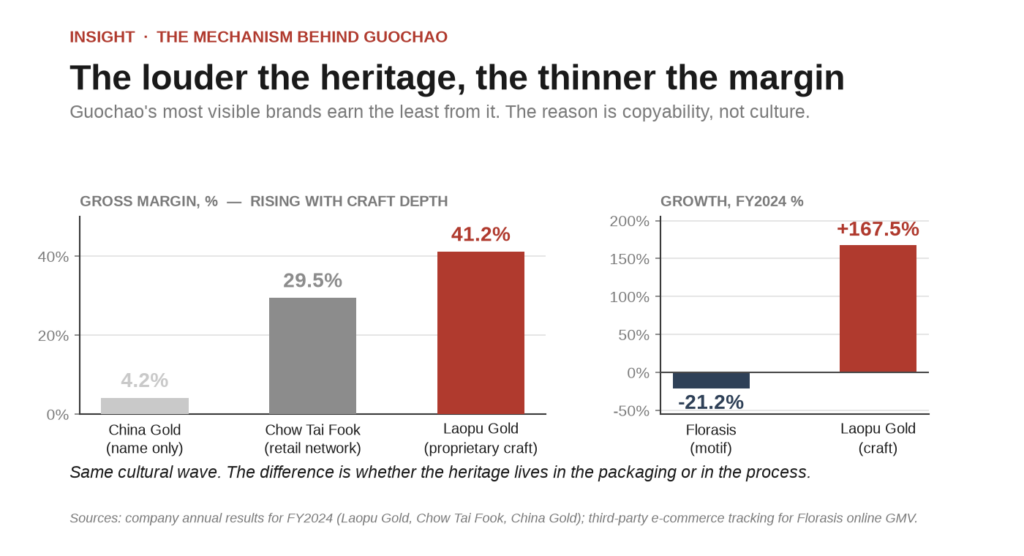
Look at the left panel honestly. China Gold sells gold with a name attached and earns 4.2%. Chow Tai Fook runs the most sophisticated retail network in the category and earns 29.5%. Laopu runs 36 stores and earns 41.2%.
The variable that moves the margin is not scale, not marketing spend, not store count. It’s how much of the value sits in a process someone else would have to spend a decade learning.
The Incentive That Explains the Whole Divergence
Now the honest part, because this is where the economics get uncomfortable.
A brand optimising for growth speed will always choose the copyable surface. Packaging redesigns ship in months. Craft capability takes years and caps your store count, because you can only open where you can staff. Florasis was venture-funded and scaling; the incentive was to build the fastest possible aesthetic signature, and it did that brilliantly. Laopu’s incentive structure was different, and so was its ceiling — 36 stores, but RMB 328 million average sales per store.
Neither company was irrational. They were responding to different incentive structures, and those structures produced different moats. That’s the insight worth carrying: the guochao premium does not go to whoever tells the Chinese story loudest. It goes to whoever can make the story expensive to imitate.
What This Predicts
If the mechanism is copyability, it makes a falsifiable prediction: as the aesthetic layer saturates, premium should concentrate in categories where craft is verifiable — jewellery, high-end skincare, spirits, instruments — and thin out where the heritage is purely visual.
That’s what the data shows. Bain’s 2025 luxury report has watches down 14–17% and leather goods down 8–11%, while beauty grew 4–7%. The categories where heritage can’t be faked are holding. The ones where it’s a surface treatment are not.
And it predicts something less comfortable for the marketing industry: another two years of brands commissioning heritage-inspired packaging, discovering it produces no margin, and concluding that guochao “stopped working.” Guochao never stopped working. They just bought the cheap half of it.