The 38% Problem: Why China’s Fastest-Growing Marketing Software Mostly Sits Unused
The number that should stop you is not the growth rate. It is the gap beside it.
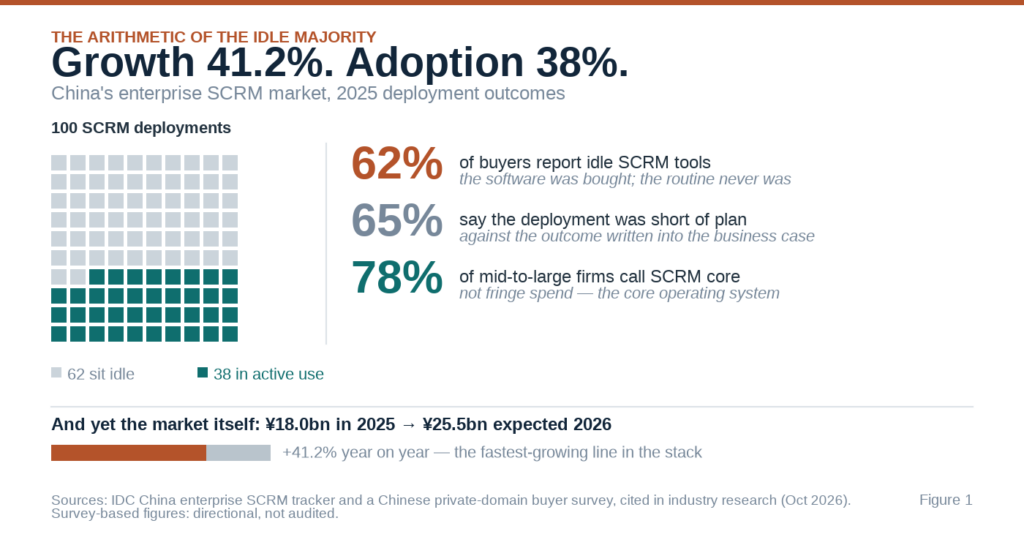
China’s enterprise SCRM market grew 41.2% in 2025 to more than ¥18 billion, and IDC expects ¥25.5 billion in 2026. Seventy-eight percent of mid-to-large enterprises now describe SCRM as the central system for private-domain operations. By any normal reading, this is a category on fire.
And yet the same body of industry research reports that 62% of the companies that bought SCRM ended up with idle tools, at an average direct loss above ¥150,000 each, with 65% saying the deployment underdelivered against the business case they had signed off.
Both numbers are true. That is the interesting part. A market can grow 41% a year while three out of five buyers get nothing from it — and once you see why, you stop reading category growth as evidence of category value.
The purchase is a decision; the routine is a project
Here is the mechanism, and it is almost embarrassingly simple.
Buying software is a decision: one budget approval, one procurement cycle, one signature. Its completion is unambiguous. You can point at it in a board deck.
Operating software is a project: staffing the roles, writing the content cadence, defining lead-routing rules, setting response-time SLAs, agreeing who owns an unresponsive customer at day nine, and then doing all of it every single day for eighteen months. Its completion is invisible, and its failure is silent.
These two things have wildly different cost curves. The decision costs money once. The project costs attention continuously. And attention is the scarce input in most Chinese marketing organisations, because the same team is also running Douyin content, Xiaohongshu seeding, livestream schedules, and platform ad accounts.
So the decision gets made, because decisions have deadlines and signatures. The project gets deferred, because projects have neither.
The incentive runs the wrong way
It gets worse, and this is the part vendors will not put in the deck.
The vendor is paid on the decision. Implementation support, training, and the operational hand-holding that actually determines whether the tool gets used are, in most contracts, a cost centre — scoped thinly, delivered remotely, and finished before the customer’s first quarterly review.
The buyer’s internal champion is also rewarded on the decision. Landing the platform is a visible win. Running it well for two years is not a promotion, it is a job.
And the platform itself is indifferent. WeCom’s APIs do not care whether your tagging taxonomy is coherent, whether your sales team logs conversations, or whether anyone reads the AI-generated daily brief. There is no penalty for a dormant account.
Three parties, all optimising for the purchase, none optimising for the use.
What the idle installations actually look like
The failure mode is not dramatic. Nobody turns the tool off. It just quietly becomes a place where leads go to be re-assigned.
In practice you see the same three symptoms. Contact tags proliferate until they mean nothing, because tagging was never assigned an owner. Group chats get created for campaigns and never archived, so the customer record fills with dead rooms. And the AI features — the service summaries, the intent scoring — produce output that nobody acts on, because acting on it was never written into anyone’s job description.
At that point the software is not failing. It is doing exactly what an unowned system does: existing.
The arbitrage nobody measures
Here is the part that makes this expensive rather than merely wasteful.
A Chinese brand’s real advantage in private domain is cost. Public-domain acquisition runs at roughly ¥1,088 per user in platform economics; private-domain acquisition runs at a fraction of that, and conversion rates are several multiples higher. That gap is the entire economic case for the WeCom stack.
But the gap only exists if the channel is actually operated. An idle SCRM system does not deliver ¥30–60 acquisition costs — it delivers nothing, while still charging the licence fee and, more expensively, while still occupying the organisational attention that could have gone into operating it.
So the true cost of the idle majority is not the ¥150,000 average loss. It is the forfeited arbitrage, multiplied across every quarter the tool sits there.
The test that predicts it
If you want to know in advance whether your SCRM deployment will be in the 38% or the 62%, do not audit the vendor. Audit your own commitments.
Ask three questions before signing. Who owns the tagging taxonomy, by name? What is the response SLA on inbound private-domain messages, and what happens when it is missed? Which AI output gets reviewed in a standing weekly meeting, and by whom?
If you cannot answer all three with a person’s name and a recurring calendar slot, you are buying a decision, not a capability. The market will keep growing 41%. Your installation will keep sitting there.