The 10% Ceiling: Why Chinese Sellers’ Own Stores Never Outgrow the Brand Behind Them
Start with a number that shouldn’t be possible.
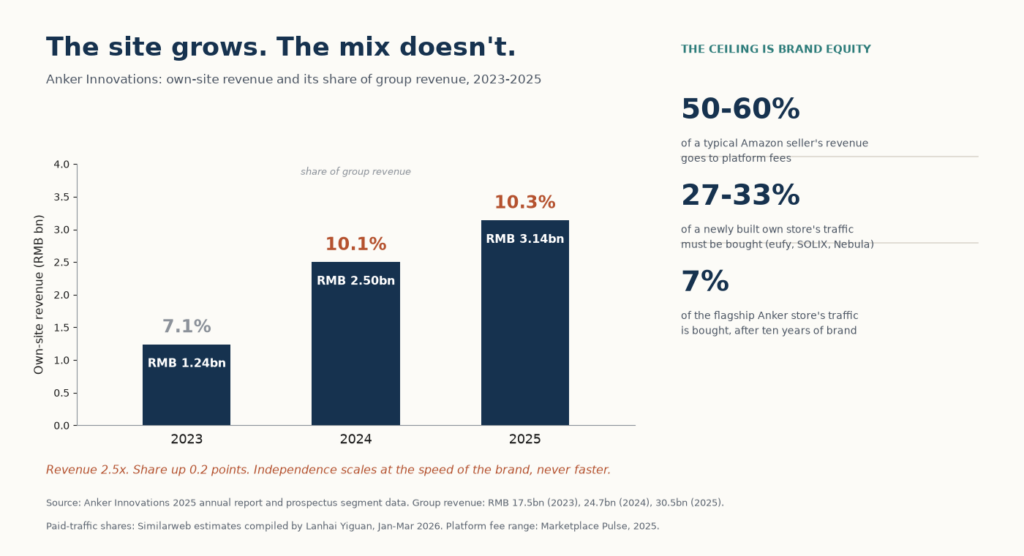
Anker Innovations, China’s most successful brand-led exporter, grew its own-site revenue from ¥1.24 billion in 2023 to ¥3.14 billion in 2025 — a 2.5x jump most Western DTC founders would frame and hang on a wall. Over the same two years, that revenue’s share of the group moved from 7.1% to 10.3%.
Two-tenths of a point. That’s the whole gain.
Which means the independent channel didn’t win share from the platform. It simply grew at exactly the speed of the company around it. Every bounce in own-site revenue was matched by a bounce in Amazon revenue, offline retail, everything else — so the ratio sat still.
The mechanism: platforms manufacture demand, stores harvest it
This is where most analyses of China’s independent-site problem go wrong. They explain the gap with cost: commissions, acquisition prices, CPMs. Costs explain why the site is expensive. They don’t explain why it stays small.
The real constraint is upstream of cost. A marketplace is a demand-creation machine: it puts a stranger in front of a product they had no intention of buying, and it manufactures the first transaction through ranking, reviews, recommendations and guarantees. An own store cannot do that. It has no stranger traffic, no comparative shelf, no accumulated social proof. It can only convert demand that already exists — demand created somewhere else, by advertising, by content, by a friend’s recommendation, by a decade of returns handled without argument.
So own-store revenue is a harvest, not a crop. And harvest size is set by the size of the field you already planted. Which is why the ceiling doesn’t respond to better design, a faster checkout, or a cleverer loyalty programme.
Raising the ceiling costs money you cannot borrow
You can buy a bigger field. You just can’t buy it cheaply.
Anker’s newer brand sites — eufy, Anker SOLIX, Nebula — draw 27% to 33% of their visitors through paid search. The flagship Anker store draws 7%. Same company, same checkout, same design language, wild difference in the traffic bill. The gap is brand equity, expressed in the only unit that matters operationally: how much of your audience arrives on purpose.
That number is also a time measurement. The 7% wasn’t engineered. It was earned across roughly a decade of products that survived reviews, warranties honoured in three markets, and repeat buyers who type the domain directly. No growth marketer can compress that curve with a better funnel.
Why the ratio is a treadmill, not a lever
Here’s the part that traps operators. The share you’re trying to raise is a fraction with the entire company in the denominator.
If group revenue grows 25% and your brand-driven demand grows 20%, your site’s share falls — even in a year you’d call an own-site success. To merely hold 10%, the site must grow at least as fast as everything else, while every incremental visitor is bought at retail media prices. The channel that was supposed to reduce your dependence becomes a fixed-cost treadmill that runs faster the bigger you get.
The tell: the shovels are shrinking
If Chinese merchants were genuinely building independence, the companies selling them the tools would be the loudest beneficiaries. They are not.
Youzan closed 2025 with 52,809 paying merchants, down from more than 100,000 at its peak, on revenue of ¥1.49 billion — up 3.1%. Weimeng’s subscription revenue fell 2.3% and its paying merchant count fell 7.2%, with management conceding that native WeChat Shop features now displace the third-party tools merchants used to rent.
The vendors whose product is an owned storefront are shrinking in a market that supposedly wants owned storefronts. That is a demand-creation signal, not a software signal.
What actually lifts the ceiling
Three things, and none of them is a website.
A demand-creation engine that isn’t paid media — content that compounds, community, product-led word of mouth. A category with genuine repeat purchase, where the second sale arrives at near-zero acquisition cost. And a considered, high-ticket, searchable purchase, where customers look you up by name because the specification sheet matters.
Outside those three, an own store is a media-buying business wearing a DTC costume — which is precisely why the ratio doesn’t move.
So the number worth watching isn’t your own-site share. It’s the share of own-site orders that came back without you paying for the click. That is the only line on the dashboard that ever lifts the ceiling.