Why 89% of Chinese Shoppers Prefer Domestic Brands — and Why Only 4.36% of Them Cite Patriotism
In February 2018, a Chinese sportswear company that had spent a decade being written off as a has-been put a hoodie on a New York runway with four characters printed across the chest: China Li-Ning.
Nobody in the room needed a translation. That was the point.
For thirty years, those same four characters on a label had meant something closer to an apology. “Made in China” was the phrase you found on the underside of a product, not on the front of one. It signalled cheapness, imitation, the thing you bought when you couldn’t afford the real thing. Li-Ning turned it into a badge.
That single gesture — the flip from stigma to status — is the whole guochao story in miniature. And the market has been repricing Chinese identity ever since.
What Guochao Actually Is (And What It Isn’t)
Guochao translates literally as “national tide.” In practice it describes a shift in how Chinese consumers value domestic brands: Chinese heritage, aesthetics and cultural symbols moved from the discount bin to the premium shelf.
Here’s the part most Western commentary gets wrong. Guochao is not a wave of anti-foreign anger. It’s not a boycott with better packaging. The data is remarkably clear on this, and we’ll get to it — when Chinese consumers were asked why they bought domestic, patriotism ranked near the bottom of the list.
What guochao really is: a change in what “aspirational” looks like.
The World Before the Tide
To understand why the flip mattered, you have to remember how lopsided the old status map was.
For decades, Chinese consumers defaulted to foreign brands as the trustworthy premium. Imported meant quality control, heritage, a certain seriousness about design. Domestic meant fast, cheap, and disposable — and a run of food-safety and quality scandals in the 2000s made that association stick harder than any ad campaign could undo.
The aspiration pointed outward. A young professional in Chengdu in 2010 who wanted to signal that she’d arrived bought the same bag as a young professional in Milan. That was the logic of the entire luxury market.
Guochao didn’t just soften that logic. It inverted it.
The Three Mechanics of the Flip
Strip away the marketing language and guochao runs on three engines.
First, heritage got re-aestheticised. Traditional patterns, crafts, motifs and materials were pulled out of the “old-fashioned” category and rebuilt as modern design. A carved lipstick bullet inspired by Ming dynasty carving isn’t nostalgia; it’s product differentiation with a 600-year head start.
Second, pride became brand equity. Buying domestic stopped being a compromise and started being a statement — about who you are, not what you can afford.
Third, the signifier itself flipped. Brands Put China on the outside of the product, and the character that once marked provenance as a limitation became a mark of confidence. Symbols are only worth what the culture around them says they’re worth. That culture changed.
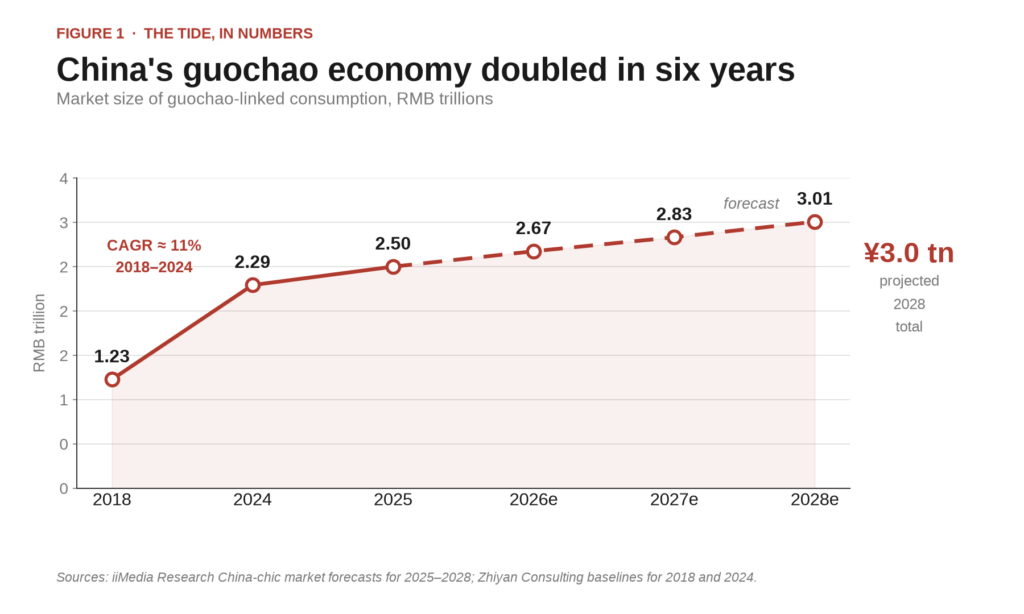
The market didn’t just grow — it compounded at roughly 11% a year through a period when plenty of other consumer categories stalled. That’s not a fad curve. That’s a repricing.
The Number That Should Stop You
Now the uncomfortable finding. Multiple surveys now show overwhelming preference for domestic brands among Chinese consumers. Statista’s fieldwork in March 2024 put it at 89% for fashion. iiMedia’s consumer research found 85.79% more inclined to choose domestic trend brands.
Sounds like nationalism, right?
Then look at the reasons. Asked what drove their choice, 48.69% said the products felt more Chinese-styled, and 47.67% said they suited traditional aesthetics better. The share who said they bought domestic purely out of support for domestic goods was 4.36%.
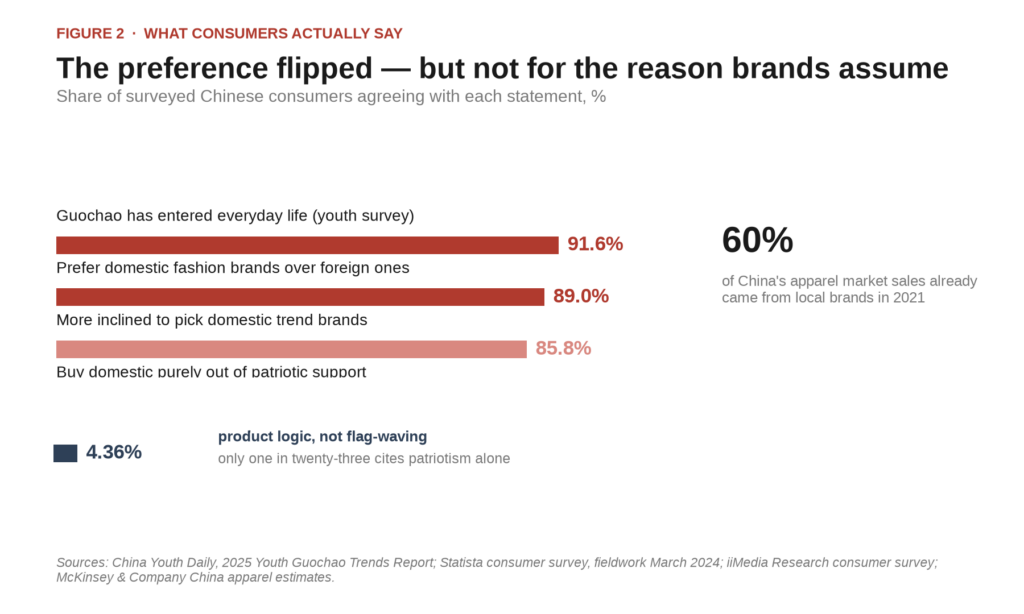
Read that again. The single loudest signal in Chinese consumer behaviour right now is not flag-waving. It’s people deciding that a Chinese brand makes a better product for them — and then, separately, feeling good about that decision.
The distinction matters enormously for anyone building a strategy on top of it. Identity is the wrapper. Product is what’s inside. Brands that confused the two have already paid for the mistake.
The Generation That Supplied the Demand
No marketing movement succeeds without a cohort to carry it, and guochao found its cohort in Chinese consumers born after about 1995.
They grew up with money. They grew up with passports. They grew up watching China be a major power — and, crucially, they grew up with global taste. That last part is what made guochao sophisticated rather than provincial. These consumers weren’t rejecting international design standards; they were applying them to Chinese references and finding the result matched their lives better.
China Youth Daily’s 2025 survey found 91.6% of young respondents saying guochao products had entered everyday life, and 93.5% saying the trend made them more interested in traditional culture. That’s not a purchase habit. That’s an identity settling into place.
Nike, Anta, and the Reversal You Can Measure
If you want to see the flip in hard numbers, look at sportswear — the category where the old status map was strongest and where the reversal has been most brutal.
Euromonitor data puts Nike’s share of China’s sportswear market at 18.1% in 2021. By 2025 it was 14.6%. Anta Group, meanwhile, reached 21.8% and has held the top spot for four consecutive years.
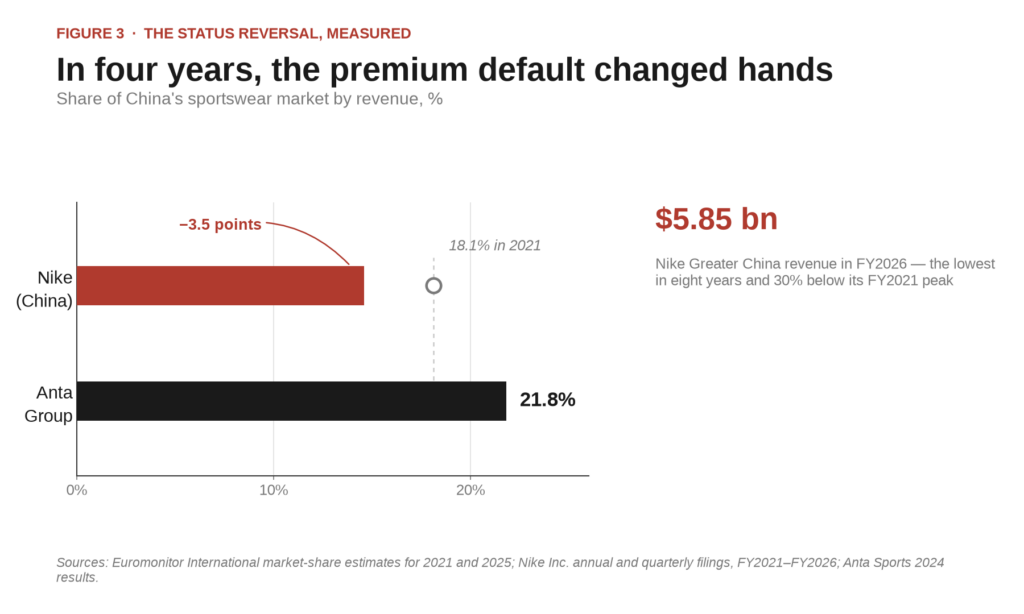
Nike’s Greater China revenue tells the same story in dollars: $8.29 billion at the FY2021 peak, $6.59 billion in FY2025, and $5.85 billion in FY2026 — the lowest in eight years.
Now, being fair: not all of that is guochao. Nike made its own mistakes, and it has been dismantling a fragmented wholesale network that fed a discount spiral. It also arrived on Douyin in 2024, years after its competitors.
But the structural story is real. When a 30-year brand halo stops being worth a price premium, it isn’t a campaign problem. It’s a status problem.
Why Guochao Worked: The Authenticity Premium
Here’s the mechanism nobody talks about enough. Identity-based positioning is a moat because it compounds and it can’t be copied feature-by-feature.
A competitor can match your cushioning technology in eighteen months. It cannot match “this brand is us.” That’s not a spec sheet; it’s a relationship, and relationships accrete.
But — and this is the hinge — the identity has to be real.
Guochao worked where the heritage was genuine: actual craft traditions, actual techniques, actual cultural continuity. It failed, spectacularly, where heritage was a costume rented for a season.
The Florasis Lesson: When the Motif Isn’t the Product
Florasis is the cautionary tale, and it’s a good one because the brand did almost everything right at first.
Founded in 2017, it built an “oriental aesthetics” position with genuinely striking design — carved lipsticks, Miao-inspired collections, packaging that looked like it belonged in a museum shop. By 2021 revenue had reached roughly RMB 5.4 billion.
Then it broke. In September 2023, a livestream remark about a RMB 79 eyebrow pencil — and the fact that its per-gram price exceeded several international prestige brands — detonated. Sales collapsed 90% within 48 hours. By 2024, online GMV had fallen to RMB 2.39 billion, down 21.19% year on year.
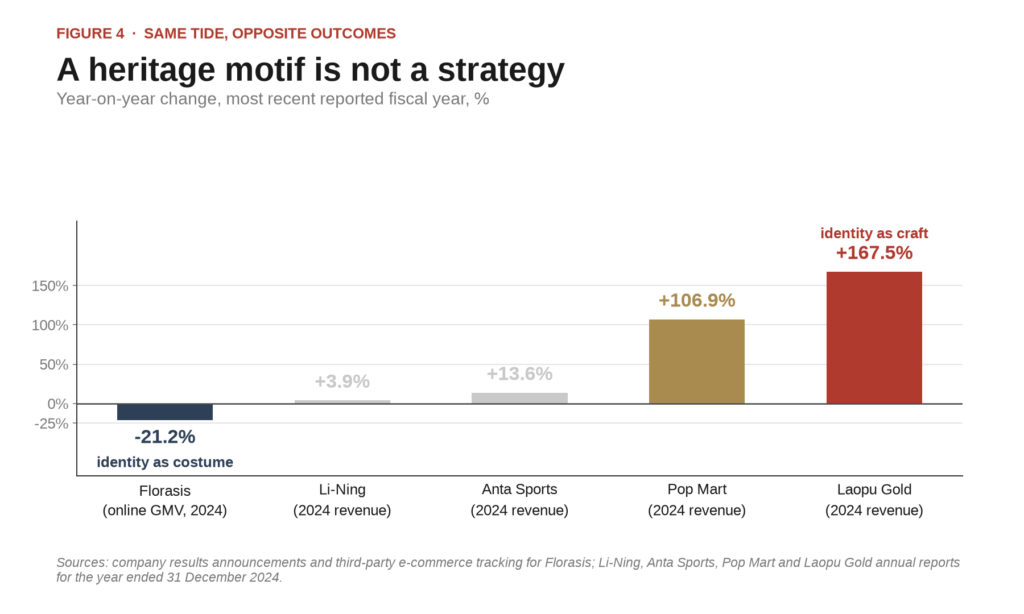
The diagnosis matters more than the drama. Florasis’s problem wasn’t the positioning — oriental aesthetics was and remains a sound strategy. The problem was that the aesthetics lived in the packaging while the product lived somewhere else. Consumers eventually noticed the gap between what they were paying for and what they were getting, and the brand had no core hero product to anchor them.
Contrast that with Laopu Gold.
The Other End of the Same Wave
Laopu Gold sells heritage gold jewellery made with techniques that carry intangible cultural heritage status — filigree, gold inlay, court-era goldsmithing. It has 36 stores. Thirty-six.
In 2024, revenue rose 167.5% to RMB 8.51 billion and net profit jumped 253.9%. Average sales per store hit RMB 328 million, and gross margin held at 41.2% — roughly ten times what mass-market gold retail earns.
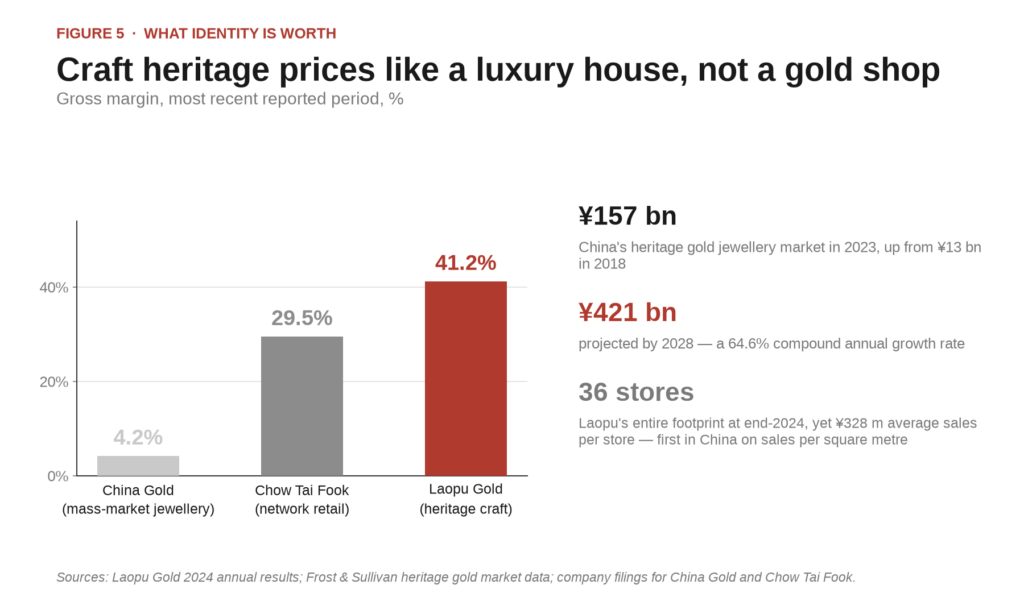
Same cultural wave. Opposite execution. Laopu priced craft like craft; Florasis priced packaging like craft. One built a luxury house, the other built a vending machine with pretty wrapping.
What This Means If You’re Not a Chinese Brand
Here’s where it gets practical, because most of you reading this run brands that are not Chinese — and the rules changed for you too.
The default prestige is gone. Foreign no longer reads as premium just by being foreign. Bain’s 2025 China luxury report shows the mainland personal luxury market contracting 3–5%, with watches down 14–17% and leather goods down 8–11%, while local brands kept taking share through culturally resonant design.
You can’t perform guochao — but you can participate in it. The winning play isn’t fake Chineseness; it’s genuine local creative authority. Adidas is the cleanest case study in the market right now. Its Greater China revenue reached €3.62 billion in 2025, up 13%, its eleventh consecutive quarter of growth — while Nike’s was falling.
How? Adidas moved design and decision rights into China. Roughly 95% of what it sells there is locally produced, and 50–60% of apparel is designed and developed in China. Its Shanghai studio produced a new-Chinese-style Tang jacket that sold out and triggered reverse daigou — foreigners asking Chinese shoppers to buy it for them.
That’s not performing identity. That’s earning a place inside it.
Re-read your competitive set. If your China strategy still assumes domestic brands are the cheap alternative you undercut, the map is five years out of date. They are now the premium competitor your customer prefers.
The Honest Caveats
No wave is uniform, and guochao has real ceilings.
The category ceiling. Identity positioning works hardest where culture is legible in the product — apparel, beauty, jewellery, food, home. It does less work in categories judged purely on performance, and less again where foreign prestige still functions as a genuine quality proxy. Watch what happened in luxury: beauty grew 4–7% in 2025 while watches sank. Not every category rides the tide.
The empty-nationalism trap. When pride becomes a sticker rather than a standard, it curdles fast. iiMedia’s data shows consumers now name “shallow excavation of traditional culture, expression that stays on the surface” as a top complaint, cited by 25.56%. The fatigue is already documented.
The commoditisation risk. Every brand can add a lattice pattern. Very few can add a craft tradition. As the surface gets crowded, the premium migrates to whoever owns the real thing — which is precisely why Laopu grew 167% while the category average sat in single digits.
The export ceiling. Guochao’s logic is powerful domestically and doesn’t travel cleanly. Pop Mart is the exception that tests the rule: its 2024 revenue doubled to RMB 13.04 billion and overseas sales jumped 375.2%, then 2025 revenue nearly tripled to RMB 37.12 billion. But when its Q4 slowed, the stock dropped more than 20% in a session. Global demand for Chinese cultural product exists; it is also concentrated in hits, not categories.
Where the Tide Goes Next
Three signals worth watching through 2027.
The first is premiumisation. The interesting question is no longer whether Chinese consumers will buy domestic. It’s whether they’ll buy domestic at luxury prices. Laopu’s 41% gross margin says yes, in the right category.
The second is craft as moat. Expect the winners to look less like marketing departments and more like ateliers — proprietary techniques, real heritage credentials, verifiable provenance. Where the story can be audited, the premium holds.
The third is collaboration replacing competition. Global brands are shifting from importing prestige to co-creating with local culture. Adidas is the template. The ones still shipping global product into China unchanged are running a strategy that expired around 2021.
The Takeaway
Guochao isn’t a trend cycle, and it isn’t anger. It’s a repricing event. A market that had spent three decades treating “Chinese” as a discount signal reversed the sign, and the brands that understood what that meant — Li-Ning on a runway, Laopu in a workshop, Anta across a portfolio — compounded. The ones that read it as packaging — Florasis with its carved lipstick and its missing product — did not.
For anyone selling into China, the strategic implication is uncomfortable but simple. The prestige you used to get for free now has to be earned. And the brands earning it are the ones that stopped asking what Chinese consumers wanted to be told, and started asking what they wanted to be.