The Livestream Isn’t a Pitch — It’s a Price Being Found
Open any live-commerce deck and you see the same frame: host, screen, conversion curve. The story is persuasion. Sit through a real stream and it thins out — you’re watching a price being found.
The number nobody argues about
McKinsey measured four regions in 2023. Conversion — attended shows that ended in a purchase, during or after — came in at 30% in Europe, 32% in China, 33% in the US, 36% in Latin America. Four cultures, six points apart. If it were a selling skill, that line would be jagged. It’s flat.
So what is the host actually doing?
Count the price changes, not the adjectives.
The price is the script
Opening price. Then a tier: this price for the next 200 units. Then the tier closes, the next costs more, a bundle appears, a window shuts. A shelf price can’t do that. A stream does it nightly.
The crowd is the meter
Each move decides who pays what while the room answers back: taps per second, sellout speed, comment heat. The host isn’t guessing at demand. She’s reading it.
The live minute is the expensive minute
Evidence: 2,705 paid livestream events on Zhihu. Demand grew less price-sensitive as the hour neared, then turned inelastic on the day itself — because people value being in the room, live. Not the product. The moment.
A 60% error in plain sight
Those events were priced about 60% too low. A fixed price aimed at an elastic crowd leaves surplus behind. Arithmetic, not marketing.
The deadline only works in the middle
A 2023 paper in Production and Operations Management adds the nuance: a deadline keeps high-valuation buyers in the room, justifying a higher price — but only at an intermediate one. Too cheap and the clock means nothing; too dear, the room empties.
The room changed hands
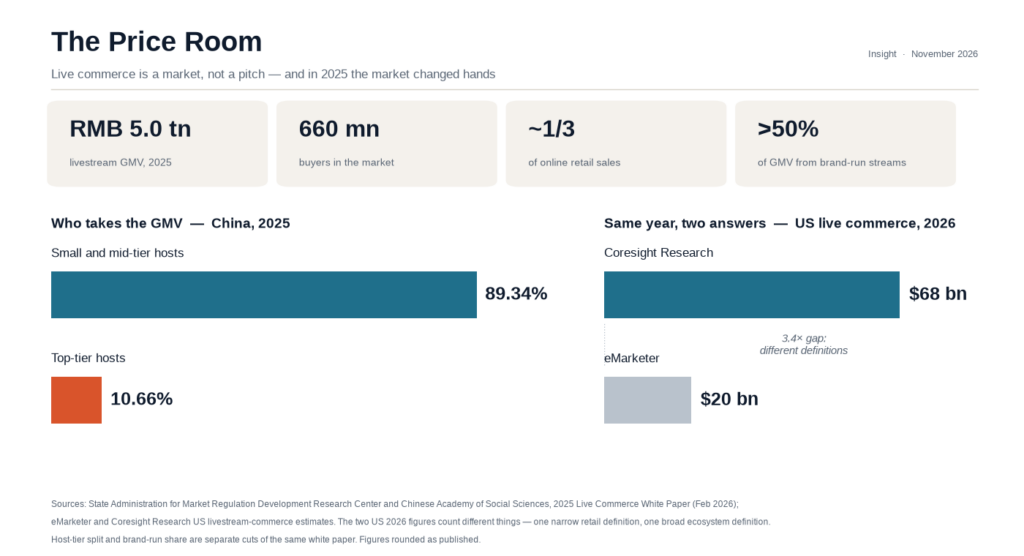
In China — a market now past RMB 5 trillion — brand-run streams take more than half of livestream GMV. Hosts outside the top tier take 89.34%; headliners are down to 10.66%. The auctioneer is no longer a star — it’s an operation, finding the price three hundred nights a year.
Where the numbers break
Be sceptical of totals. For 2026, eMarketer puts US livestream commerce near $20 billion; Coresight Research says $68 billion — same year, 3.4× apart, both defensible. TikTok Shop moved $50.3 billion globally in H1 2026, up 92%. The format scales faster than our instruments.
£4.8 million for a price that never moved
In October 2026 the UK competition authority fined Wayfair £4.8 million: Flash Deals ran countdowns, and goods stayed at the same or a lower price after the clock expired. Emma Sleep signed undertakings over false countdowns. Penalties now run to 10% of global turnover, and China’s Order No. 56 requires a displayed price to be corrected the moment it changes.
Four moves that price the room
- Build the ladder before you stream: tiers, quantities, exit rules.
- Give every tier a true reason. “200 units at this price” is a fact. A countdown isn’t.
- Log velocity: taps per minute, sellout time, close rate. That’s your willingness-to-pay data.
- Keep one tier whose depth depends on what the first hour proved.
The takeaway
Live commerce does sell; that part isn’t wrong, only late. Selling happens after the price is found. Treat the stream as a pitch and you’ll discount your way to a number anyone could have guessed. Treat it as a market — honest tiers, real limits, a host reading the room — and you’ll charge what the room was willing to pay.