One Funnel, One Assumption, Zero Accuracy
The funnel was never a lie about customers. It was a lie about how many of them there were.
When Elias St. Elmo Lewis sketched the four steps of AIDA in 1898, and William Townsend drew the triangle around them in 1924, the architecture was honest. One salesperson. One buyer. One conversation. One direction. Compress the general into the specific — Townsend described selling as forcing “a broad and general concept of facts through a funnel.” A century later we kept the drawing and quietly dropped every condition that made it work.
Here is the mechanical problem: a funnel is an average. One entry, one slope, one exit. Buy that structure into your budget and you are funding a customer who does not exist — a blended person, built from millions, optimized against a mean nobody actually sits on.
Buyers do not behave like that. Google and The Behavioural Architects simulated 310,000 purchase scenarios across 31 categories and came back with a word you do not expect from a media company: spaghetti. No typical journey. No standard order. Shoppers swing between two mental modes — exploration, then evaluation — and loop, over and over, until something breaks the cycle. Gartner found the same shape in B2B, dressed as six buying jobs that happen in no particular order, get revisited at least once each, and occupy roughly 17% of a buyer’s total purchase time spent with suppliers.
Two assumptions died while you were reading that. First, the entry point. Consumers no longer start at the top, because there is no top. They arrive from an AI answer that already ranked the options, from a creator’s two-minute video, from a review thread, from a livestream that sold out at eleven at night. Adobe’s data show AI-referral traffic to US retail sites up 1,219% between October 2024 and July 2026, growing 62% year over year and converting 60% better than traffic from anywhere else. Gartner expects traditional search volume to fall 25% by 2026. Every one of those is a front door.
Second, the sequence. Personalization did not just improve; it raised the floor of what is tolerable. McKinsey found 71% of consumers expect personalized interactions and 76% get frustrated when they do not arrive. In a market like that, sprinkling personalized creative into a single funnel is not personalization. It is one well-dressed assumption.
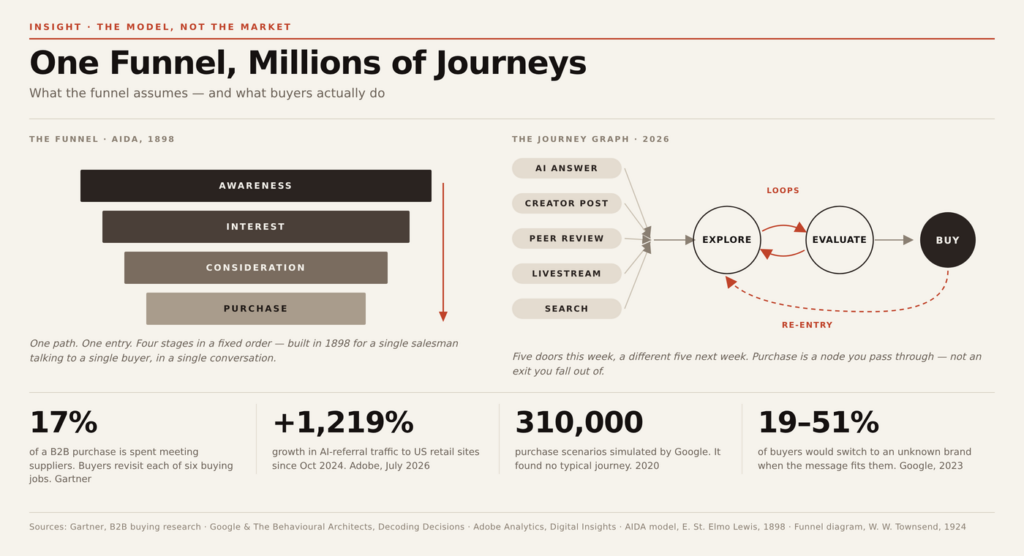
What replaces the funnel is not a better funnel. It is a graph: many doors, loops in the middle, purchase as a node you pass through rather than an exit you fall out of, and re-entry built in. You stop planning a stage and start detecting a state, then answering it in the moment. Google’s 2023 follow-up to the same research shows why that is worth the effort: when an otherwise unknown brand’s proposition was personalized with first-party data and behavioral signals, 19% to 51% of buyers said they would switch away from their first choice, depending on the category.
Keep the funnel for the one thing it is genuinely good at: allocating money roughly between brand building and conversion. That is accounting. Fire it as a behavioral model, because it never was one — and because the invoice for treating an accounting abstraction as a map of human behavior comes due every quarter.
The funnel did not die because personalization got good. It died because it was built to hold one customer, and we finally have millions.