Why Chinese Ads Stopped Selling and Started Answering
Two numbers from China’s 2025 paperwork sit badly next to each other.
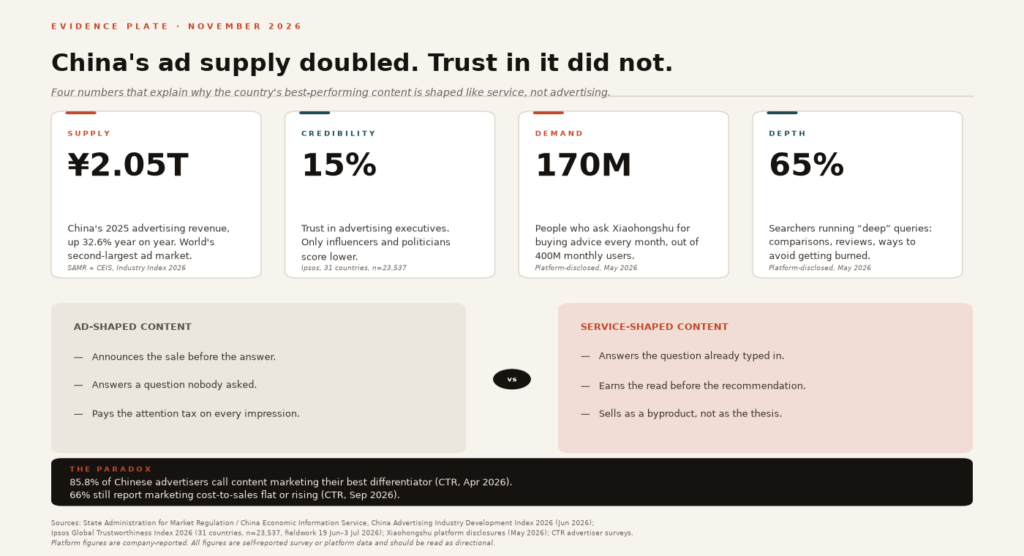
China’s ad industry booked ¥2.05 trillion in 2025, up 32.6% and double its 2020 level, per the State Administration for Market Regulation. Consumer associations handled 2,016,448 complaints; the share alleging false or misleading claims rose to 7.88% from 6.60%. More advertising than ever. More of it contested.
That gap isn’t a moral story. It is a pricing problem — and it explains the habit Western marketers file under “cultural quirk”: in China, the content that sells rarely looks like content. It looks like help.
The credibility floor is now a category
The 2026 Ipsos Global Trustworthiness Index (23,537 adults, 31 countries) finds advertising executives trusted by 15% — a net score of −26, third from the bottom. Only influencers (14%) and politicians (13%) rank lower; doctors sit at 58%.
The ad industry is among the least trusted in the survey, selling the least trusted product in the room. Every impression arrives pre-discounted, not because a given ad is dishonest, but because the format carries a reputation it cannot shed.
Where the attention actually went
Not away. Into questions.
Xiaohongshu reported more than 400 million monthly users, about 170 million daily users and 800 million searches a day by May 2026. Roughly 170 million people ask it for buying advice each month, and 65% of those searches are deep: comparisons, reviews, ways to avoid getting burned.
Here is the mechanism. An ad must create the question before it can answer it — expensive, and it announces the intent. A guide inherits a question the buyer has already typed. Cheaper to produce, cheaper to trust, and it never has to say the word buy.
The economics behind the disguise
Edelman’s 2026 brand study, 17,688 respondents in 15 markets, finds 88% call trusting a brand an important or critical purchase criterion, level with quality (89%) and value (88%). Utility ranks as the strongest relevance driver, ahead of identity, community and pop culture. And 41% say what people not paid by the brand say matters most to their trust, against 20% who cite the brand’s own voice.
The pitch pays a tax on every impression. The answer collects trust before the ask. Service is not a softer ad; it is a different job description.
The part advertisers keep getting wrong
They already believe in content. In CTR’s 2026 advertiser survey with the Communication University of China, 85.8% say content marketing is the best way to differentiate a brand, and 49.5% are raising content budgets.
CTR’s September 2026 outlook adds the punchline: 66% report marketing cost-to-sales flat or rising over three years. The budget moved. The shape didn’t. Most content is still an ad with a longer runtime and a friendlier first line.
Three questions separate the two. Would this still be useful with our logo removed? Does it answer a query someone actually typed, in their own words? Does the product arrive as evidence, or as the conclusion?
Fail the first and you are buying reach. Pass all three and the sale becomes a byproduct — the only kind Chinese buyers reliably accept.
The limit
Not a universal law. Service content is strongest where people research before they buy; in impulse categories the question is shallower, though it still exists — how to use it, how to care for it, what to avoid. A category with no real question has no real guide, and usefulness cannot be faked. That is exactly why it works.