The Influencer Bubble Is a Pricing Problem, Not a Popularity Problem
There is a sentence that keeps surfacing in brand-side planning meetings, usually said quietly, usually by the person who has to defend the number: “We paid for the post. We do not know what it did.”
That sentence is the whole story. Not fraud, not collapse, not some dramatic reckoning where the influencer economy goes to zero. Something less cinematic and more expensive: the slow discovery that a market built on rented attention has been paying a size premium for an asset that stopped appreciating years ago.
The money is still arriving. America’s advertisers spent roughly $37 billion on creators in 2025, up 26% year over year and about four times faster than the media industry as a whole, according to the IAB’s survey of some 450 US ad-spend decision-makers. The same body expects about $44 billion in 2026. Nearly half of those buyers now treat creators as a must-buy, ranking the channel behind only paid search and social.
So this is not a bubble bursting. It is a bubble deflating from the inside, one tier at a time, while the headline number keeps going up and hides what is happening underneath it.
Let’s take the cracks in order.
The Money Did Not Leave. It Learned to Skip People.
Here is the first thing worth understanding before anyone tells you influencer marketing is dying: the budget is not shrinking. Its route is changing.
The IAB’s numbers show spend nearly tripling from $13.9 billion in 2021. What the top-line figure conceals is that a growing share of that money never reaches a creator’s bank account at all. EMARKETER’s forecast, reported by Business Insider in May 2026, puts US spending on boosting creator posts at roughly level with spending on commissioning them by 2027, at about $14.2 billion each. By 2028, amplification is projected to overtake content fees outright — $16.1 billion against $15.71 billion.
Read that again, because it inverts the story most people tell. The industry’s growth is increasingly a media-buying story, not a creator-payday story. James Nord of the agency Fohr put the reason bluntly to Business Insider: the content “generally is not performing as well as it should for how much it’s costing,” so brands are forced to buy distribution to extract a return.
Which means the thing you are actually paying for when you book a creator is now frequently the ad you have to run behind the creator’s post. The influencer is becoming a production vendor with a name attached.
Crack One: The Supply Explosion
Somewhere north of 200 million people worldwide now produce content for an audience, and industry estimates routinely settle around 207 million active creators. Goldman Sachs’ re-baselined figures put professional creators at roughly 67 million in 2025, heading toward something like 107 million by 2030.
Now hold that against the shape of the population. In HypeAuditor’s account database — 88.7 million Instagram accounts, 102 million TikTok accounts, 14.5 million YouTube accounts — nano creators with 1,000 to 10,000 followers are 88.7% of TikTok accounts and 81.5% of Instagram influencers. That is vendor data built from aggregated open sources and machine-learning estimates, so treat the exact percentages as directional. But the direction is not in dispute, because every independent dataset shows the same long tail.
The consequence is arithmetic, not opinion. Attention did not grow. Supply did. When the number of people producing content rises faster than the number of hours anyone has to watch it, the average creator’s slice gets thinner whether or not anyone’s behaviour changes.
And the barrier to entry just dropped again. HypeAuditor reports 83% of Instagram influencers used AI tools in content production in 2025. Whatever you think about AI slop, it removed the last remaining friction between “I have opinions” and “I have a channel.”
Crack Two: The Barbell
If you want one table to describe the creator economy in 2026, it is this one. CreatorIQ’s State of Creator Compensation, published in January 2026, is the closest thing the industry has to honest payroll data: 65,000 flat-fee payments from brands and agencies to creators, tracked over three years.
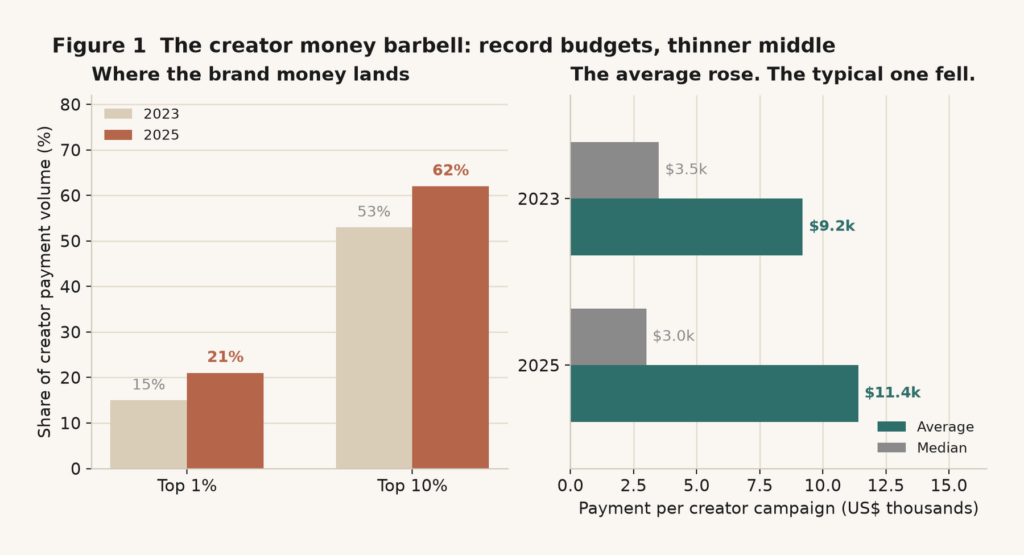
The top 1% of creators took 21% of all payment volume in 2025, up from 15% in 2023. The top 10% took 62%, up from 53%. Meanwhile aggregate payments to creators grew 59% — while brand and agency investment in creator campaigns grew 171%. The gap between those two growth rates is the sound of money being captured upstream, by platforms, agencies and a very short list of names, before it reaches the long tail.
Then look at the average versus the median. Average payment per creator campaign rose to $11,400 in 2025 from $9,200. The median fell, from $3,500 to $3,000. Averages rise when the top end inflates; medians fall when the middle thins. Both happened in the same year, in the same dataset.
In CreatorIQ’s own survey of 300 creators, only 11% cleared $100,000 in annual income. Roughly half of US creators earn under $10,000 a year, per a separate 1,000-creator survey by The Influencer Marketing Factory. You can argue about the sampling, but you cannot make the median look healthy.
Crack Three: Reach Was Rented, and the Rent Went Up
Every creator on every platform is a tenant. They build an audience on land someone else owns, under a lease someone else can rewrite on a Tuesday.
Metricool’s 2026 study — over a million accounts and nearly 40 million posts — measured what that lease renewal looked like. Average reach per Instagram Reel fell from 14,922 in 2024 to 9,689 in 2025, a 35% drop. Reach on static posts fell 31%. Total interactions dropped 44% for posts and 37% for Reels. And this happened while connected accounts roughly doubled their posting volume and raised weekly frequency by 21%.
That last detail is the cruelest part of the dataset. Creators responded to falling reach by producing more, and the platform answered by distributing less per post. Effort went up, yield went down, and nobody could opt out.
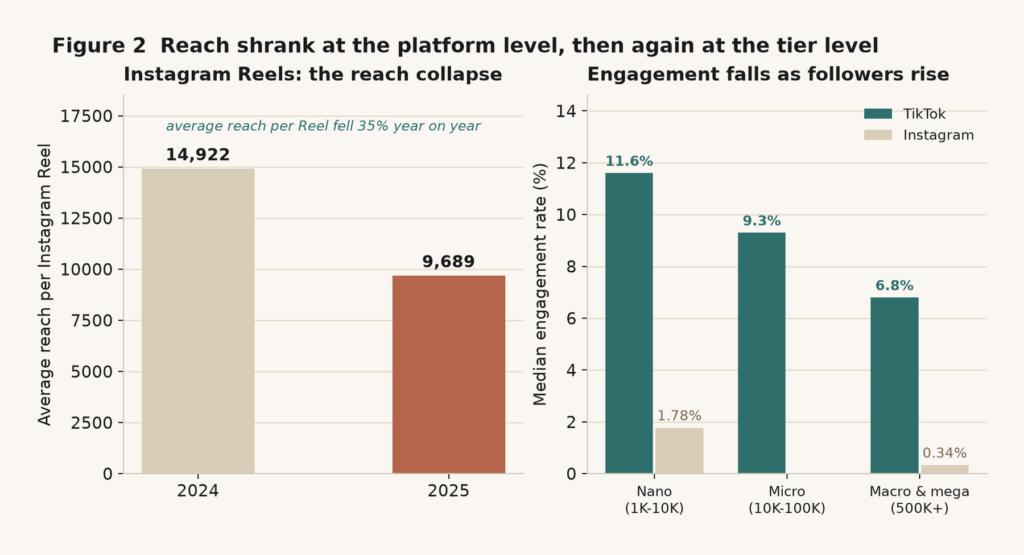
Layer the tier effect on top and the math gets worse. HypeAuditor’s medians: on TikTok, 11.6% engagement for nano creators, 9.3% for micro, 6.8% for macro and mega. On Instagram, 1.78% for nano against roughly 0.34% for accounts above half a million followers.
So a brand buying scale is buying two discounts at once — a smaller share of reach from the platform, and a lower hit rate from the audience that remains.
Crack Four: The Trust Ledger
Here is where the story stops being about spreadsheets.
A Spanish research group, YTEZETA Studios, published a study in October 2026 based on 1,116 valid responses. Some 86.5% of respondents had stopped following at least one influencer over something that person did or said. 77.1% said they now pay less attention to influencer recommendations than they did a few years ago. 52.4% had reconsidered a relationship with a brand because of the behaviour of an influencer attached to it. It is one country, one sample, one moment — but the mechanism it describes is not local.
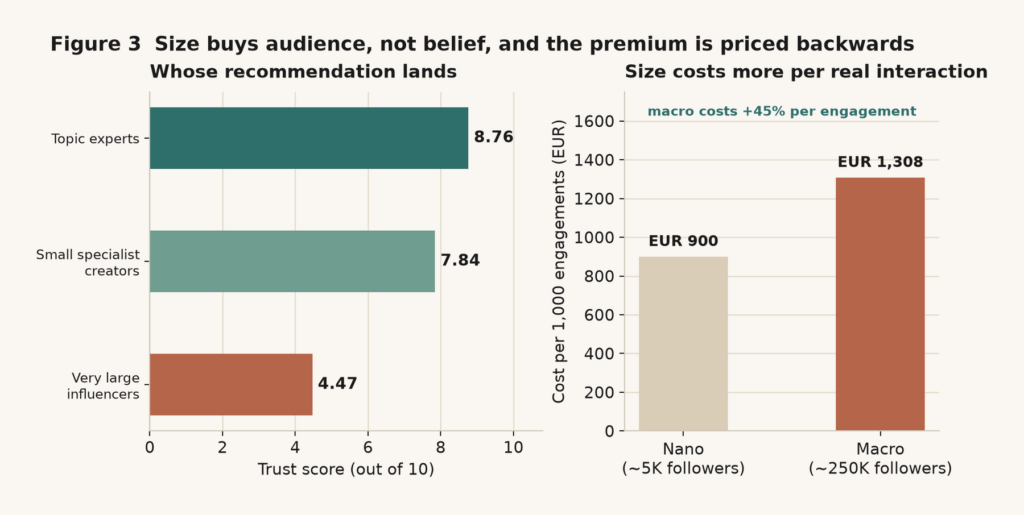
The same study asked people how much they trust different sources. Topic experts and professionals scored 8.76 out of 10. Small specialist creators scored 7.84. Influencers with very large communities scored 4.47. That is not a small preference gap. That is a different product category.
Then TBWA’s cultural intelligence unit, Backslash, surveyed adults in the US and UK and found something odder still: 62% said being hard to influence is now more aspirational than being an influencer. Confronted with a viral post, only 25% assumed people genuinely loved it. 42% assumed a brand engineered it; 33% assumed bots and fake engagement. Asked what makes a person interesting, respondents ranked highly specific taste first at 48% and a large online following dead last at 19%.
The asset being sold was always belief. Belief is now the thing in shortest supply.
And a new stress test arrived in 2026. A Gartner survey of 1,006 US consumers, fielded May to June, found 35% now rely on influencers less for shopping information specifically because AI-generated content has made them more skeptical of everything in the feed. When synthetic media can manufacture a convincing endorsement at near-zero marginal cost, the scarcity value of a real human recommendation should rise. Instead, in the short run, everything that looks like a recommendation gets discounted.
Crack Five: The Size Premium Is Priced Backwards
Now put price and performance on the same axis and watch what happens.
SociaVault Labs ran published per-post rates against engagement benchmarks to compute a cost per 1,000 engagements. On Instagram, a nano creator at around 5,000 followers lands near €900 per thousand engagements; a macro creator at around 250,000 followers lands near €1,308. The macro costs roughly 45% more per real interaction. Their caveat matters — this is a synthesis of public rate cards plus their own benchmarks, not audited invoices — but the direction is consistent with everything else here: price rises faster than engagement scales.
The market has started repricing, unevenly. Indian creator agencies quoted by Storyboard18 in October 2026 describe creators in the 1–3 million follower band accepting 15–20% fee cuts or hybrid performance deals. At one agency, briefs seeking creators in the 50,000–500,000 range jumped from about 30% to about 55% of inbound work in a year.
Italy gives you the cleanest natural experiment. DeRev’s sixth annual report, covering roughly 5,000 Italian creator profiles between June 2025 and June 2026, found celebrity earnings falling on every major platform — down 18.8% on Facebook, 9.5% on Instagram, 8.6% on TikTok — while mid-tier and macro communities actually grew and their rate cards rose. 63.2% of celebrities lost Instagram followers over the year.
The premium on size is being removed. Not the premium on relevance, and not the premium on trust.
Who Actually Gets Hurt
This is where the outline I started from needed correction, and the correction is worth spelling out because it changes the strategy.
The intuitive story is that the “squeezed middle” means mid-tier creators. The data says something more precise: the squeeze is on the size premium, not on a tier label. The IAB found mid-tier creators at 50,000 to 500,000 followers were the most hired cohort in 2025, at 61% of buyers, ahead of macro and micro at 55% and celebrities at 30%. EMARKETER’s 2026 forecast has nano and micro accounts collectively taking nearly half of US creator spend, up from less than a fifth a few years ago.
Both facts can be true simultaneously, and that is the whole point. Budget is fleeing the top of the market and landing in the middle and the tail. What is being liquidated is the specific proposition that a large follower count, on its own, justifies a large invoice.
Who is exposed, then:
Creators whose only differentiator is scale. If your pitch is “two million followers,” you are now negotiating against a spreadsheet that shows your effective cost per engagement is worse than a specialist with 40,000.
Creators with thin category identity. The lifestyle generalist who can plausibly endorse skincare on Monday, a phone on Wednesday and a fintech app on Friday. An agency quoted by Storyboard18 described the audience’s response perfectly: they stop hearing a recommendation and start seeing an ad slot.
Anyone fully platform-dependent. No email list, no community, no owned surface. When the algorithm adjusts, they have no second door.
Who is not exposed, or is quietly gaining: the specialist with real domain standing; the micro creator whose audience arrived for a reason; the creator who built a newsletter, a product or a community and treats the platform as marketing rather than as the business.
Two Markets, One Correction: What China Already Ran
If you want to see how this ends, look at the market that got there first.
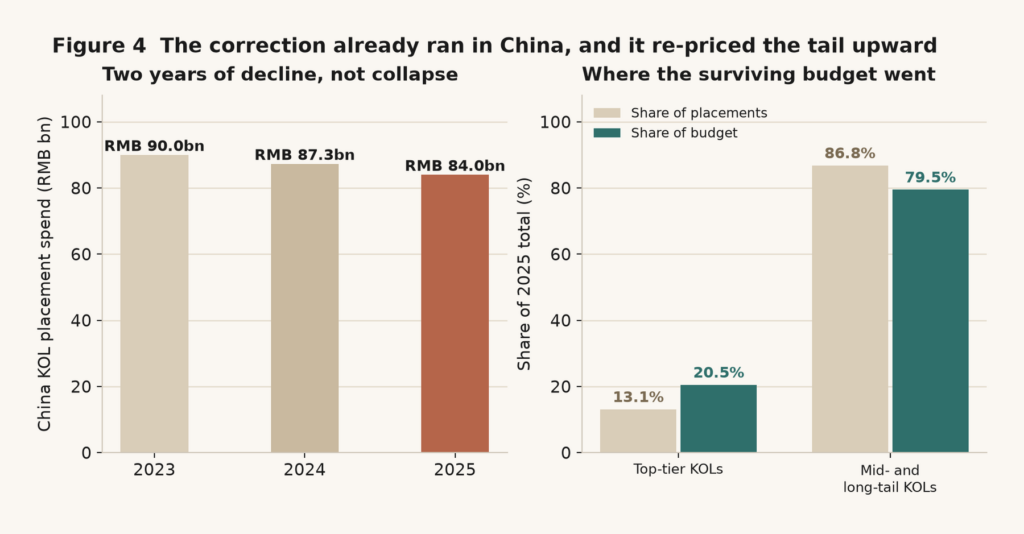
China’s KOL placement market peaked at RMB 90 billion in 2023, slipped to 87.3 billion in 2024 and 84 billion in 2025, per TopKlout’s annual advertiser survey. Two consecutive years of decline. On the surface, a contraction.
Underneath, a reallocation. In 2025, top-tier KOLs accounted for just 13.1% of placements and 20.5% of spend, while mid-tier and long-tail creators took 86.8% of placements and roughly 80% of the money. That is the correction, already executed.
And the pricing behaviour is instructive. R3’s 2026 China social KOL governance whitepaper found official rate cards rose 11.6% in 2025 while actual transaction costs fell 3.4% — a gap R3 calls the scissors problem, created by layered agency markups between the published card and the invoice. Nearly a third of brands said they would increase paid amplification of existing KOL content; only 17% planned to buy more content. Same shift you see in the US, arrived at from a different direction.
The lesson for anyone planning Western budgets: the tail does not necessarily get cheaper when the top gets cut. It gets repriced, and the money that survives becomes more demanding.
The Compliance Squeeze Arrives
There is one more cost that the bubble years let everyone defer.
The FTC’s endorsement guides already hold brands and creators jointly liable, and the agency’s consistent position is that a platform’s paid-partnership label does not by itself constitute an adequate disclosure. In January 2026 the Commission issued its first warning letters under the Consumer Review Rule, naming ten companies over fake reviews, incentivised testimonials and deceptive review practices. The maximum civil penalty for the relevant violations sits at $53,088 per violation and, per the Federal Register, was left unchanged for 2026.
How well is the field doing? One commercial tracker, Influencer Advisory, examined 260,527 YouTube sponsor deals across 45,615 brands since January 2024 and found only 3.0% carried an explicit disclosure phrase in the call-to-action text. That is a vendor dataset and should be read as an indicator rather than a census. But even allowing for generous error, the compliance base rate is low enough that enforcement has an enormous target surface.
Here is the part brand teams consistently miss: a contract clause making the creator responsible for compliance does not transfer regulatory liability. It gives you a claim against the creator after the regulator has already named you.
The Correction: What Actually Gets Repriced
Deflation, not explosion. Five things get repriced, and none of them is “creator marketing.”
Reach to resonance. Budget moves from audience size to audience fit. The IAB’s buyers, asked what they evaluate, put creator reputation first at 58% and audience alignment at 56% — both ahead of raw scale.
Flat fees to outcome-linked deals. Hybrid structures — a smaller base fee plus commission or performance kickers — are how the 15–20% fee cuts get absorbed without the deal dying. 40% of IAB respondents already name ROI as their top KPI for creator work; the contract terms are catching up.
Rented reach to owned distribution. The creators surviving best have an email list, a community, a product. Platform audiences are inventory; owned audiences are an asset. Same distinction, applied to humans.
Creator to creator-business. The ones who operate like small brands — clear point of view, real differentiation, their own distribution — stop competing on follower count because they are no longer selling follower count.
Opacity to documentation. Disclosure, substantiation, whitelisting rights, usage rights. The compliant operator becomes cheaper to hire precisely because legal review stops being an adventure.
What Brands Should Do in the Next Two Quarters
Re-audit on cost per engagement, not cost per post. Take your last twelve creator deals. Divide fee by average views or engagements. You will find that at least one macro you renewed for relationship reasons is your worst-performing line item per unit of attention. That is your renegotiation list.
Buy roles, not tiers. Stop asking “what size” and start asking what job the creator does: ignition, consideration, conversion, validation. One million-follower creator for a launch moment, twenty specialists for the quarter that follows. A single agency executive quoted by Storyboard18 put the shift well — million-plus creators have not disappeared from plans, they have moved from being the whole plan to being one layer of it.
Stop treating amplification as an afterthought. If EMARKETER’s forecast is even approximately right, the majority of your creator ROI will soon come from what you do with the content rather than what you pay for it. Budget for boost from the start; negotiate usage and whitelisting rights in the first draft of the contract.
Prefer creators with an owned surface. It is the single best proxy for durability, and it costs you nothing to ask.
Instrument disclosure before enforcement finds you. Written disclosure language per format, in the caption where a viewer actually reads it, with a named owner on both sides. Boring, cheap, and the only part of this article that could save you a five-figure-per-post problem.
What This Is Not
Two honest caveats, because the data does not support a clean morality tale.
First, mid-tier is not universally “winning.” One agency principal, Mohit Ghate of Wit & Chai, pushed back publicly on the mid-tier narrative, arguing that different tiers simply do different jobs — large creators for awareness and trust, mid-tier for consideration, small creators for purchase — and that there is no real evidence mid-tier delivers better ROI across the board. Hypetap’s data points to 50,000–100,000 followers as the most predictable tier rather than the most efficient one. Predictability and efficiency are different products.
Second, the ROI numbers you have seen quoted most often are not what they claim to be. The famous $5.78 returned per dollar is an earned-media-value figure — a valuation of exposure at an assumed CPM — and it has circulated since 2019 as though it were measured sales. Treat any single ROI multiple for an entire channel as a marketing artefact. Your own incrementality test is the only number that survives scrutiny.
The Takeaway
The influencer bubble is not popping. It is being audited.
What fails the audit is the proposition that audience size is a proxy for influence, and that a follower count written on a rate card is a defensible basis for a five-figure invoice. What passes is narrower and harder to fake: someone with actual standing in a subject, an audience that arrived on purpose, a channel they control, and a deal structured so that everyone finds out whether it worked.
The uncomfortable part for the industry is that this is not a downturn. Spend is up. The market is bigger than it has ever been. It has simply stopped paying the same amount for the same thing — and a great many people built businesses on the assumption that it never would.