Closed Loop, Open Questions: What Retail Media’s Measurement Really Proves
The shelf turned into an ad network, and it is now the most concentrated, fastest-growing, least audited channel in advertising.
For twenty years, the answer to “where does the ad money go” was boringly simple. It went to two companies, and everyone else fought over the leftovers.
That answer has cracked. Not because Google or Meta did anything wrong, but because the retailers finally noticed something they had been sitting on the whole time: they already shepherd the customer to the shelf, and the shelf is where the decision actually happens.
So they started selling the shelf.
That is retail media in one sentence. The rest of this piece is about what it means, why the money is arriving so fast, and where the story stops being flattering.
What a retail media network actually is
Strip away the jargon and a retail media network is a retailer’s advertising business. Not a side project, not a clever partnership — a P&L line with sales targets, salespeople, and its own technology stack.
The product is visibility. Brands pay the retailer to appear in front of shoppers on the retailer’s own properties: the search bar on the website, the category page in the app, the screen above the freezer aisle, the checkout display. And increasingly, off the retailer’s properties entirely, using the retailer’s purchase data to target ads on social, streaming TV, and the open web.
Two surfaces matter, and they behave nothing alike:
- Digital. Sponsored search results, display units, product carousels, on-site video. Fast to deploy, easy to measure, brutally competitive.
- Physical. In-store screens, digital shelf edges, in-store audio, interactive kiosks. Slow to build, hard to measure, and — for grocery in particular — where most transactions still happen.
The giants are familiar. Amazon built the template. Walmart Connect industrialised it. Target’s Roundel followed. Then came the wave: grocers, pharmacies, convenience chains, hotel groups, airlines, even a car rental company or two. BCG counted 42 major retailers running their own media networks in 2026, up from about 15 in 2020. Every one of them looked at a thin product margin and a fat data asset and asked the same question: why am I not selling this?
The four moves that turned a store into a network
Retail media did not appear fully formed. It assembled itself in four steps, each one unlocking the next.
Move one: sell the search bar. Sponsored products — the paid listings at the top of a retailer’s search results — were the original product, and they remain the workhorse. By eMarketer’s count, sponsored search accounts for more than 60% of US retail media spending, a roughly $38 billion US line on its own in 2025. It works because it is inline with intent: the shopper typed a query, and money changes hands at the exact moment of wanting.
Move two: sell everything around the search bar. Display, category takeovers, branded storefronts, on-site video. Marginally less precise, considerably cheaper, and useful for the part of the job search cannot do — building memory before the query exists.
Move three: leave the building. Off-site retail media uses the retailer’s audience data to buy inventory elsewhere: social, connected TV, programmatic. This is where the strategic shift lives. Off-site is now a genuine growth engine; 63% of the largest US networks offer off-site search capability, and 72% of retail media advertisers name video as a main off-site channel. eMarketer expects Amazon and Walmart to take a combined 81% of US off-site retail media spending in 2027. The retailer stops being a landlord and becomes a media agency with a warehouse attached.
Move four: monetise the aisle. Screens, shelf-edge labels, in-store audio, sampling. This is the romantic part of the story and, so far, the smallest. More on that below, because the gap between ambition and revenue here is one of the most useful things a brand can know.
The economics explain the urgency. Advertising runs at margins product retailing can only dream about. Walmart’s global ad business generated roughly $6.4 billion in fiscal 2026, and that figure equaled more than a fifth of the company’s $29.8 billion operating income. A business worth under 1% of revenue produced over 20% of the profit. When your core business earns pennies per dollar of sales, a high-margin ad line is not a nice-to-have. It is the growth story.
Why the money arrived in 2026
Three structural forces converged, and none of them is a fad.
Third-party data decayed, and purchase data did not. Cookies and device identifiers were the plumbing of open-web targeting, and the plumbing has been failing for years. Retailers, meanwhile, sit on something different in kind: deterministic records of what was actually bought, in what quantity, at what price, in what basket, and whether it was ever bought again. That is not a proxy for intent. It is the outcome.
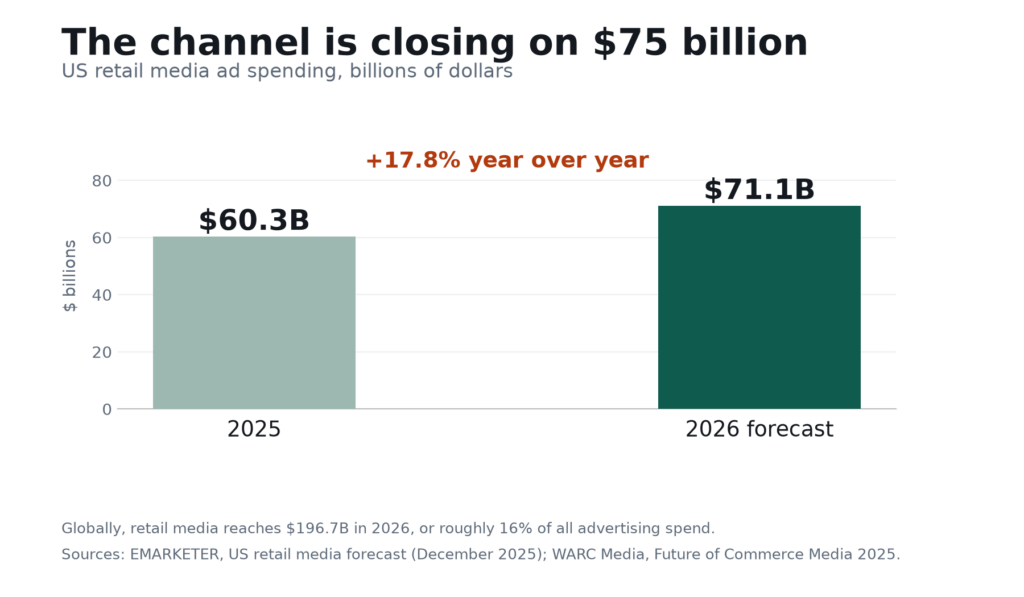
Budgets had to go somewhere measurable. When CFOs got cautious, they did not stop spending; they moved spending to the places that could show a receipt. Retail media is a receipt machine. eMarketer puts US retail media at $60.32 billion in 2025 and somewhere between $71 billion and $74 billion in 2026 depending on which forecast edition you pick up — growth of roughly 18% to 23% while search and social slow. Globally, WARC has the channel at $196.7 billion in 2026, about 16% of all advertising spend, and projects that it overtakes linear and connected TV combined. Omdia goes further, expecting retail media to approach a fifth of global ad revenue by 2030.
The measurement story got sold as a product. “Closed loop” became the phrase that unlocked budgets outside the shopper-marketing team. It is also the phrase that deserves the most scrutiny.
A word on numbers, because they will not reconcile. eMarketer’s US retail media total, IAB and PwC’s commerce media total ($63.4 billion in 2025, up 18%), and WARC’s global figure are built on different definitions — some include retail media only, some fold in affiliate and quick-commerce, some treat off-site differently. If you are building a budget case, pick one house and stay with it. Mixing them produces slide decks that do not survive a CFO’s second question.
Two companies own the channel
Here is the part most explainers skip, and it is the part that should shape your plan.
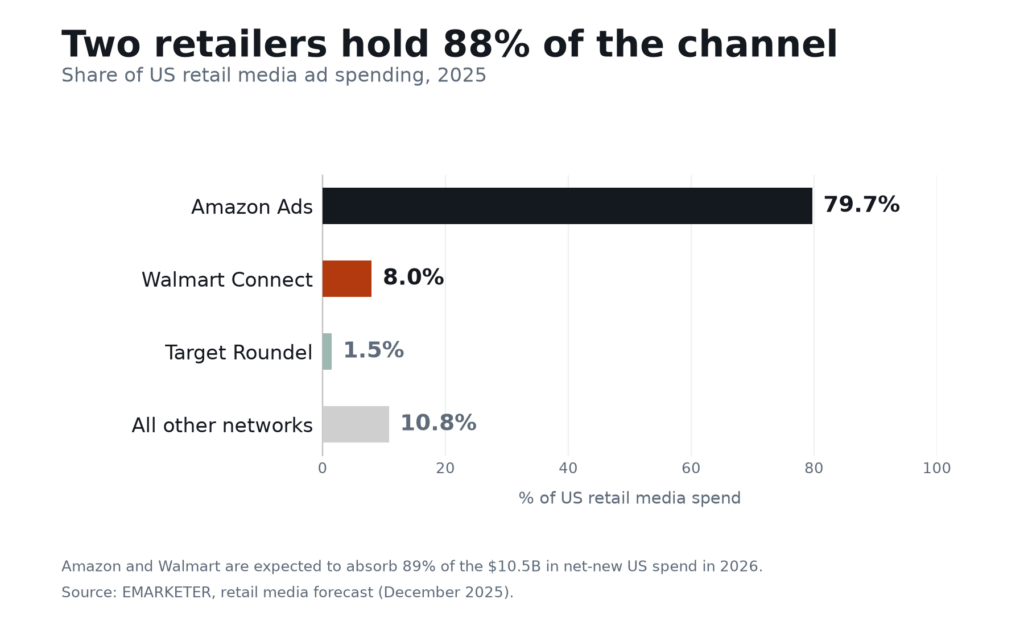
US retail media is not a market in the ordinary sense. It is close to a duopoly with a long, thin tail. Amazon held 79.7% of US retail media spending in 2025. Walmart Connect held 8.0%. Target’s Roundel held 1.5%. Amazon and Walmart together accounted for 87.7% of the total, and eMarketer expects them to absorb 89% of the net-new dollars in 2026 — $9.42 billion out of $10.53 billion. Every other network tracked by eMarketer is projected to hold flat or lose share through 2027.
Sit with that for a second. A channel growing at nearly a fifth a year, and nine of every ten incremental dollars land with two retailers.
What follows from concentration is not subtle. Pricing power sits with the networks, not the brands. Roadmaps get set by two companies. Innovation in formats, measurement, and terms happens at the pace of the largest players’ product cycles. And the “diversify across networks” advice you will read everywhere is, in practice, advice to diversify across the 10% of the market that cannot carry a national plan.
The counterweight is not another giant. It is a set of commerce intermediaries that sit between consumers and merchants: Instacart and DoorDash each generate close to $1 billion in annual US ad revenue, and leading quick-commerce players in Asia run ad businesses above that mark. They offer something the retail giants structurally cannot — visibility across multiple merchants. They have not yet proved they deliver incremental audiences at scale, but they are the most credible competitive pressure the duopoly faces.
The killer advantage, and the crack in it
Closed-loop measurement is retail media’s whole sales pitch, and it is a fair one. The retailer sees the impression and the transaction in the same system, because it owns both. No probabilistic matching, no panel extrapolation, no modelled conversions. You saw the ad on Tuesday, you bought on Thursday, the retailer can draw the line.
Every other channel would pay real money for that. Which is precisely why it gets oversold.
The problem is not that closed-loop attribution is wrong. It is that a large share of what it credits would have happened anyway. A shopper who searches “laundry detergent,” clicks your sponsored listing, and buys is not necessarily a shopper you won. She may have been going to buy that detergent regardless. The ad changed which brand she reached for — or it changed nothing at all, and you paid for a sale you already owned.
This is not hypothetical. Albertsons Media Collective has publicly tightened its own rules to count only conversions that happen after exposure: if you saw the ad on the 14th and bought on the 13th, the network does not take credit. That kind of discipline is admirable and rare. Most networks still report what flatters them.
Academic work has caught up with the problem. A 2026 paper on cannibalization-corrected attribution, deployed across multiple global markets, shows that raw paid-attribution signals systematically overstate true incremental growth when paid channels overlap with organic demand, brand traffic, or other acquisition paths — and that correcting the bias materially changes budget allocation. In plain language: the report you get is directionally useful and numerically optimistic.
The measurement mutiny
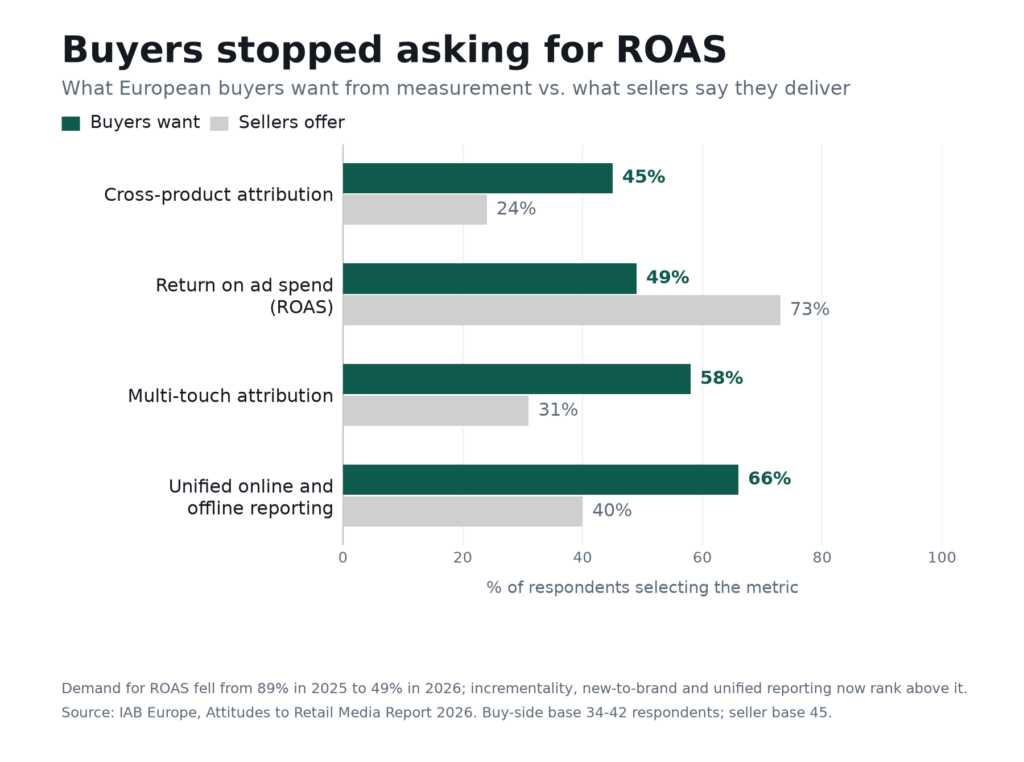
If you want one data point that captures 2026’s mood, take this one. IAB Europe’s Attitudes to Retail Media survey, published in November 2026, found that the share of European buyers asking networks for return on ad spend fell from 89% in 2025 to 49% in 2026. A 40-point collapse in twelve months, on a metric that had just spent a year at the top of the wish list.
That is not buyers losing interest in performance. It is buyers losing faith in the ratio.
ROAS counts sales that would often have happened anyway. It rewards the network for demand it did not create, and it says nothing about whether the campaign grew the business or merely intercepted it. What replaced it at the top of the list is telling: unified online-and-offline reporting (66%), new-to-brand and new-to-category measurement (63%), and incrementality (57%). Those three questions are all versions of the same question — did this actually add anything?
And here is the awkward part. Sellers cannot answer it. Only 31% of European sellers offer multi-touch attribution against 58% of buyers who want it. Unified online-and-offline reporting is offered by 40% while 68% of buyers ask for it. Cross-product attribution: 24% supply, 45% demand. Meanwhile, 76% of sellers lead with reach and frequency, and 73% with ROAS — the exact metric buyers just stopped requesting. Not one seller in the sample prices on cost per acquisition, in a channel whose entire proposition is proximity to the sale.
IAB Europe’s own framing is blunt: sellers who lead their pitch on ROAS are answering last year’s question.
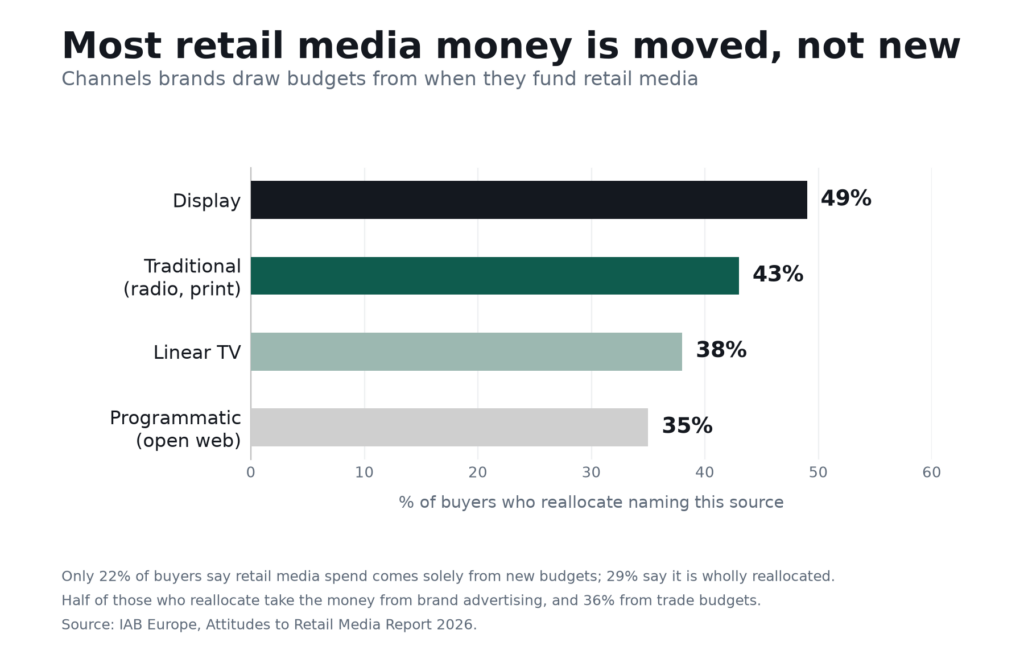
There is a commercial consequence hiding in this. Retail media is largely funded by cannibalizing other budgets — half of the buyers who reallocate take the money from brand advertising, 36% from trade, 31% from performance, 31% from social. If retail media eats brand budgets, it inherits brand budgets’ obligation: proof of durable, incremental effect, not last-click receipts. That bill has not been paid yet.
Pay-to-play, and the tax question
Let me put the uncomfortable version plainly.
A brand that does not buy sponsored placements on a major retailer’s search results can watch its organic listings slide down the page. Not because the product got worse, but because the auction is the ranking. The retailer monetizes the sale and the visibility of the sale, on the same page, at the same moment.
Is that a tax? Sometimes, yes. And the honest answer is that the tax is only defensible if the ad is incremental. Which is why the measurement fight and the pricing fight are the same fight. If a network cannot prove lift, then what it is selling is a toll on demand the brand already created.
The efficient version of this looks different, and it is worth knowing the difference. When inventory grows faster than demand can bid it up, costs flatten or fall. In Q4 2025, Amazon sponsored-product clicks rose more than 20% while cost per click fell about 1% — an efficiency expansion, not a squeeze. That window closes as auctions mature. Walmart’s sponsored-product click costs still run at roughly a third of Amazon’s, which tells you the Walmart auction is earlier in its cycle and less contested. It also tells you where the arbitrage is, and how long it will last.
Amazon and Walmart are not the same bet
Treating the two giants as one line item is the most common budgeting error in the channel.
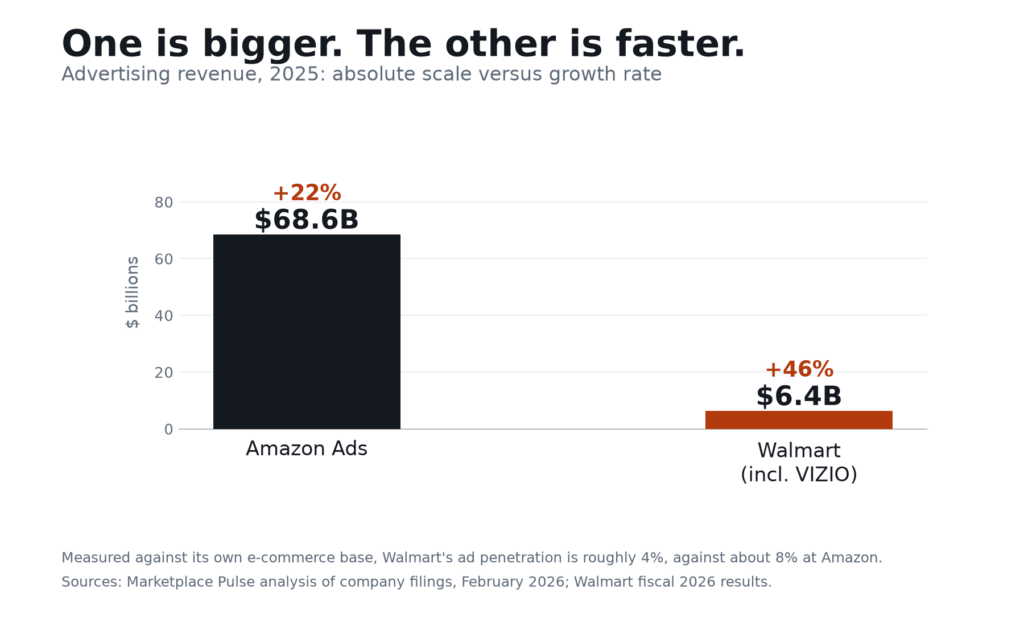
Amazon’s advertising business generated $68.6 billion in 2025, up 22%, and about $21.3 billion in the fourth quarter alone. Advertising is now roughly a tenth of Amazon’s net sales — a diversified media business wearing a retail coat, with Prime Video, Twitch, Fire TV, and a demand-side platform feeding it. Then the growth rate broke: Q3 2026 advertising revenue grew 11%, the slowest pace in nearly four years, which Amazon attributed largely to Prime Day shifting into the second quarter. Some of that is calendar arithmetic. Some of it may be the beginning of something else, which we will get to.
Walmart is a different shape entirely. Global advertising reached about $6.4 billion in fiscal 2026, up 46%, with Walmart Connect in the US up 41% in the holiday quarter and 43% in the following Q2 excluding VIZIO. The scale gap is enormous — roughly 11 to 1 — but the penetration gap is not. Measured against its own e-commerce base, Walmart’s advertising represents around 4% of sales, against about 8% at Amazon. Walmart’s marketplace is also young: marketplace gross merchandise value is estimated near $15 billion, roughly a tenth of its e-commerce base, against roughly 69% at Amazon.
What that means practically: Amazon is where you defend rank in a mature, expensive, well-instrumented auction. Walmart is where you buy share in an auction that is still forming, at a fraction of the click cost, with a smaller but faster-growing audience and a seller base expanding quickly. Those are different jobs. Budgeting them identically is how brands end up overpaying in one place and underinvesting in the other.
The physical shelf is still the slowest surface
Every retail media keynote ends with the store. The aisles, the screens, the shelf-edge labels, the audio at the freezer. It is a genuinely exciting story. It is also, by the numbers, the least mature part of the channel.
The global in-store digital advertising display market was worth about $4.39 billion in 2025, is tracking toward $4.90 billion in 2026, and is forecast at $7.69 billion by 2030 — an 11.9% compound annual rate. Compare that with a $71 billion US channel and the proportion becomes clear. In-store is growing; it is not yet where the money is.
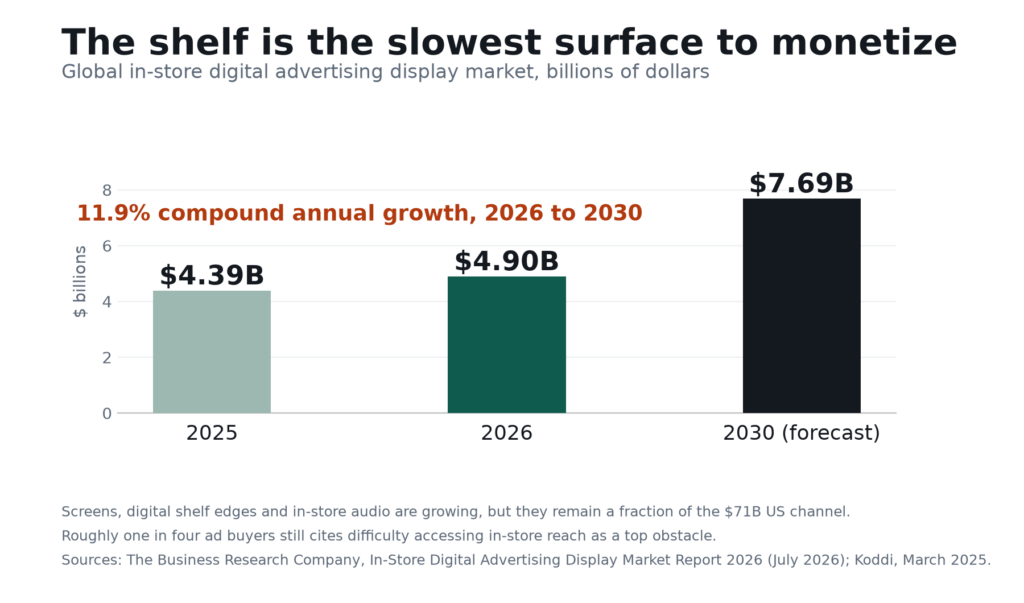
The friction is physical and organizational. Retrofitting thousands of stores with networked screens is a capital project with a five-to-seven-year payback logic. Content has to be scheduled per store, per daypart, per inventory level. And roughly one in four ad buyers still names difficulty accessing in-store reach as a top obstacle, which is a polite way of saying nobody can sell them the aisle in a usable form.
The demand case is strong, though, and it is why the gap will close. More than 91% of food and beverage purchases still happen in stores. Roughly 70% of grocery retailers have said they intend to deploy in-store retail media within 18 months. If you sell anything chosen at a shelf rather than a search bar, this is the surface that eventually matters most — and the brands that learn the operational rhythm early will pay less for it than the ones who arrive after it is priced like sponsored search.
The agent in the room
Now the part that could reprice the whole channel.
AI shopping agents — software that researches and buys on a consumer’s behalf — are being positioned as the next interface. Morgan Stanley has estimated that such agents could account for 10% to 20% of US e-commerce spending by 2030. Whether or not that number holds, the direction is clear enough that the two biggest retail media businesses are already behaving differently about it.
Amazon blocked Meta’s shopping agent from its store in September, citing unauthorized access to customer credentials, and previously won, then lost, a court order against Perplexity’s shopping agent. Walmart went the other way: in October it stood up infrastructure that lets third-party agents shop on its site, creating a profile per agent linked to the shopper’s account, with approval and spending-limit controls.
Why the split? Because advertising and agentic commerce make awkward housemates. Sponsored search works when a human scans a results page. An agent does not scan; it queries, filters, and ranks on attributes. If the agent ignores the sponsored slot, the $38 billion US sponsored-product line loses its premise. If the agent is allowed to read the sponsored slot as a signal, the auction mutates into something closer to a product-data contest.
The early evidence is suggestive rather than conclusive. Amazon’s advertising growth decelerating to 11% while its retail business grows is not proof of agentic disruption, but it is the kind of signal worth watching quarterly. Meanwhile, both companies are hedging: Walmart has tested ads inside its AI shopping chatbot, and Amazon has embedded them in its AI shopping assistant. Procter & Gamble, Nestlé, and L’Oréal have all said publicly they are reworking product data so AI agents can digest it.
What this changes for the discipline of retail media is the unit of competition. If an agent decides, the fight moves from “who owns the top sponsored slot” to “whose product attributes are machine-readable and verifiable.” That is a very different investment — structured data, spec accuracy, review authenticity, price competitiveness — and it is one most brands are not staffed to make yet.
What brands should actually do
Enough diagnosis. Here is what the data supports.
1. Buy the channel, but audit the attribution. Retail media is a performance channel with real, measurable returns. It is also a channel whose measurement is self-reported by the party being paid. Set up holdout tests or geo-experiments on your top campaigns, and treat the network’s ROAS dashboard as a starting hypothesis rather than a verdict.
2. Stop treating incrementality as a nice-to-have. The single most valuable question you can ask a network in 2026 is “what did this add that would not have happened?” Ask it in the RFP, ask it in the QBR, and ask it with a holdout design attached. Networks that can answer will become your long-term partners. Networks that cannot are selling placement.
3. Separate your Amazon plan from your Walmart plan. Amazon is a mature, expensive, high-intent auction where you defend rank and buy data. Walmart is an earlier auction with cheaper clicks, faster growth, and a younger marketplace. Different margins, different creatives, different KPIs. One budget line labeled “retail media” is a planning failure.
4. Diversify for leverage, not for reach. Spreading budget across the long tail will not carry a national plan, and pretending otherwise wastes money. Diversify where it buys you something concrete: a measurement concession, a category exclusivity, a testbed for a format, or access to an audience the duopoly does not own.
5. Keep organic fundamentals funded. Reviews, listing quality, price competitiveness, availability. Retail media amplifies a strong listing and accelerates a weak one toward irrelevance. The brands that suffer most from pay-to-play pressure are the ones that let their organic presence decay while buying their way up the page.
6. Start the agent-readiness work now, cheaply. Clean product attributes, verifiable specs, consistent identifiers across retailers. This is unglamorous plumbing, and it is the thing that will still be paying off when the agent question is settled.
The takeaway
Retail media is not a bubble, and it is not a footnote. It is the third wave of digital advertising after search and social, and unlike most channel narratives, its rise is structural: first-party purchase data that does not decay, measurement tied to actual transactions, and placement at the moment of decision.
But the flattering version of the story stops at “closed loop.” The accurate version adds three qualifications. The channel is nearly a duopoly, so the leverage problem is real and getting worse. The measurement is self-interested, so the incrementality question is not optional. And the largest physical surface — the store itself — is still the least monetized, which means the next wave of pricing pressure has not arrived yet.
The shelf became an ad network. The brands that do well in it will be the ones that buy visibility, verify the numbers, and keep enough organic strength that they are never purely renting their place on the page.