You Can’t Optimize What You Can’t Audit: A Buyer’s Guide to GEO Monitoring Tools
Every few years marketing invents a dashboard before it invents a definition. Rank trackers arrived before anyone agreed what a ranking meant. Social listening arrived before brands decided whether sentiment was a number or a mood. That is happening again with AI visibility — and the results are being sold to you at $29 and $489 a month.
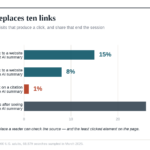
Start with the fact that should frame everything below. Pew Research Center tracked 900 American adults through 68,879 Google searches in March 2025. When a page carried an AI summary, users clicked a traditional result in 8% of visits. Without a summary, 15%. And in the 1% of visits to summary pages where anyone clicked a link cited inside the summary itself, that was the entire yield.
One percent. That is the prize this category is built to chase.
So before ranking anything, be clear about what is being ranked. Not tools that make you visible. Tools that tell you whether you were visible. Different businesses. Only one of them can be sold as software.
The Short Version
GEO monitoring tools run a fixed panel of prompts against AI engines on a schedule and log whether your brand appeared, where, and which sources the answer cited. That architecture is identical at $29 a month and at enterprise pricing.
The category is real, growing, and uneven. Profound raised a $96 million Series C in February 2026, bringing total funding to $155 million on a $1 billion valuation, on the strength of a monitoring dashboard. Peec AI built a serious business on sentiment and share of voice. Otterly.AI sells the cheapest honest entry point. Semrush and Ahrefs have bolted AI modules onto suites you may already pay for.
Almost none of them measure what decides whether the work mattered: accuracy, brand lift, pipeline. That gap is not a roadmap problem. It is the boundary of the architecture.
A Citation Is Not a Customer
A citation is a proxy for attention, attention is a proxy for memory, and memory is a proxy for revenue. Every tool in this market measures the first term.
The middle links are thinning in ways the dashboards cannot see. Ahrefs compared 300,000 keywords between December 2023 and December 2025 and found that when an AI Overview appears, the top-ranking page loses about 58% of the clicks it would otherwise have earned. Position two lost 50.8%. Position three, 46.4%. For every 100 clicks a top page used to collect, Google now keeps 58.
Citation without a click is not nothing. But “not nothing” is hard to take to a CFO, and it explains why this category keeps getting measured and renewed without ever quite proving itself.
What a GEO Monitoring Tool Actually Has to Do
Most buying comparisons start with a feature grid. Wrong starting point. Start with the job.
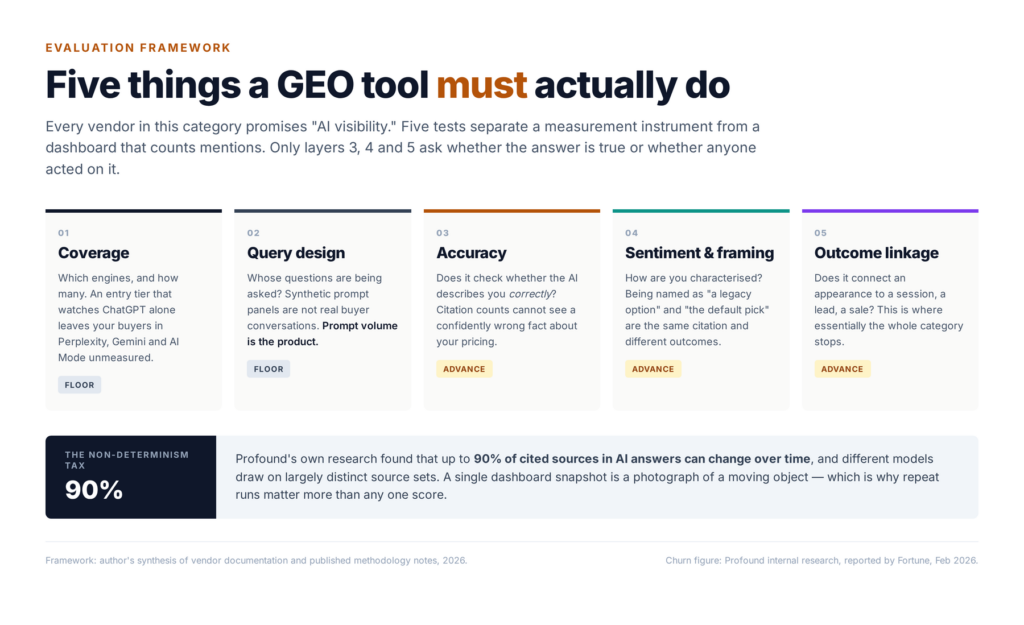
There are five tests, and they stack. The first two are table stakes. The last three are where vendors quietly stop talking.
Test one: coverage, and the illusion of it
Which engines, and how completely? This is where entry pricing does its quiet work. Otterly’s $29 Lite tier watches four engines with 15 prompts; Gemini, AI Mode and Claude cost extra on every plan — $59, $59 and $109 a month respectively on Standard. Add all three to a $189 Standard plan and you are at roughly $416.
The engines are not interchangeable either. Profound tracks up to nine answer engines at enterprise level. Ahrefs covers Copilot and Claude. Semrush’s toolkit does not.
Test two: query design
Whose questions are being asked? Every vendor runs a prompt panel, and no vendor sees what real buyers type into ChatGPT. They sample synthetic panels because the real conversations are unobservable from outside the platform.
Two tools will report different visibility scores for your brand on the same day, and both will be right. Different prompts, schedules, engines, samples of a moving target.
Prompt volume is the product. Otterly’s Lite answers a much smaller question than its Premium tier’s 400 prompts. Read the prompt count before the price.
Tests three through five: accuracy, sentiment, outcome
Does the tool check whether the AI describes you correctly? Does it track how you are characterised, not just whether you appear? Does it connect any of this to a session, a lead, a sale?
Almost nothing does all three. Profound and Peec AI publish sentiment and share-of-voice metrics. Semrush includes a GA4 integration that isolates AI referral traffic inside your analytics — which links appearance to click, though not to the presence that caused the click. The outcome layer is absent from the comparison set.
The Tool Landscape, Sorted Honestly
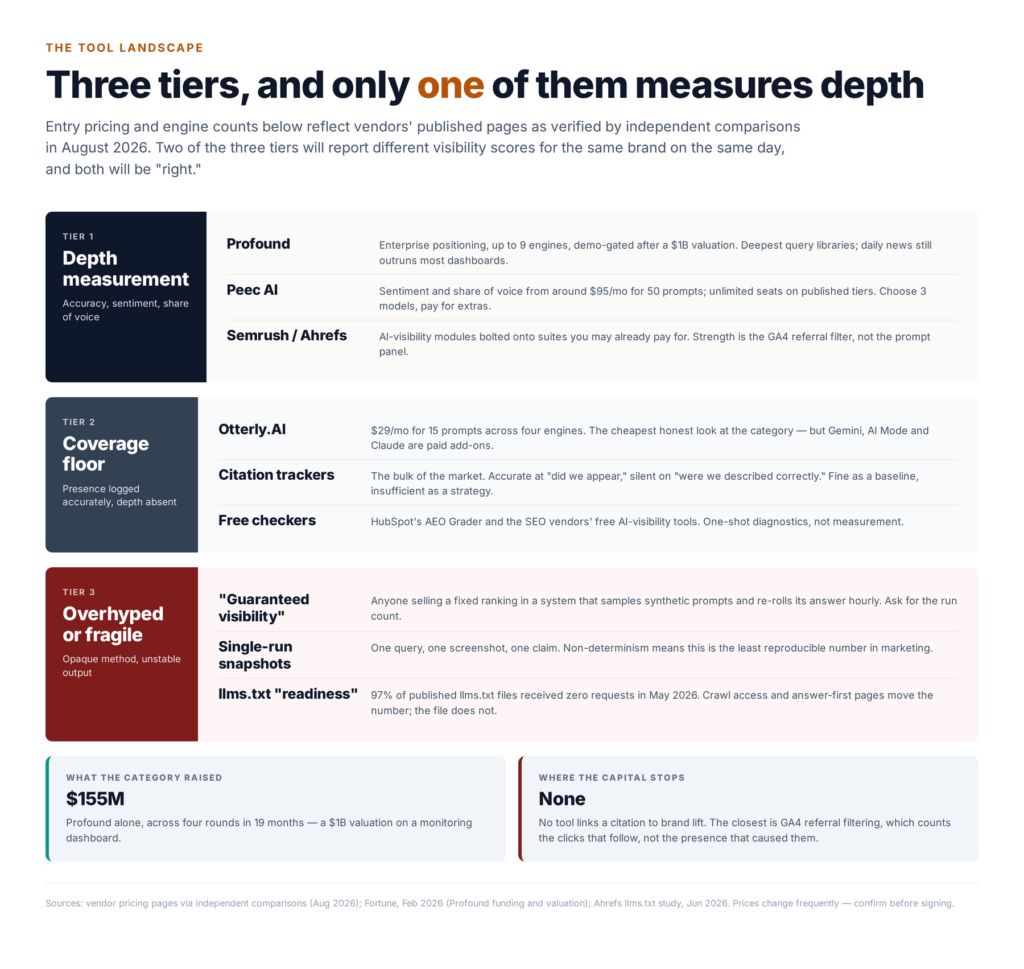
Ranked by measurement depth. Prices reflect vendors’ current public pages, verified this month. They move — confirm before signing.
Tier one: depth measurement
Profound is the category’s centre of gravity. Enterprise pricing is quote-only; the public page offers a free seven-day trial with 50 prompts daily across ChatGPT, Gemini and AI Overviews, then moves to custom enterprise terms tracking up to nine answer engines. Its query libraries are the deepest in the market, and its agent analytics reads crawler behaviour rather than answer text — a different signal from what competitors sell. What you buy is benchmarking. What you should demand is run count per reported score.
Peec AI is the tool to hand a marketing manager with a budget and no patience for procurement. Starter is $95 a month for 50 prompts, unlimited users, and six engines including AI Mode and Gemini — engines Otterly charges $59 each for. Pro is $245 for 150 prompts; Advanced $495 for 350 with multi-country coverage. Perplexity appears only at enterprise level. That is an honest structure: the expensive thing is genuinely expensive, not hidden behind tier one.
Semrush AI Visibility Toolkit and Ahrefs Brand Radar are the suite plays. Semrush covers five platforms and its GA4 referral filter is the closest thing here to attribution. Ahrefs added custom AI prompt tracking to Brand Radar in January 2026, on an index processing over 239 million prompts monthly — 162 million AI Overviews, 29 million AI Mode queries, 100 million across ChatGPT, Copilot, Gemini and Perplexity — plus YouTube, TikTok and Reddit monitoring.
Both answer adjacent questions rather than the one you asked. Semrush tracks prompts it generates. Ahrefs’ full AI index sits behind an expensive add-on.
Tier two: the coverage floor
Otterly.AI is the cheapest honest look at the category: $29, 15 prompts, four engines. Standard $189 for 100 prompts, Premium $489 for 400. The catch is structural and already priced above.
Below it sits the bulk of the market: citation trackers that accurately log appearance and say nothing about accuracy. Useful as a baseline. Insufficient as a strategy. And free diagnostics like HubSpot’s AEO Grader — one-shot instruments, not measurement.
Tier three: overhyped or fragile
Anyone selling a guaranteed position in an AI answer. Anyone reporting a single query as a stable finding. And the llms.txt “readiness” industry, which deserves its own paragraph.
Ahrefs analysed 137,210 domains and found that 97% of published llms.txt files received zero requests in May 2026. Of the roughly 38,000 valid files, only about 1,100 saw any traffic at all, and bots tied to live AI retrieval accounted for just 1.1% of requests. Google has stated in writing that its search products do not use the file. Publishing one is harmless. Believing it moves visibility is not.
The Four Gaps Nobody Has Closed
This section should shape your budget more than any feature comparison.
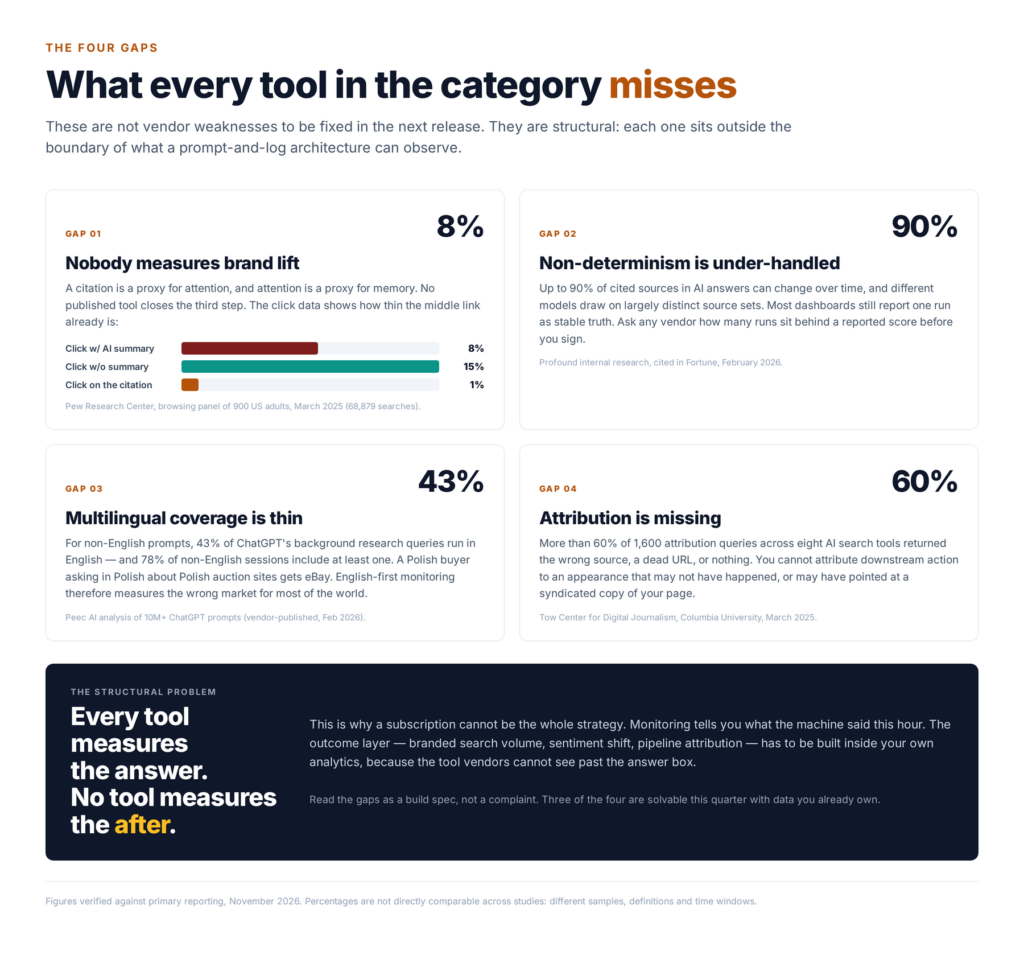
Gap one: nobody measures brand lift
No vendor in this comparison tells you whether AI visibility changed how people think about you. They tell you that you appeared more often. Different claim.
The click data suggests the path from appearance to memory is narrower than the industry’s enthusiasm implies. Eight percent versus 15%. One percent on the citation itself. Being named is an asset. Being remembered is the business.
Gap two: non-determinism is treated as noise
Profound’s own research found that up to 90% of cited sources in AI answers can change over time, and that different models draw on largely distinct source sets. Read that twice: it is simultaneously the category’s best sales argument and its most honest confession.
If answers were stable, visibility would be a project. Because they churn, it is an operation — something to monitor monthly. Operations justify subscriptions. Subscriptions justify billion-dollar valuations.
Fair enough. But it also means the number on your dashboard is a sample from a distribution, reported as a fact. Ask how many runs sit behind a score. Ask what the variance looks like. A vendor who cannot answer is selling a photograph of a moving object.
Gap three: the English-first blind spot
Peec AI analysed more than 10 million prompts and roughly 20 million fan-out queries and found that 43% of the background searches triggered by non-English prompts run in English. In 78% of non-English sessions, at least one query switches to English. Turkish prompts hit 94%. Spanish, the lowest, still reaches 66%.
The consequence is visible. Ask ChatGPT in Polish, from Poland, about Polish auction portals, and Allegro — the country’s dominant platform — is missing or buried while eBay surfaces. Ask in German about German software companies and get a list with no German companies on it. In the Spanish cosmetics example Peec documented, ChatGPT added the word “globales” to a sub-query the user never used.
So when an English-first tool tells you visibility is fine, it measures the market you compete in only if you sell in English. Weglot’s research across 1.3 million citations found untranslated Spanish sites collecting 17,094 Spanish citations in AI Overviews against 2,810 for the same queries in English. Vendor-published, so discount accordingly. The direction is loud.
Gap four: attribution, where it falls down
You cannot attribute an outcome to an appearance you cannot verify. Columbia’s Tow Center for Digital Journalism gave eight AI search tools a verbatim quote from a real article and asked for the headline, publisher, date and URL. Across 1,600 queries, more than 60% of answers were wrong. Perplexity was best at 37% wrong. Grok-3 was worst at 94%. ChatGPT misidentified 134 of 200 articles and flagged uncertainty 15 times. It never once declined to answer.
The tools cite syndicated copies instead of originals, fabricate URLs, and land on error pages — Grok-3 produced 154 dead links across 200 responses. Attribution means tracing a downstream action to a specific citation. When the citation is wrong at that rate, attribution is not hard. It is undefined.
How to Choose Without Getting Fleeced
Four rules, in descending order of money saved.
Match the tool to your maturity, not your ambition. If you have never checked whether you appear, $29 and 15 prompts will teach you more than a demo call. If you know you are invisible and need to know why, buy depth — sentiment, accuracy, share of voice.
Never rely on a tool alone. Every vendor samples synthetic prompts. Every one misses nuance a human catches. A quarterly manual audit run by someone who knows your category will find framing problems no dashboard flags.
Prioritize depth over dashboard polish. A beautiful interface reporting shallow data is a liability, because it gets trusted. Ask what the tool measures that a competitor does not, and make the vendor answer in specifics.
Build the outcome layer yourself. No vendor measures brand lift, so your measurement has to live in your own analytics: branded search volume, direct traffic trends, sentiment shift over time, pipeline attribution by referral source.
The data supports this more than the industry admits — with a caveat worth naming. Adobe Analytics found AI-referred traffic to US retailers converting 42% better than non-AI traffic in March 2026, a reversal from 38% worse in March 2025, with 48% longer sessions and 37% higher revenue per visit. Adobe sells an LLM optimizer, so read the framing with that in mind. Seer Interactive measured ChatGPT referrals converting at 15.9% against 1.76% for organic — one B2B client, six months. Siege Media’s 78-site sample put the median gap at 1.26x. Amsive found no significant difference across 54 sites. A study of 973 e-commerce sites in Marketing Science found ChatGPT referrals converting lower than most channels.
The honest read: direction is consistent, magnitude is not, and your own numbers will differ from everyone else’s. Measure your own. It takes an afternoon of GA4 configuration.
The Part No Vendor Will Tell You
The most useful sentence in this article is one nobody in the category is incentivised to say: measurement is not improvement.
A dashboard tells you that you are absent from the answers that matter. It does not make you present. The work that moves the number is unglamorous — crawlable pages that answer real buyer questions, structured so a retrieval system can quote them, and third-party mentions on pages AI systems already trust.
AirOps classified 21,311 brand mentions across 500-plus commercial-intent queries on GPT-5, Claude Sonnet 4.5 and Perplexity Sonar and found 85% came from third-party pages, 13.2% from brands’ own domains. Brands were 6.5 times more likely to be surfaced through earned sources than their own site. Nearly 90% of third-party mentions came from listicles, comparisons and reviews.
So if the choice is $400 a month of measurement or $400 a month of content that earns citations, early-stage teams should usually buy the content and measure lean. Monitoring is the input to optimisation. It was never the optimisation.
The Takeaway
GEO monitoring tools are necessary and insufficient, and the market is young enough that both remain true at enterprise prices.
Citation counters are the floor. Accuracy, sentiment and share-of-voice platforms are the advance. But nothing in this comparison measures the outcome that decides whether any of it worked, and the underlying citation data is wrong often enough that attribution stays theoretical.
The sophisticated approach is unromantic. Buy the cheapest measurement that answers your actual question. Pair it with manual audits. Build outcome metrics inside analytics you already own. Then treat the dashboard as what it is: a smoke alarm, not a fire department.