Why the Fifth-Ranked Page Wins the Citation
It took me three audits to believe it. The page getting lifted into the AI answer was rarely the one ranking first. It was often fourth, fifth, occasionally something sitting below the fold of page one — while the top result, with the better domain, the fatter backlink profile and an eleven-year head start, appeared nowhere inside the generated response.
I assumed I was misreading the data. I wasn’t. I was misreading what the engine was doing.
Ranking compresses. Retrieval doesn’t.
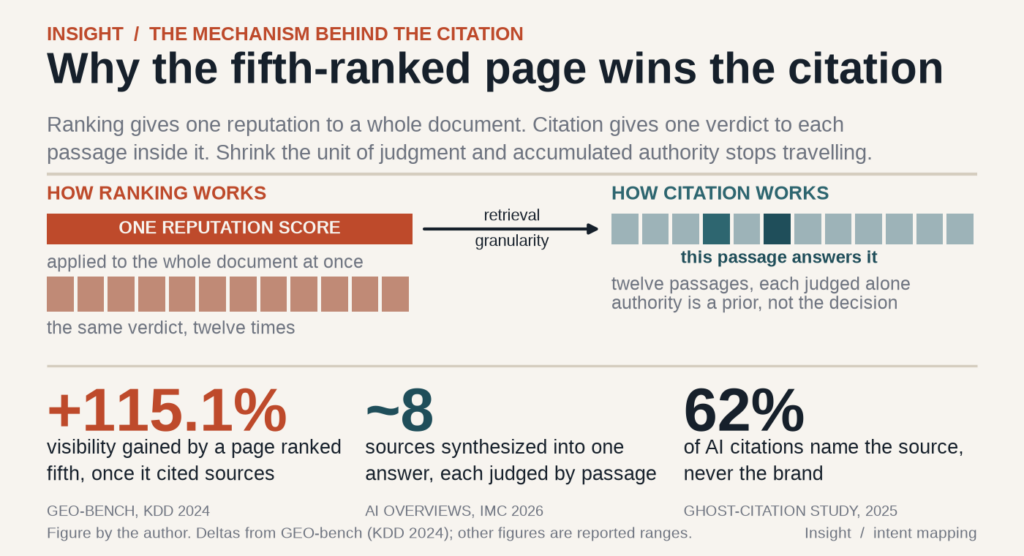
A search ranking assigns one reputation to one document. Thousands of signals get crushed into a single number, and that number is then applied uniformly to every paragraph on the page. Call it a compression: cheap to compute, easy to compare, and blind to internal variation. The whole page inherits the score, whether it deserves it or not.
An AI answer never consumes a document. It consumes passages. The retrieval layer slices candidates into chunks, scores those chunks against a decomposed version of your question, and assembles the answer from whatever survived. The question it asks is not “is this domain trustworthy.” It is “does this piece of text answer what I was asked.”
Those are different contests, held at different altitudes.
The equaliser, and why it exists
The GEO benchmark measured something that looked wrong at first: a page ranked fifth gained 115.1% visibility once it started citing sources, and the top-ranked page in the same test lost ground.
Nothing mysterious happened. Adding citations improved the passages. It did not improve the domain. In a passage-level contest, that is the only intervention that counts.
This is also why most teams keep losing. Their production process optimizes the container — title tag, meta description, internal links, word count, keyword placement — and never touches the passage. They edit at document altitude in a competition decided three inches lower.
The part almost nobody fixes
Here is the mechanism I now think matters most, and it took me a while to see it.
Most B2B writing is built as a cumulative argument. Paragraph two depends on paragraph one. The payoff arrives in paragraph nine, after the setup. Read linearly, it is persuasive. Sliced into chunks, it self-destructs: every paragraph becomes an orphan that references something outside itself.
Retrieval does not read linearly. It reads each chunk cold.
So the real constraint is not “write better paragraphs.” It is that each paragraph must survive being cut out of the page with no title, no introduction, no preceding context, and still make complete sense on its own. That is a different craft, and most content teams have never been asked to practice it.
Why this is getting worse, not better
Two forces compound.
Query fan-out. The engine splits a single question into several sub-questions and retrieves a passage for each one. A page with one strong thesis now needs five or six self-sufficient answer units to cover the same ground.
Citation share without credit. Roughly 62% of AI citations mention the source but never the brand behind it. You can win the passage contest and still be invisible — which sounds like bad news, and partly is. But it also means the thing being judged is the text itself, stripped of your reputation. On that field, an unknown brand with a genuinely better paragraph is not the underdog. It is the favourite.
What I changed in practice
I stopped briefing pages and started briefing answer units. Before anything gets written, I ask: what are the six specific questions this page must answer cold? Then each one gets its own self-contained block, its own evidence, its own plain-language verdict.
The page still ranks. It just also gets quoted now, which was the point.