Keyword Research Is Dead. Intent Mapping Replaced It.
Somebody opens ChatGPT at 11pm and types: I run a twelve-person design studio, we keep losing track of client feedback, what should we actually be using?
Now watch what happens next. No ten blue links. No scrolling. One synthesized answer, maybe four tools named, maybe a caveat about pricing tiers, maybe a note that small teams often outgrow the cheapest plan. The person reads it, nods, and either buys something or closes the tab.
Here is the uncomfortable part. If you sell project management software, that query contains zero of your target keywords. Not one. There is no best CRM 2026 in it, no project management tool comparison, nothing your keyword tool would have flagged. And yet it is the single most commercially loaded question that person will ask all week.
That gap, between what people type and what they mean, is where keyword research quietly stopped working. Not because keywords became worthless, but because the machine on the other end stopped matching strings and started reading intent.
The keyword list was a map of a country that no longer exists
Traditional keyword research rests on an assumption so old nobody bothers to state it: that the query string is a reliable proxy for the need behind it. Target best CRM software, write the page, rank the page, collect the click.
That assumption held while the search engine’s job was retrieval. Google matched your string against an index and handed back a list. Your job was to be on the list, near the top. The string was the unit of work because the string was the unit of matching.
Then the answer box arrived, and the unit of matching changed.
Ask an AI engine best CRM and what should I use to manage customer relationships. Different strings. Wildly different strings, in fact, one is four words and one is nine. The engine treats them as the same request, because it is not comparing strings. It is resolving a need. Same need, same answer, same cited sources.
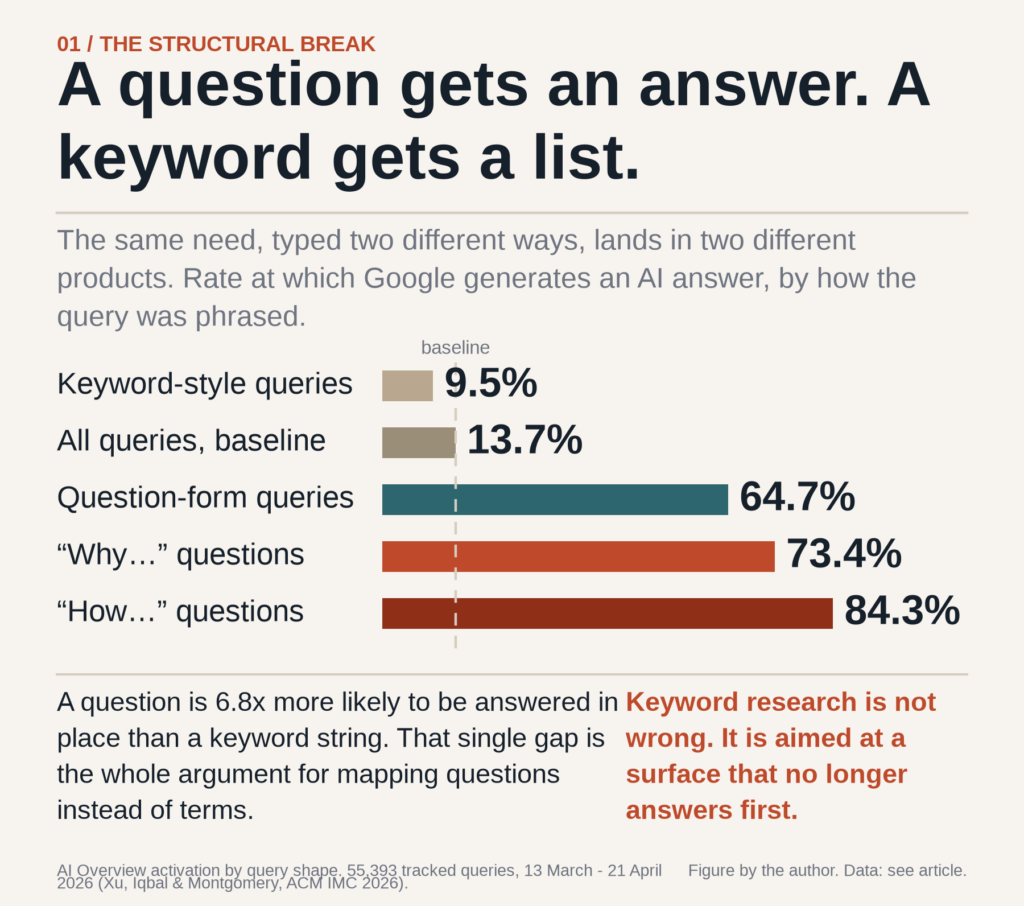
That chart is the whole argument in one image. Among those 55,393 queries, roughly 13.7% produced an AI-generated summary. Among question-form queries, the rate hit 64.7%. Queries starting with how cleared 84%. Queries starting with why, 73%. And keyword-style strings, the kind most content calendars are still built around, triggered an answer 9.5% of the time.
A question was roughly seven times more likely to be answered in place than a keyword string. Seven times.
The tell is in how people type
Length is the other half of the story. Researchers measuring AI search behavior with Similarweb panel data found average prompts running 70 to 80 words, against 3 to 4 words in a classic Google search. That is not people being verbose for fun. It is people handing over context: constraints, budget, team size, what they already tried, what went wrong last time.
Each of those details is an intent signal. Twelve-person studio. Losing track of feedback. Those two phrases narrow the answer space enormously, and a keyword list has no place to put them.
Google’s own numbers point the same way. AI Mode passed a billion monthly users and its query volume has more than doubled every quarter since launch. People are not searching more efficiently. They are asking differently.
Intent was always the real unit. We just couldn’t measure it.
Worth being honest about the intellectual history here, because it saves you from treating intent mapping as a shiny new thing. It isn’t new. In 2002, Andrei Broder published a taxonomy of web search that split queries into informational, navigational and transactional. Two decades of SEO practice grew up around that trio. Google’s own quality guidelines later refined it into Know, Do, Website and Visit-in-person.
So the concept is old. What changed is the cost of ignoring it.
When search returned ten links, a fuzzy intent model was survivable. You could rank for a string without understanding the need behind it, because the click was the reward and the click was cheap to earn. When search returns one synthesized answer, the fuzziness becomes fatal. The engine has to decide, before it writes a word, which need you are serving and whether your page serves it. Vague pages lose that decision.
Put differently: intent used to be a strategic nicety. Now it is the retrieval key.
Why “informational” is not an intent you can build on
Here is where most intent-mapping advice goes soft. It tells you to tag queries as informational, commercial or transactional, then build content per bucket. Sounds tidy. Doesn’t work.
Look at the measured trigger rates. Across 5.47 million queries tracked over fourteen months, informational searches produced an AI Overview 36% of the time. Commercial searches, 8%. Transactional, 5%. A sevenfold spread, and genuinely useful for budgeting attention.
But zoom into that informational bucket and the spread gets violent. Comparison queries, the X vs Y shape, triggered an answer 95.4% of the time. Reviews: 86.3%. Question-format queries: 85.9%. Price and cost queries: 83.4%. Best-of lists: 81.3%. Single-word informational queries dropped to 27.3%.
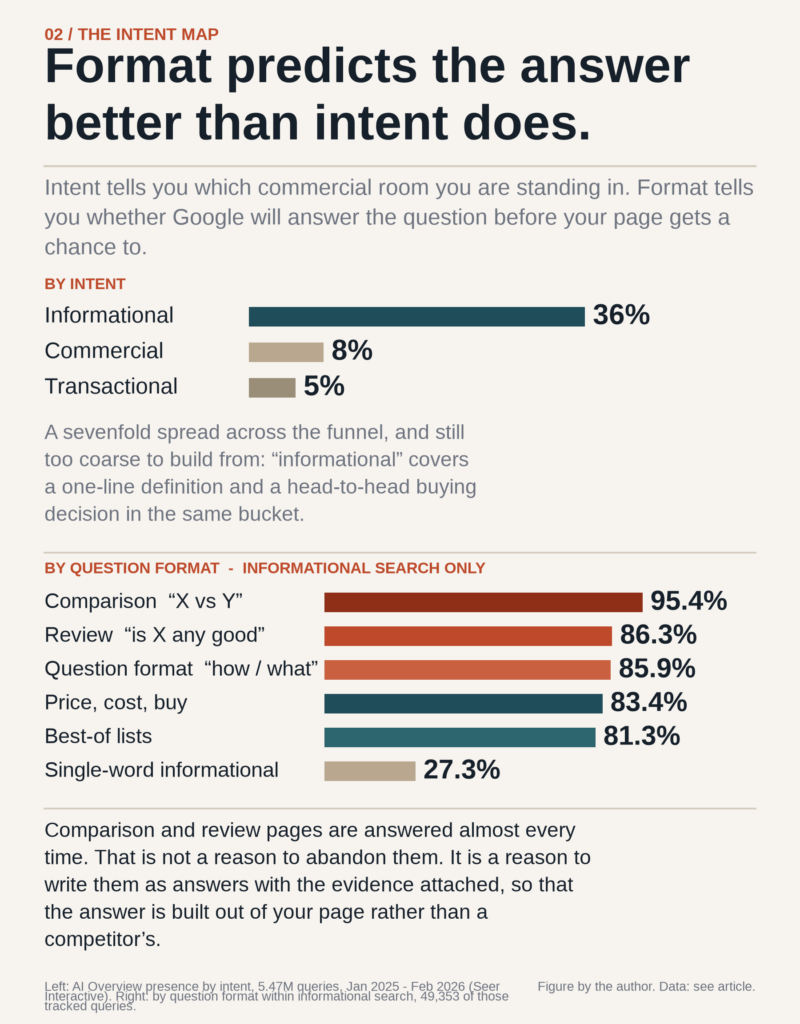
So informational is not one thing. It contains a definition request that Google will always answer itself, and a head-to-head buying decision that Google will answer but which decides real money. Same label. Opposite economics.
Format beats category
If you take one operational lesson from this piece, take this one: tag by format, not by funnel stage.
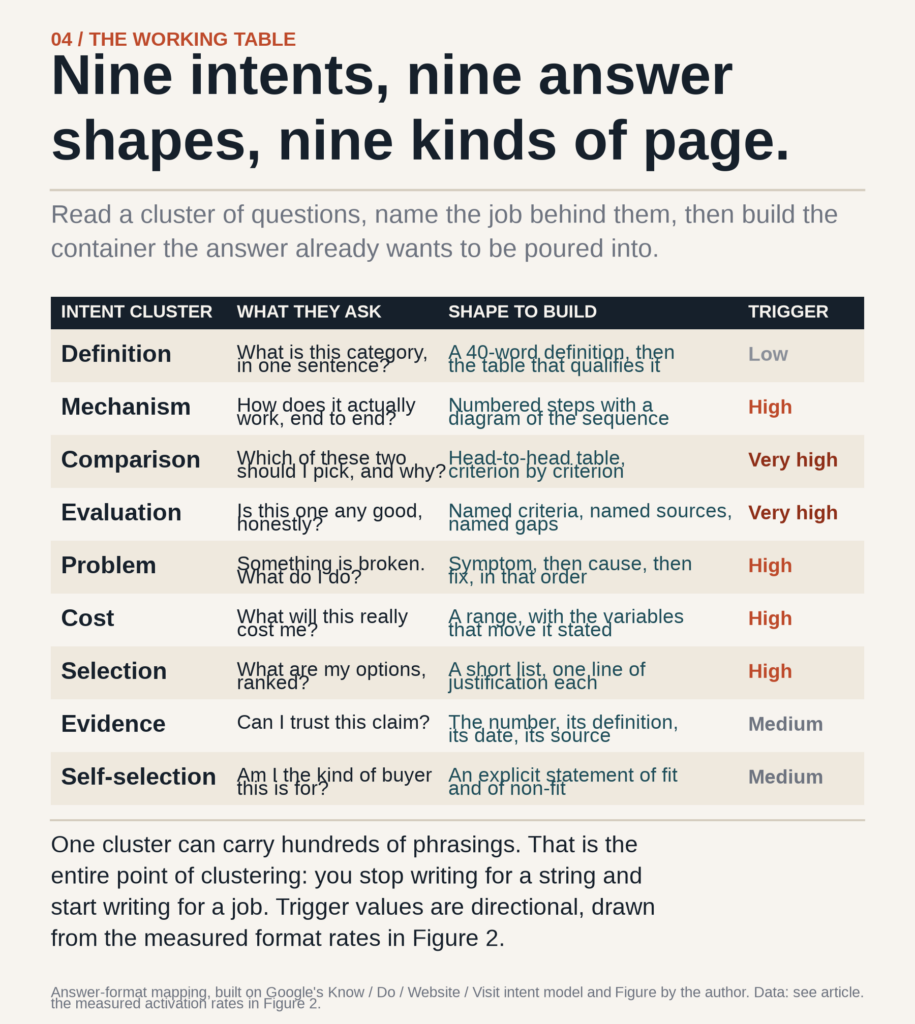
Format is the shape of the ask. Is it a definition, a comparison, an evaluation, a diagnosis, a cost question, a shortlist request? Those shapes are stable. They survive model upgrades. They map cleanly onto page types you can actually commission.
And crucially, format is where the AI’s answer already has a template. A comparison answer wants a table. A diagnosis answer wants ordered steps. If your page does not contain that shape, the engine will synthesize the shape from someone else’s page and cite them.
The five layers of an intent map
What follows is the framework I actually use, stripped of the consulting slide deck.
Layer one, the cluster. Not a keyword. A group of phrasings that express one underlying job. Ten questions worded ten ways, all of them really asking will this survive contact with my team.
Layer two, the job. Name what the asker is trying to finish. Not learn about X. Something closer to justify a purchase to a skeptical finance lead. The job is the sentence you write at the top of the brief.
Layer three, the answer shape. Decide the container the answer wants. Definition, table, steps, ranked list, diagnostic tree, range with variables. This is the layer most teams skip, and it is the layer that determines whether your page gets cited or merely ranked.
Layer four, the gap. Map which clusters you currently satisfy and which you don’t. Then map the same for two competitors. The uncovered intersections are your actual content plan.
Layer five, the value. Rank clusters by what a correct answer is worth. A transactional cluster is worth more per answer than a definitional one. A comparison cluster is worth more than both, because it is where the decision gets made.
How to actually do this, in five moves
Frameworks are cheap. Here is the work.
Mine the questions nobody types into Google
Your keyword tool is the worst possible source for this. It only knows what has already been searched often enough to be indexed. The richest intents sit in your support inbox, your sales call recordings, your onboarding tickets, your review complaints, your community threads.
Read twenty sales calls and count the questions. You will find the same six or seven needs, phrased in language no keyword tool would ever surface, because the phrasing is too specific, too messy, too human.
Cluster by job, not by wording
Group the questions until each group can be summarized in one sentence about purpose. If the sentence needs an and, split the group.
This is judgment work, and it is imperfect by nature. Two analysts will draw slightly different clusters. That is fine. The clusters are hypotheses, not taxonomies. What matters is that each cluster points at one deliverable.
Watch the answer, not the ranking
Run your target questions through AI Overviews, ChatGPT and Perplexity yourself. Then read the answers as artifacts. What shape did the engine choose? Which sources did it use? Which claim got stated first?
You are reverse-engineering the answer template the engine already prefers for that cluster. If every answer in your category opens with a comparison table and yours opens with a 900-word essay, the template mismatch explains the missing citation better than any authority metric.
Worth knowing: nearly 30% of the sources cited inside AI Overviews do not appear in that query’s first-page results at all. The average overview pulled from about eight sources. Citation selection and ranking are related, not identical. Ranking is a qualifying condition. It is not the whole contest.
Audit coverage honestly
Build a two-column list: clusters you satisfy, clusters you don’t. Then do it again for the two competitors whose answers keep showing up.
The overlap between they answer it and you don’t is your queue. Everything else waits.
Sequence by value, then by cost
Highest commercial value first, then ease of production. A comparison page that takes two days and sits in a 95% trigger zone beats a thought-leadership essay that takes three weeks and triggers nothing.
The trap: mapping intent perfectly and still losing
You can do every step above and still get skipped, because intent mapping tells you what to build. It does not tell you what to put inside.
That is a separate problem, and it has a measured answer. The Generative Engine Optimization benchmark tested nine content rewrites across 10,000 queries. Adding attributed quotations, adding verifiable statistics, and citing credible sources inline each lifted source visibility by roughly 30 to 40%. Keyword stuffing did nothing.
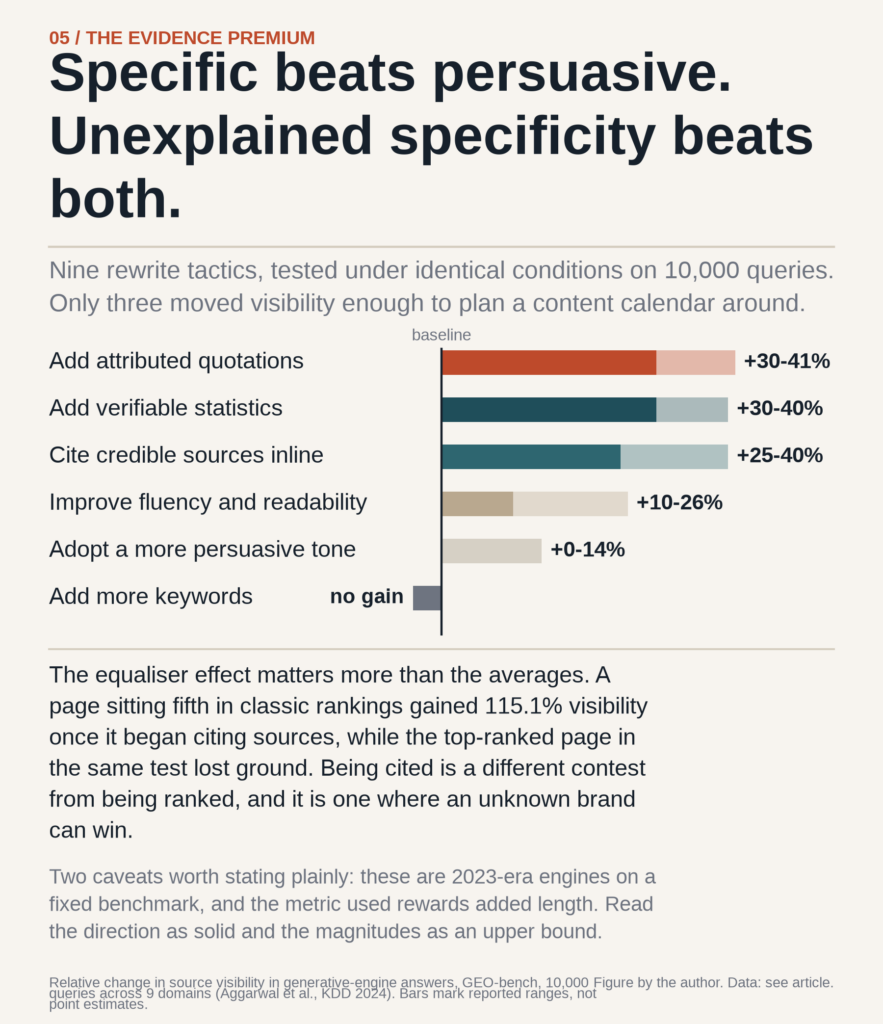
The finding I keep coming back to is buried in the appendix of most summaries. The gains were not distributed evenly. A page ranked fifth in classic search gained 115% visibility when it started citing sources. The top-ranked page in the same test lost ground.
Sit with that. It means AI citation is a different contest from ranking, and it is one where a smaller, more specific, better-evidenced page can beat a domain with ten years of link equity.
One more thing worth stealing
Roughly 62% of AI citations never mention the brand being cited. The source gets used, the name gets dropped. If your page supplies a generic industry statistic, the model can lift the number and never say your name.
The fix is structural, not cosmetic. Attach proof to claims that are yours: your benchmark, your customer’s result, your named methodology. A fact that only exists because you measured it cannot be detached from you.
What I got wrong about this, and what still doesn’t work
Three caveats, offered sincerely.
Intent mapping is inference, and inference is wrong sometimes. Two people reading the same cluster will disagree about the underlying job. Treat your map as a bet, revisit it quarterly, and expect to be embarrassed by one or two clusters a year.
Answer formats drift. Engines change their templates as models improve. A mapping built in January can be stale by autumn. The categories are stable; the specific formats are not.
Clustering precision is a skill, not a setting. Too broad and you miss the nuance that decides the answer. Too granular and you have 400 clusters and no calendar. There is no formula for the right altitude. You feel it after a few cycles.
And one thing the data genuinely does not support: the idea that recovering your old traffic is possible. In the US, 68% of Google searches now end without a click. Position-one click-through on queries with an AI Overview fell from 7.3% to 1.6% over two years. Even queries without an overview lost clicks. You are not going to optimize your way back to 2023.
What you can do is stop treating the click as the only unit of value. Being the source an answer is built from is worth something, even when nobody visits. Ask any brand that has watched its category’s default recommendation switch to a competitor and then tried to buy its way back.
Conclusion
Keyword research did not die. It got demoted. It is now a measurement tool, useful for sizing demand and checking whether your cluster work maps onto real volume. It is no longer a discovery tool, because the discovery happens in language a keyword list cannot hold.
The unit of work is the intent, not the term. The unit of production is the answer shape, not the page. And the unit of proof is the specific, checkable claim, not the confident tone.
Get those three right and your content scales across hundreds of phrasings you never thought to target. Get them wrong and you will keep writing excellent pages for questions nobody is asking anymore.
Key takeaways
- Keyword strings trigger an AI answer 9.5% of the time. Question-form queries trigger one 64.7% of the time. The gap is the market.
- Informational is too coarse to plan against. Comparison and review formats trigger answers above 85%; single-word informational queries sit at 27%.
- Build the answer shape, not just the topic. Tables for comparisons, ordered steps for diagnosis, ranges for cost.
- Specific evidence outperforms persuasive tone by a wide margin, and it disproportionately rewards pages that are not already ranked first.
- 68% of US Google searches end without a click. The click is no longer the scoreboard.